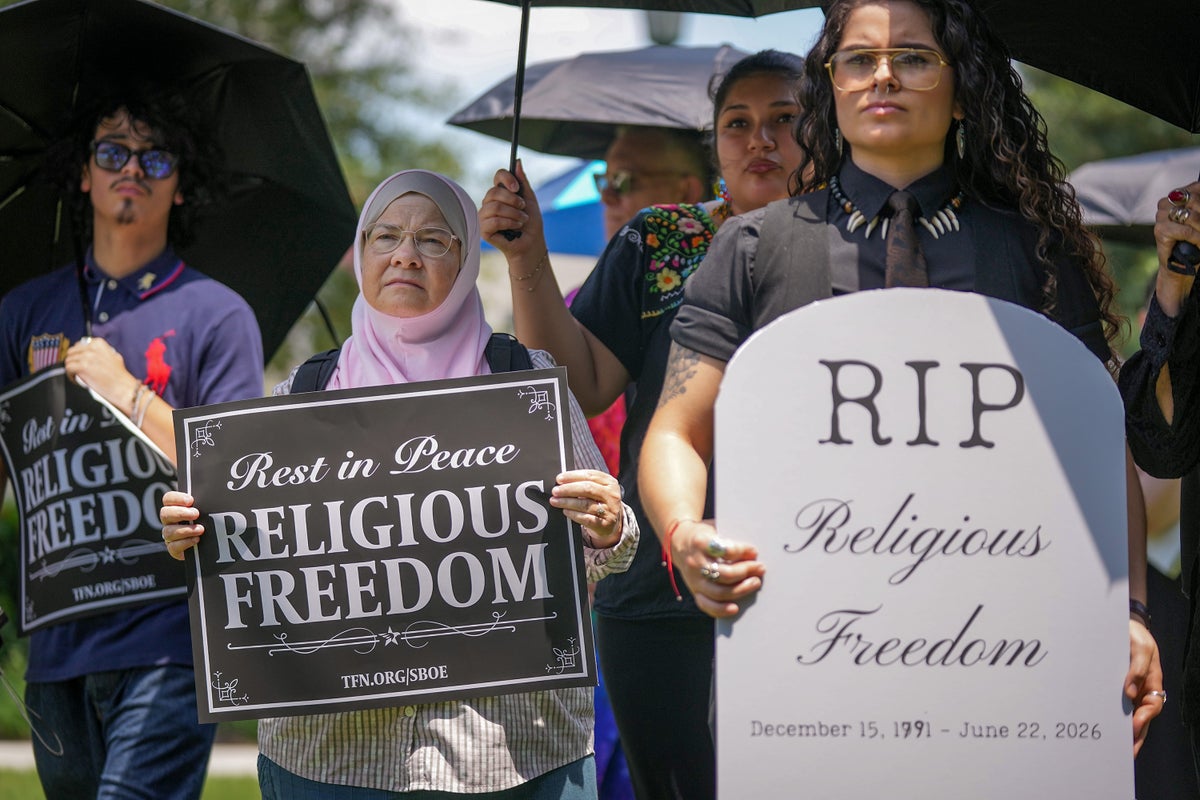
The air in the elementary school basement smells of damp cardboard and floor wax. On a folding table, a stack of freshly printed curriculum binders sits under the harsh buzz of fluorescent lights. To an outsider, it looks like standard bureaucratic paperwork. To a parent, a teacher, or a child sitting in a wooden desk just two floors above, it represents a profound shift in the American cultural tectonic plates.
Texas is rewriting the rules of what belongs in a public school classroom.
At the center of this quiet storm is a new elementary school reading curriculum designed by the Texas Education Agency. It does not merely suggest the inclusion of biblical texts; it builds lessons directly around them. Under the Bluebonnet Learning Framework, a kindergarten student learning about the concept of the "Golden Rule" will find themselves reading from the Gospel of Matthew. A fifth grader studying Leonardo da Vinci’s The Last Supper will be guided through the New Testament account of Christ’s final meal with his disciples.
This is not a vague nod to historical influence. It is a systematic integration. For decades, the line between church and state in American public education was treated like a high-voltage wire. Touch it, and the lawsuits follow. Now, Texas is walking right up to the wire with a pair of wirecutters, betting that a newly conservative federal judiciary will watch them snip it.
The Child at the Desk
Consider Maya. She is a hypothetical seven-year-old girl sitting in a third-grade classroom in a suburb just outside Houston. Her family is Hindu. She wears a small, polished stone pendant around her neck, a gift from her grandmother in Hyderabad. She knows the stories of Ganesha and Krishna. She knows the warmth of the lights during Diwali.
Today, her teacher opens a state-approved reading booklet. The lesson is about justice and law. The text for the day is the story of Moses leading the Israelites out of Egypt, presented not as an anthropological artifact of the ancient Near East, but as the foundational anchor of the moral universe.
Maya listens. The language is grand, ancient, and authoritative. Her teacher, the person she trusts to tell her how the world works, is reading it. Maya looks around the room. Her classmates are nodding. She touches the stone at her throat. A quiet, heavy question begins to form in the back of a seven-year-old’s mind: Is my story wrong?
This is where the political rhetoric stalls and the human reality begins. The debate over religious curriculum is rarely fought by the people who have to live with the fallout. It is dreamed up in air-conditioned capitol offices in Austin, argued by lawyers making six figures, and weaponized on evening cable news. But the impact lands squarely on the shoulders of children who are still trying to figure out if they fit in.
The state argues that the curriculum is entirely optional. School districts do not have to adopt it. But the carrot at the end of the stick is heavy. The state is offering an additional $60 per student in funding to any school district that adopts the materials. For a cash-strapped district struggling to pay for air conditioning repairs or bus fuel, that is not a choice. It is a financial ultimatum.
The Teacher’s Dilemma
Step into the shoes of a teacher. Let’s call him Marcus. He has taught fourth grade in a rural West Texas town for twelve years. He knows how to handle a room full of energetic ten-year-olds. He knows how to teach fractions using pizza slices. He knows how to comfort a kid who scraped their knee at recess.
But Marcus is not a theologian.
Under the new guidelines, Marcus is expected to navigate the complex, deeply sensitive waters of biblical narrative. He must teach the story of Abraham and Isaac. He must explain covenant, sacrifice, and divine command.
Marcus knows his classroom. He has students whose parents are devout Southern Baptists. He has students whose families are non-religious, others who are Muslim, and some whose parents belong to evangelical churches that interpret scripture with fierce literalism.
"Mr. Marcus," a student asks, raising a hand. "Did this actually happen? Did God really tell him to kill his son?"
What does Marcus say? If he says yes, he violates the trust of the non-religious parents who expect public schools to stick to secular history. If he says it is a metaphor, he risks the wrath of a school board flooded with complaints from angry parents accusing him of undermining their faith.
The state’s defense is that the Bible is being taught as literature and history, which is legally permissible. We cannot understand Western art, literature, or law without understanding the Bible. That is a historical fact. Shakespearian tragedies, the speeches of Abraham Lincoln, the civil rights rhetoric of Martin Luther King Jr.—all of them are drenched in biblical imagery.
But there is a vast, treacherous gulf between teaching about religion and teaching through religion. When a curriculum uses a sacred text as the primary vehicle for teaching basic reading comprehension to seven-year-olds, the distinction evaporates. The literature lesson becomes a Sunday school lesson, whether the state admits it or not.
The Architecture of a Shift
To understand how we arrived at this basement table in Texas, you have to look at the changing legal landscape of the United States. For half a century, the Supreme Court operated under a doctrine that kept religion and public education strictly segregated. The landmark 1971 case Lemon v. Kurtzman established a three-pronged test to ensure government actions didn't excessively entangle with religion.
That test is dead.
In recent years, the high court has systematically dismantled the old wall. In Kennedy v. Bremerton School District, the court ruled in favor of a high school football coach who prayed on the fifty-yard line after games. The legal tide has turned. Conservative lawmakers in Texas recognized the shift and realized the door was open.
They are not just pushing the envelope; they are rewriting the address.
Critics argue this is a coordinated effort to Christianize public spaces. Proponents claim it is a rescue mission for American culture, an attempt to restore a moral compass to a generation they view as adrift. They point to falling reading scores and rising behavioral issues as evidence that the current system is failing. Their solution is a return to traditional roots.
But whose tradition?
Texas is no longer a monolithic monoculture. It is a sprawling, diverse powerhouse of nearly 30 million people. Houston is one of the most ethnically diverse cities in the country. The suburbs of Dallas are home to thriving communities of immigrants from across the globe. The children sitting in those classrooms reflect the world as it is, not as it was in 1950.
The Price of Conformity
There is a specific kind of loneliness that happens when your culture is treated as an footnote while another is treated as the default.
I remember sitting in a public school classroom decades ago during a holiday seasonal lesson. The teacher spent three weeks on Christmas traditions, the nativity, and the theological significance of the holiday. Then, on the final day before winter break, she spent five minutes explaining Hanukkah with a plastic menorah.
She meant well. She thought she was being inclusive. But as the only kid in the room who didn’t celebrate Christmas, those five minutes felt worse than silence. It felt like being invited to a party just so everyone could watch you stand in the corner. It made me feel separate. It made me feel like an outsider in my own hometown.
What Texas is proposing is that feeling, scaled up, institutionalized, and funded by taxpayers.
When we force public schools to become arbiters of religious tradition, we ask them to perform a task they are fundamentally unsuited for. A school can teach a child how to read, how to calculate the area of a triangle, and how to understand the separation of powers. It cannot teach them how to save their soul. When it tries, it usually ends up damaging both the education and the faith.
Faith is fragile. It thrives in the home, the church, the mosque, the temple. It grows through personal revelation, family tradition, and community care. When you hand it over to a state bureaucracy to be packaged into a standardized, multiple-choice reading comprehension unit, you strip it of its mystery and its power. You turn something sacred into a chore.
The binders on the table in that Texas elementary school are not just curriculum changes. They are a wager. The state is betting that the desire for extra funding and the political momentum of the moment will silence the doubts of parents and teachers. They are betting that the quiet discomfort of children like Maya will go unnoticed.
The bell rings. The classroom doors fly open. A wave of children floods into the hallway, laughing, shouting, trading snacks, and arguing about video games. They are a brilliant, chaotic tapestry of different backgrounds, faiths, and futures. For now, they are just kids trying to grow up. But beneath the noise of the hallway, the machinery of the state is moving, preparing to teach them exactly who belongs, and who is just visiting.