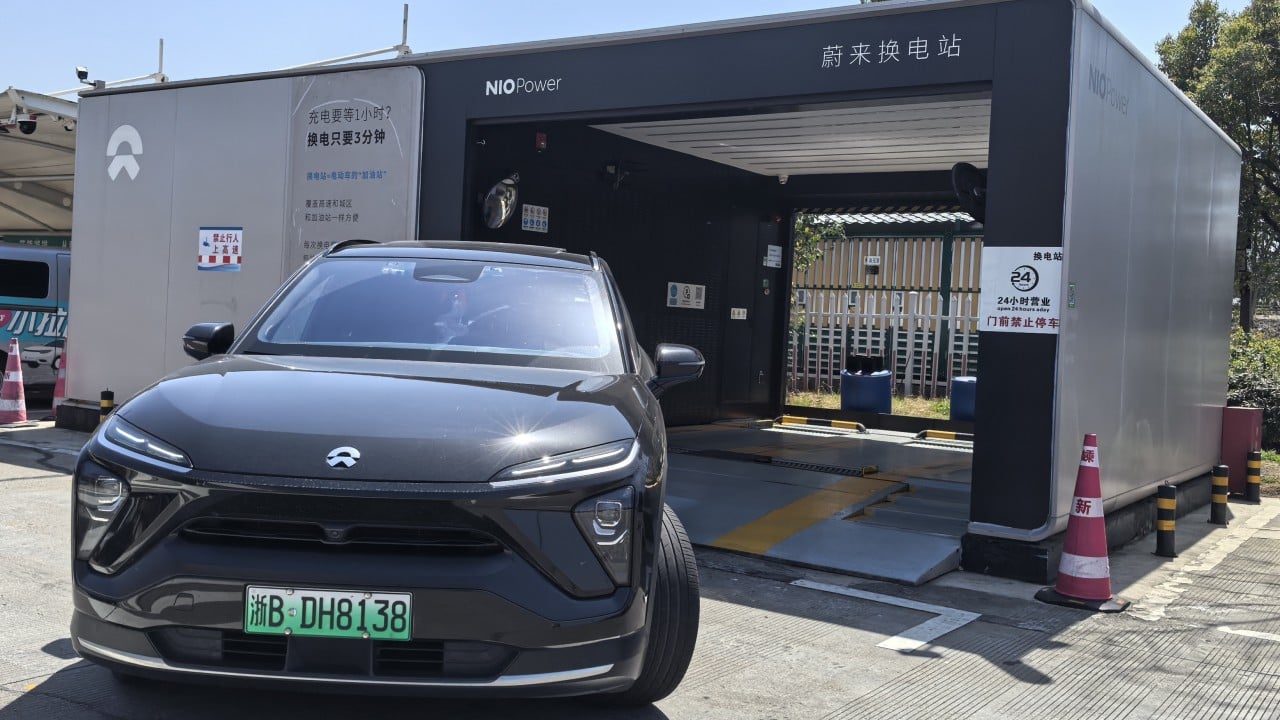
For a decade, the auto industry treated Nio like a stubborn kid burning cash in a backyard fire pit. While every legacy titan and Silicon Valley copycat chased ultra-fast DC plugs, Nio spent billions building concrete automated vaults designed to swap a dead electric vehicle battery for a fresh one in three minutes.
The lazy consensus from market analysts was entirely predictable. They called it an expensive vanity project. They said proprietary architectures would isolate brands. They argued that ultra-fast charging speeds would render mechanical swaps obsolete before the infrastructure ever turned a profit.
They were wrong about the core economics, but they were right about the isolation. Doing it alone was financial suicide.
When Zhejiang Geely Holding took a thirty percent stake in Nio Power at a valuation hovering around sixteen billion yuan, the narrative flipped overnight. This was not a friendly corporate handshake. It was a white-flag surrender by the rest of the industry, admitting that the physics of electrical grid degradation cannot be solved by bigger cables alone.
Let us look past the corporate press releases and examine why this deal marks the actual death of the standalone charging station myth.
The Grid Capacity Wall Nobody Wants to Talk About
Imagine a highway service station trying to fast-charge fifty electric heavy-duty haulers and passenger cars simultaneously at three hundred kilowatts each. You are pulling megawatt-scale loads that require dedicated local substations, massive copper upgrades, and continuous transformer cooling.
The electrical grid cannot handle widespread, simultaneous ultra-fast charging without massive structural failures or exorbitant peak-demand utility pricing.
Battery swapping bypasses this bottleneck entirely. A swap station acts as a localized energy buffer. It draws power from the grid slowly and steadily around the clock, storing energy safely inside stationary and queued vehicle packs until a car pulls up to drain the local grid instantaneously for three minutes.
Nio understood this structural advantage early. What they failed to calculate was the crushing capital expenditure required to blanket a continent with standardized real estate. Building thousands of automated concrete boxes, stocking them with multi-thousand-dollar lithium-ion packs, and maintaining automated robotic lifting arms is an absolute cash furnace.
I have watched companies burn through nine figures trying to scale proprietary hardware networks in closed ecosystems. Economics always wins in the end. Nio hemorrhaged capital because they tried to act as a closed-loop utility provider while manufacturing luxury vehicles.
The Standardization Trap
The reason battery swapping failed to gain traction outside of China is not consumer resistance. Drivers love the idea of trading a dead power pack for a fully charged one faster than filling a gas tank.
The failure point was automotive tribalism. BMW would never use a Mercedes battery architecture. General Motors would never build a vehicle around a Ford-swappable floor pan. Automotive executives would rather swallow glass than yield proprietary packaging control to a direct competitor.
For years, skeptics pointed to this fragmentation as the fatal flaw of the swap model. They claimed standardization across competing automakers was a pipe dream.
Geely buying into Nio Power shatters that assumption. Geely is not a minor player; it is an automotive octopus controlling Volvo, Polestar, Lotus, and Zeekr, alongside its own mass-market brands. By folding its commercial and passenger swap efforts directly into Nio's ecosystem and trading equity in its Haohan Energy charging arm, Geely is signaling a brutal realization.
Standardization is no longer optional when the cost of independent infrastructure buildouts threatens corporate survival.
When rivals share a standardized floor configuration, the battery pack transitions from a proprietary brand differentiator into a shared utility layer, much like gas pumps or electrical grids. Once that threshold is crossed, the competitive battleground shifts away from how you juice the car and back to software, design, and vehicle dynamics.
The Brutal Downside of the Shared Vault
Do not mistake this consolidation for a frictionless utopia. Shared infrastructure introduces massive operational headaches that the techno-optimists conveniently ignore.
When multiple manufacturers share a single pool of circulating batteries, quality control becomes a nightmare. If a budget-tier commercial van from a partner brand degrades a shared battery pack faster through aggressive fast-cycling, that damaged pack might end up inside a premium luxury sedan during the next automated swap.
Asset depreciation is another silent killer. Lithium-ion chemistry degrades with every cycle and calendar day. If utilization rates drop during an economic downturn, thousands of expensive battery packs sit idle on the balance sheet, losing value while accumulating carrying costs.
Pooling assets spreads the financial bleeding, but it does not stop the wound. Both Nio and Geely are essentially betting that vehicle sales volume will outpace the degradation curve of their circulating inventory. It is a high-stakes gamble on scale. If volume stalls, they are simply sharing a larger anchor.
Why Western Automakers Are Blind to the Shift
While Chinese manufacturing conglomerates consolidate physical energy networks, Western legacy automakers are still trapped in the delusion of proprietary DC fast-charging networks or slow, unprofitable joint ventures that build a token handful of token plazas.
They are optimizing for the wrong variable. They think the consumer wants a faster cable. The consumer wants convenience that mirrors internal combustion habits without turning a parking lot into an industrial power plant.
The Nio and Geely alliance proves that physical energy logistics are converging toward unified utility standards. Standalone charging networks that rely solely on grid-tethered cables will struggle to service high-density urban environments and commercial fleets where parking space is at a premium and grid capacity is finite.
Stop looking at battery swapping as a feature of a single car brand. It is rapidly transforming into the underlying municipal plumbing for high-density electric mobility.
The companies that own the exchange real estate will control the energy margins of the next decade. Everyone else will just be paying for the copper.