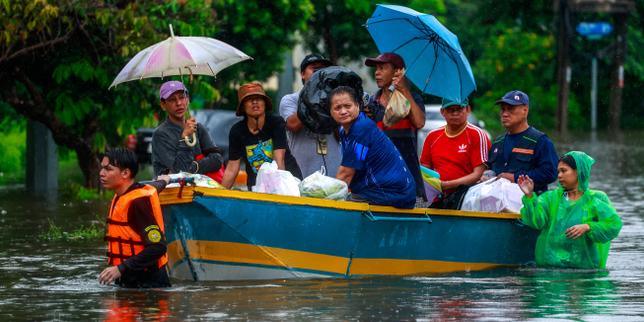
Every monsoon season, the international news cycle executes a predictable, lazy ritual. Footage of temples half-submerged in Chao Phraya brown water hits global screens. Agonized anchors warn tourists to cancel flights. Panic ripples through backpacker forums and luxury travel groups alike. The narrative is always identical: Bangkok is sinking, helpless against climate change, and fundamentally mismanaged by authorities who watch their capital drown.
It is a dramatic story. It is also entirely wrong.
If you believe the standard media panic, Bangkok is an urban tragedy unfolding in slow motion. I have spent years walking these piers, talking to drainage engineers at the Bangkok Metropolitan Administration, and watching real estate speculators completely ignore the water while building another fifty-story glass monolith on Sukhumvit. The truth is much more cynical and far more interesting. Bangkok is not a victim of nature. It is an engineering masterpiece engaged in an ongoing, brutal, and largely successful wrestling match with physics.
The Myth of the Sinking Megacity
Let us clear up the hysteria immediately. You will read constantly that Bangkok is sinking at alarming rates, destined to become the Venice of Southeast Asia by default.
Stop. Look at the numbers.
Yes, rapid groundwater extraction in the mid-twentieth century caused severe subsidence. The city dropped significantly in certain districts during the boom decades. But that crisis peaked decades ago. Once the Thai government banned private tube wells and mandated piped municipal water, the subsidence rate in central Bangkok plummeted to near zero.
What the headlines confuse is natural delta compaction with active structural collapse. Bangkok sits on soft marine clay deposited over thousands of years. It breathes. It shifts. But it is not disappearing beneath the waves like a dissolving sugar cube. The floods you see on CNN are not proof of an apocalyptic failure; they are the normal, anticipated friction points of an immense, low-lying delta city managing millions of cubic meters of tropical runoff during peak high tides.
When you look at a flooded alleyway in Thonburi, you are looking at a system designed to hold water temporarily so that the economic engine of Sukhumvit and Silom can keep turning without missing a single transaction.
Where the Conventional Travel Advice Fails
The standard advice given to travelers during monsoon season is useless. Travel blogs regurgitate the same sterile warnings: stay indoors, wear waterproof boots, and expect total transit paralysis.
This advice treats Bangkok like a European city experiencing an unexpected cloudburst. It ignores how the urban morphology actually functions. Bangkok is not built on a flat grid; it is built on layers of vertical separation.
When street-level drainage gets overwhelmed, the city does not grind to a halt. It simply shifts vertically. The BTS Skytrain and MRT subway systems operate independently of surface inundation. High-end shopping malls feature massive subterranean flood walls and secondary pump arrays that cost more than small municipal budgets in Western Europe. While a street vendor might be lifting their charcoal grill onto bricks, patrons inside a nearby mega-mall are ordering artisanal coffee sixty feet above dry concrete.
The amateur traveler panics at the first puddle on Silom Road and cancels their trip. The seasoned insider knows that a torrential downpour in July means the air is clean for three hours, the street food stalls are less crowded, and the drainage canal pumps will clear the surface water before your morning meeting ends.
The Brutal Economics of the Chao Phraya Flood Gates
Why does water pool where it pools? The answer is not incompetence. It is urban triage.
Imagine a scenario where the Bangkok Metropolitan Administration decided to keep every single square inch of the municipal boundary bone dry during a severe seasonal surge. To achieve that, you would have to flood the surrounding agricultural provinces upstream and choke the navigation channels completely.
Bangkok's flood management is an exercise in cold, calculated sacrifice. The city uses a vast system of massive drainage canals, known locally as khlongs, controlled by an intricate network of sluice gates and industrial pumps. Water is deliberately held in retention basins, agricultural buffer zones, and specific low-priority neighborhoods to protect the high-density financial core and historical districts.
This is the dirty secret of urban flood control: equity does not exist in a delta. Someone's neighborhood gets designated as the sponge.
When you see footage of residential streets underwater in suburban districts like Bang Khen or non-core outer zones, you are witnessing the system working exactly as programmed. The city managers are sacrificing the periphery to preserve the core. It is ruthless, highly effective, and entirely omitted by journalists who fly in for forty-eight hours, film a flooded soi, and declare the capital a failed state.
Why Real Estate Developers Are Laughing at the Doomsayers
If Bangkok were truly facing imminent, irreversible submersion, real estate capital would flee. Look at the skyline instead. Billions of dollars in foreign and domestic investment continue to pour into mega-projects along the riverfront and transit axes.
Developers are not stupid. They price environmental risk into every square meter. Modern developments in Bangkok incorporate massive underground retention tanks, multi-tiered sump pumps, and structural ground-floor elevations engineered to sit comfortably above historical flood crests.
The market has spoken. The risk is manageable, priced, and engineered around. The only people surprised by Bangkok's water management are those who expect a tropical river delta to behave like a dry desert plateau.
Stop Fighting the Water
The fundamental error underlying all the hysterical coverage of Bangkok's floods is the archaic Western impulse to conquer nature. We want concrete walls that banish water permanently. We want sterile, frictionless geography.
Bangkok teaches a different lesson. In a delta, you do not banish water. You negotiate with it. You provide it paths, you give it temporary parking spaces, and you build your life around its rhythms.
Next time you see a viral video of motorbikes wading through axle-deep water near the Grand Palace, do not panic. Ask yourself who benefits from that narrative, and remember that an hour later, the pumps will cycle, the sun will cut through the humidity, and the city will be back to selling noodles on the corner.