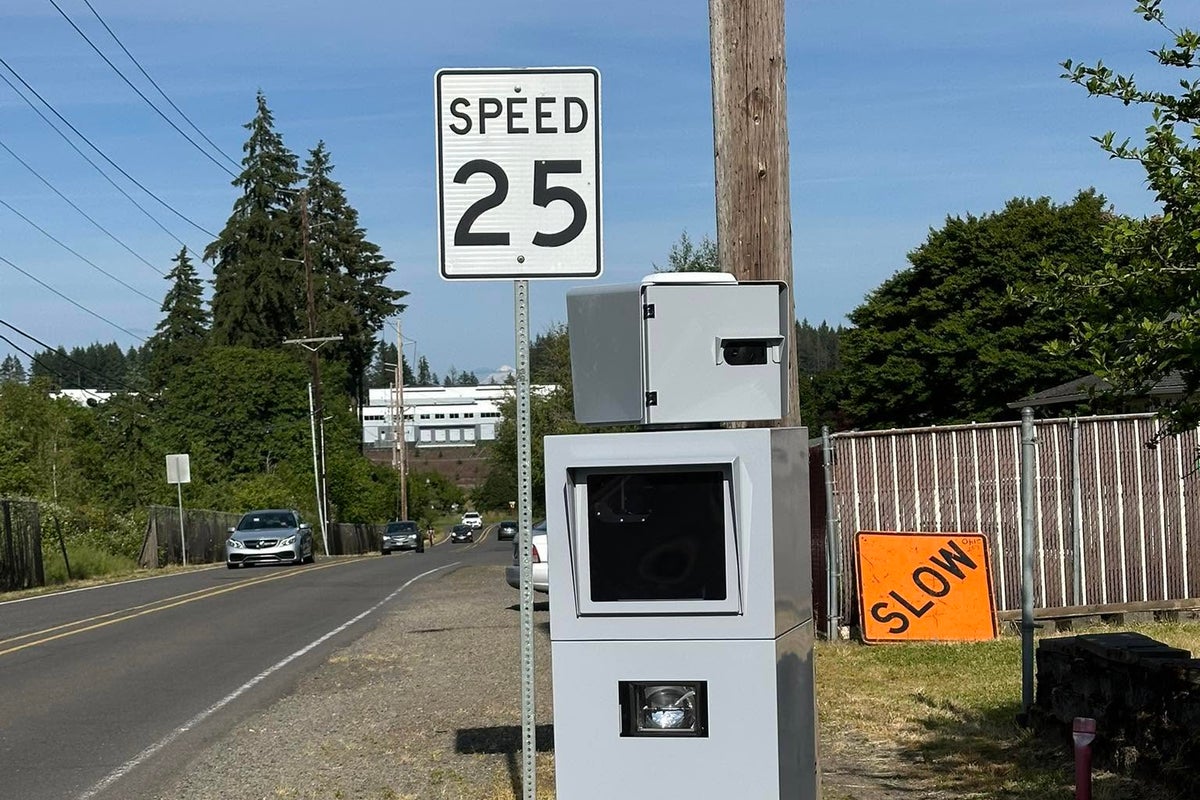
A single mobile speed camera on Oregon Street in the small city of Sherwood, Oregon, flagged more than 1,000 drivers for speeding infractions in its first two weeks of operation. Local police deployed the automated enforcement system near the intersection of Southwest Oregon and Lower Roy Street to curb chronic speeding. While the initial wave of notifications consisted of warnings rather than immediate fines, the staggering volume of infractions highlights a growing national shift toward automated, vendor-managed traffic policing. This rapid surge in automated enforcement raises fundamental questions about infrastructure design and the privatization of public safety.
The immediate takeaway is that the sheer volume of violations points to a structural failure in the roadway itself, rather than a sudden, localized epidemic of reckless driving. When a single camera catches over a thousand drivers in a matter of days, the road design is actively encouraging the exact behavior the municipality is penalizing.
Why Automated Surveillance Cannibalizes Real Traffic Engineering
Municipalities across the country are facing tight budgets and aging roads. When a neighborhood group complains about speeding commuter traffic cutting through residential zones, city councils face two distinct choices. They can fund a complete physical redesign of the street using traffic-calming measures, or they can sign a contract with a private tech vendor to install automated enforcement cameras.
The first option costs significant taxpayer dollars. The second option costs the city virtually nothing upfront and quickly turns into a major source of revenue.
On Oregon Street, drivers frequently use the corridor as a cut-through route between major highways like Highway 99W and neighboring cities like Newberg. The physical environment of the road features wide lanes and a smooth transition from a nearby roundabout. These engineering choices signal to the human brain that it is safe to maintain a higher rate of speed.
Putting a camera in a location where the infrastructure actively encourages faster driving does not fix the road. It simply monetizes the design flaw.
True traffic safety relies on engineering intervention. Narrower lanes, raised crosswalks, chicanes, and curb extensions naturally force a driver to lift their foot off the accelerator. An automated speed camera does none of this. It sits on the side of the road, captures data, and issues a notice weeks after the event occurred.
The driver remains a hazard in the moment the infraction happens, meaning the immediate safety of the pedestrian on the sidewalk is completely unchanged by the presence of a lens.
The Shadow Economy of Vendor Managed Policing
The rapid deployment of automated traffic enforcement across Oregon is powered by private corporations operating under a business model that blurs the line between public safety and corporate profit. Companies like Verra Mobility partner with local police departments to handle the entire logistical pipeline of automated ticketing. They provide the hardware, maintain the radar units, process the digital photographic evidence, and manage the automated mailing systems.
In exchange for this turnkey service, the private vendor takes a direct percentage of the revenue generated by the citations, or they charge a substantial monthly equipment leasing fee that is subsidized directly by ticket collections.
This financial arrangement creates an inherent conflict of interest. The private corporation has a fiduciary duty to its shareholders to maximize ticket volume, which runs entirely counter to the public safety goal of reducing speeding violations to zero.
- The Presumptive Fine Structure: Under Oregon traffic law, citations caught by automated cameras carry heavy financial penalties.
- An infraction of 11 to 20 mph over the limit results in a Class C violation and a $165 presumptive fine.
- Traveling 21 to 30 mph over the limit escalates to a Class B violation, carrying a $265 fine.
- Exceeding the limit by 31 mph or more triggers a Class A violation, hitting drivers with a $440 penalty.
Because these automated tickets are treated as moving violations under state statutes, they are reported directly to the Oregon Department of Motor Vehicles. This means a single automated camera snapshot can cause a long-term spike in private auto insurance premiums for the registered owner.
The financial pain is real, and it flows out of the local community into the bank accounts of corporate contractors located hundreds of miles away.
The Illusion of Safety vs The Reality of Revenue
Proponents of automated photo radar frequently point to data from federal highway agencies showing that automated cameras can reduce injury crashes by 20% to 25% at high-risk intersections. While fixed cameras at major, high-injury intersections have a documented safety record, the deployment of mobile, temporary speed cameras in transitional residential zones often produces a different outcome entirely.
Instead of creating a steady, uniform flow of safe traffic, localized speed cameras often trigger the kangaroo effect. Drivers who are familiar with the neighborhood learn exactly where the camera is stationed. They brake sharply as they approach the radar zone, crawl past the camera at the exact posted speed limit, and then accelerate heavily the moment they pass the field of view.
This constant braking and accelerating actually increases the unpredictability of traffic flows, creating new rear-end collision hazards for trailing motorists who are caught off guard by sudden deceleration.
[ Roundabout / Highway Exit ] ---> [ Driver Accelerates Naturally ] ---> [ Sudden Braking for Camera ] ---> [ Driver Accelerates Again ]
Furthermore, the legal mechanisms used to validate these tickets reveal significant vulnerabilities in due process. When a traditional police officer pulls a vehicle over, they positively identify the driver at the scene, check their license, and issue a citation to the individual who committed the infraction. Automated systems cannot do this. They photograph the license plate and the front windshield, matching the registration to the DMV database.
If a vehicle owner receives an automated ticket in the mail for an infraction they did not commit, the state of Oregon places the burden of proof squarely on the citizen. To dismiss the ticket, the registered owner must fill out a formal Certificate of Innocence or an Affidavit of Non-Liability.
This process requires the citizen to submit a sworn statement under penalty of perjury, often forcing individuals to choose between paying a fraudulent fine or actively incriminating a family member or friend who was borrowing the vehicle.
The Inequity of Digital Enforcement
The reliance on automated traffic cameras exposes a stark socioeconomic divide in how public infrastructure treats citizens. For a wealthy commuter, a $165 or $265 ticket received in the mail is an annoying inconvenience, a minor tax paid for speeding that has zero impact on their daily quality of life. For a working-class driver or a service worker commuting between towns, that same fine can wipe out an entire week's discretionary income, forcing difficult choices between paying a traffic citation and buying groceries or paying utility bills.
Traditional traffic stops allow an officer to use professional discretion based on road conditions, traffic flow, and context. A camera possesses no discretion. It is a binary machine that issues penalties indiscriminately, disproportionately punishing those who cannot afford the baseline fines or the subsequent insurance hikes.
When a city chooses cameras over physical road improvements, they are choosing to balance their operational costs on the backs of commuters rather than investing in permanent, equitable safety infrastructure.
The rapid accumulation of over a thousand speeding infractions in a two-week span on Oregon Street should not be celebrated as a victory for public safety. It stands as a clear indictment of a flawed roadway that requires immediate engineering intervention. Until municipalities prioritize physical street design over automated corporate surveillance, these programs will continue to function primarily as an efficient mechanism for localized taxation under the banner of public safety.