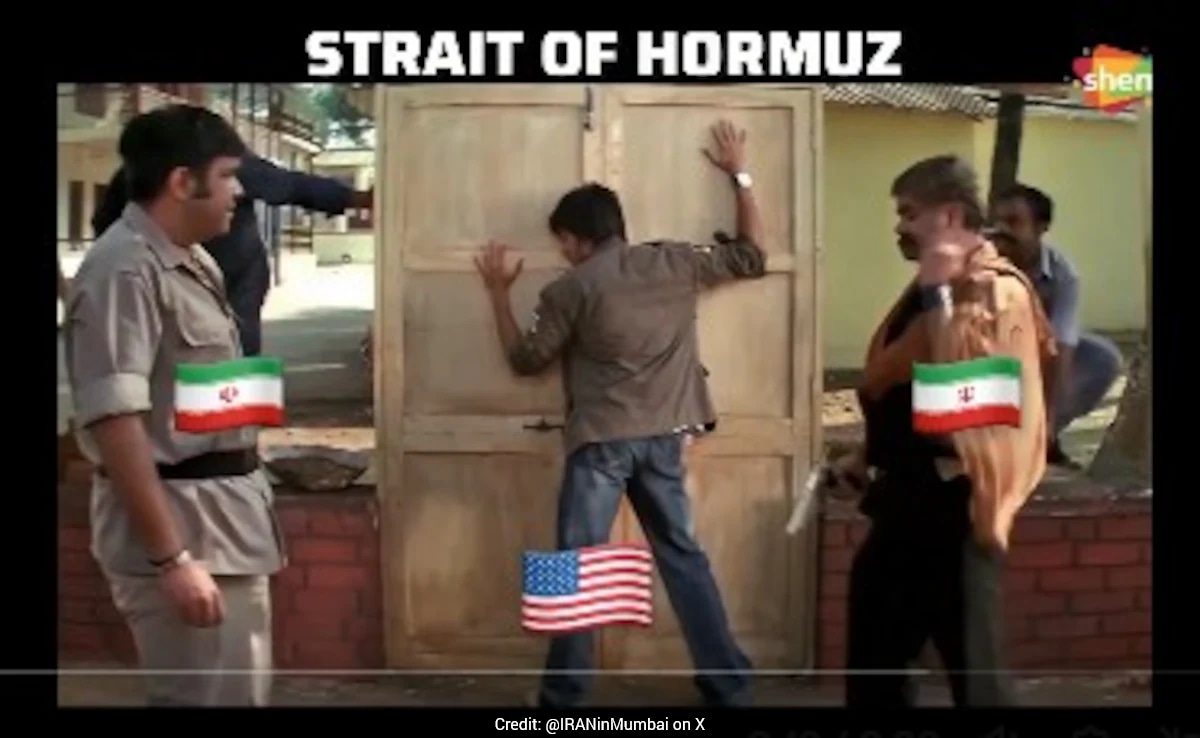
The recent deployment of an Indian cinematic meme by Iranian-affiliated media to signal a blockade of the Strait of Hormuz represents a sophisticated evolution in Asymmetric Semiotic Warfare. By utilizing a clip from the Bollywood film Dhamaal, Iranian actors are not merely mocking US naval presence; they are utilizing a high-context cultural artifact to communicate strategic intent while maintaining plausible deniability and maximizing psychological impact across the Global South. This maneuver operates at the intersection of maritime logistics, regional power projection, and digital information operations.
The Strategic Architecture of the Hormuz Bottleneck
To quantify the gravity of any blockade signal, one must first define the physical and economic constraints of the Strait of Hormuz. The passage is a non-substitutable maritime artery where the Cost of Disruption scales exponentially rather than linearly.
- Physical Constraint: The shipping lanes consist of two 2-mile-wide channels (one inbound, one outbound) separated by a 2-mile buffer zone.
- Volume Factor: Approximately 21 million barrels of oil per day (bpd) pass through this corridor, representing roughly 20% of global petroleum liquid consumption.
- The Insurance Premium Variable: Physical blockage is not required to achieve economic disruption. A credible threat increases War Risk Premiums, which can raise the operational cost of a VLCC (Very Large Crude Carrier) by hundreds of thousands of dollars per transit.
Iran’s use of viral media acts as a low-cost force multiplier for this physical leverage. By signaling the intent to "close the door" through humor, they bypass traditional diplomatic escalation ladders, making it difficult for Western powers to formulate a proportional kinetic response to a digital provocation.
The Triad of Iranian Information Operations
The selection of a Dhamaal clip—specifically one involving a comedic mechanical failure or a "trap"—is a calculated choice that serves three distinct strategic functions.
1. Cultural Alignment and the Global South Audience
The choice of Indian cinema is a deliberate pivot away from Western-centric media. India is a primary consumer of Persian Gulf energy. By using Bollywood imagery, Iran speaks directly to a massive demographic that shares a cultural vocabulary, effectively positioning the US as the "outsider" in a regional dispute. This creates a shared "in-group" humor that undermines the perceived authority of the US Fifth Fleet.
2. Cognitive Dissonance as a Defensive Shield
Traditional military threats (missile tests, troop movements) demand immediate intelligence analysis and potential counter-escalation. Memetic threats, however, create cognitive dissonance. The absurdity of the medium—a slapstick comedy—clashes with the severity of the message—global energy strangulation. This mismatch causes a delay in the "OODA loop" (Observe, Orient, Decide, Act) of Western strategic communications teams.
3. The Cost-to-Impact Ratio
The production cost of the video is near zero. The distribution cost, fueled by social media algorithms optimized for high-engagement "cringe" or humor, is also negligible. Conversely, the cost for the US and its allies to provide maritime security (Operation Prosperity Guardian equivalents) involves billions in fuel, maintenance, and personnel. Iran is achieving a high level of Strategic Irritation with a zero-capital investment.
The Mechanics of Maritime Interdiction
If we move beyond the digital signaling to the tactical reality of a blockade, the logic follows a specific Interdiction Function. Iran does not need to sink ships to "close" the Strait; they only need to make the risk-adjusted cost of passage unbearable for commercial insurers.
The Iranian tactical toolkit for this involves:
- Swarm Dynamics: Utilizing hundreds of Fast Attack Craft (FAC) to overwhelm the Aegis Combat Systems of destroyers.
- Smart Mine Deployment: Acoustic and magnetic mines that can be deployed by civilian-looking dhows, making detection a persistent intelligence failure.
- Anti-Ship Cruise Missiles (ASCM): Land-based batteries located in the rugged terrain of the Musandam Peninsula’s northern approach, providing a "high ground" advantage that is difficult to neutralize without a full-scale ground invasion.
The Dhamaal video serves as a "soft" version of these "hard" capabilities. It reminds stakeholders of the vulnerability of the passage without the diplomatic fallout of a live-fire exercise.
Quantifying the Impact of Memetic Signaling
In the framework of Behavioral Economics, the Iranian video functions as a "heuristic shortcut." Instead of analyzing a 50-page white paper on Iranian naval capabilities, the public and market speculators consume a 30-second clip that implies dominance.
The impact can be mapped across three variables:
- Vulnerability Perception (Vp): The degree to which the target (US/Global Markets) feels exposed.
- Credibility of Intent (Ci): The history of Iranian actions (seizing tankers like the Stena Impero) gives the joke a dark underlying truth.
- Audience Reach (Ar): The virality of Indian memes ensures the message penetrates non-military circles, impacting retail investor sentiment and oil futures.
The resulting Signal Strength (S) is calculated as:
$$S = Vp \times Ci \times \log(Ar)$$
Because $Ar$ (Audience Reach) is logarithmic in the age of social media, the signal strength of a meme can often outweigh the signal strength of a formal Ministry of Foreign Affairs statement.
The Failure of Western Counter-Narratives
The current Western response to such signaling is typically silence or dismissal as "propaganda." This is a failure of Information Maneuver. By ignoring the memetic layer, the US cedes the narrative space to Iran.
A more robust counter-strategy would require:
- Narrative Deconstruction: Directly addressing the meme's logic to expose the underlying weakness (e.g., the economic self-harm Iran would suffer from a closed Strait).
- Symmetric Humor: Engaging in the same medium to deflate the "toughness" projected by the adversary.
- Economic Transparency: Providing real-time data on successful transits to counter the "blockade" narrative with hard evidence of flow.
The reality remains that the Strait of Hormuz is as much a psychological construct as it is a geographical one. If the world believes it is closed, the economic effects are largely the same as if it were physically obstructed.
Strategic Forecast: The Weaponization of Cringe
The "Dhamaal" incident is not an isolated joke; it is a pilot program for the Weaponization of Cringe. We should anticipate a surge in state-sponsored actors utilizing hyper-local pop culture from rival or neutral nations to bypass traditional censorship and reach global audiences.
The immediate strategic play for regional players is to decouple their dependency on the Strait through land-based pipelines (such as the East-West Pipeline in Saudi Arabia or the Abu Dhabi Crude Oil Pipeline). However, as long as the global price of Brent crude is tied to the marginal barrel coming out of the Gulf, Iran’s memetic signaling will remain a potent tool for market manipulation.
Future naval doctrine must integrate Social Media Monitoring as a primary sensor input, treating a viral Bollywood clip with the same analytical rigor as a radar blip. The war for the Strait of Hormuz is currently being fought not with torpedoes, but with templates and trending audios. Failure to adapt to this asymmetric reality ensures that the West will continue to be outmaneuvered in the theater of public perception.