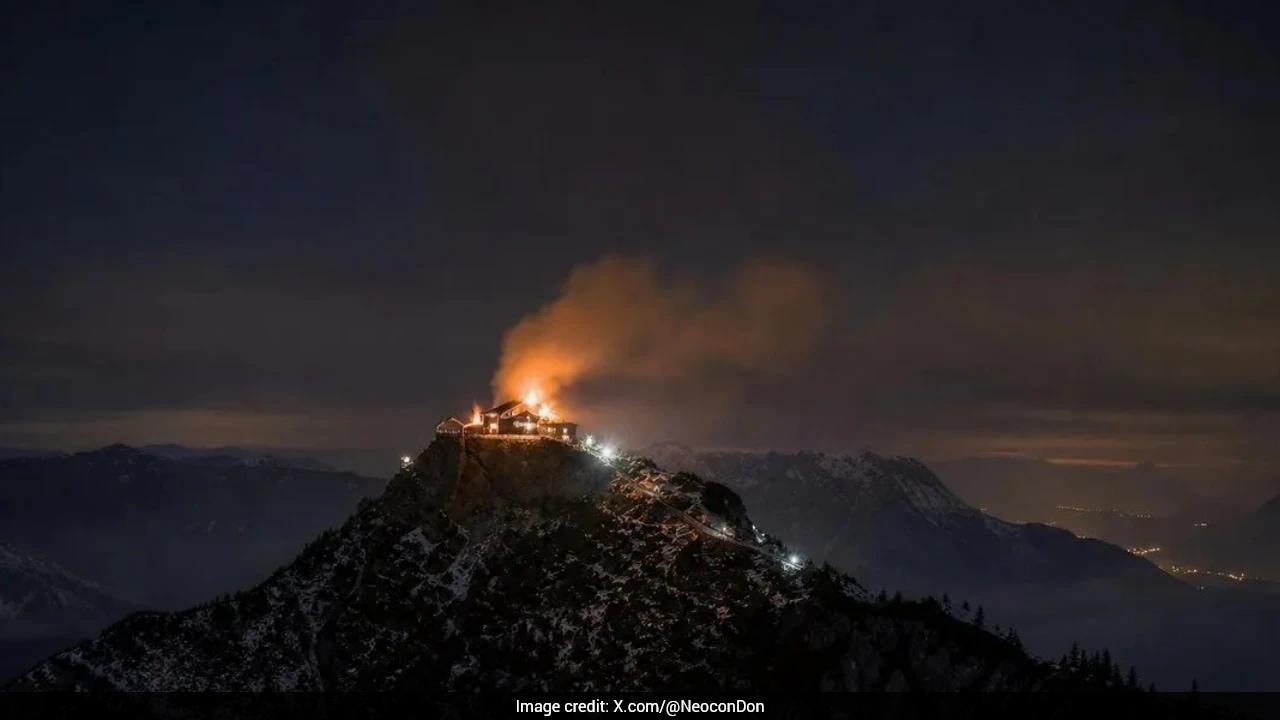
Smoke smells different at six thousand feet.
Down in the valleys of Bavaria, a house fire carries the acrid, recognizable stink of modern life—melting PVC pipes, burning polyester carpets, singed insulation. Up on the Obersalzberg, high above the alpine town of Berchtesgaden, the air is thin, cold, and sharp with pine resin. When timber burns up there, it smells like history trying to escape the soil.
On a quiet stretch of mountain road, sirens recently shattered that alpine stillness. Flames tore through the Kehlsteinhaus—known to the rest of the world as the Eagle’s Nest—the mountaintop chalet built as a fiftieth-birthday gift for Adolf Hitler. Firefighters raced up the steep, winding single-lane switchbacks, battling both the blaze and the sheer vertical hostility of the Bavarian Alps. Within hours, Bavarian police had a suspect in custody, suspected of deliberate arson.
The headlines wrote themselves in cold, predictable ink. Fire Engulfs Hitler’s Mountain Retreat. Suspect Detained.
Read those words again. Notice how clean they are. Notice how easily they slide past the conscience, reduced to a twelve-word news alert you swipe away while waiting for your morning coffee. A building caught fire. Someone got arrested. Nobody died. Next story.
But if you have ever stood on that granite ridge, felt the wind whip off the Watzmann massif, and looked down at the green carpet of Salzburg stretching toward the horizon, you know that nothing on the Obersalzberg is ever just a building.
The Architecture of Memory
Let me be honest with you. For years, I struggled to understand why Germany kept the Eagle’s Nest standing at all.
When I first visited Berchtesgaden, I expected a monument to shame, or perhaps a ruin choked by weeds. Instead, I found a line of tourists eating bratwurst and drinking cold beer on a terrace where architects of genocide once sipped tea and redrew the borders of Europe. It felt wrong. It felt unsettling, almost obscene, to watch travelers pose for smiling selfies against the exact brass-lined elevator doors that once carried the Führer through four hundred feet of solid rock.
That discomfort is the invisible stake at the heart of this story.
To understand why a fire at the Eagle’s Nest sends a tremor through German society, we have to separate the myth from the stone. Most visitors—and plenty of lazy headline writers—confuse the Eagle’s Nest with the Berghof. They are not the same place.
The Berghof was Hitler’s actual mountain home, a sprawling estate lower down the slope where he spent roughly a third of his time in power, hosting Mussolini, Chamberlain, and his inner circle. Allied bombers flattened the Berghof in April 1945, and seven years later, Bavarian authorities blew up the remaining concrete shell to prevent it from becoming a neo-Nazi shrine. Today, nothing remains of the Berghof except a crumbling retaining wall hidden in the woods, easily missed if you don't know where to look.
The Eagle’s Nest, perched high above it on the Kehlstein peak, survived.
Built over thirteen months by more than three thousand laborers—many of them working in brutal winter conditions that claimed dozens of lives—the stone pavilion was orchestrated by Martin Bormann as a diplomatic reception house. Ironically, Hitler hated it. He suffered from vertigo, feared the mountain weather, and distrusted the brass elevator carved into the mountain’s shaft, worrying a lightning strike or a saboteur might trap him inside. He visited barely fourteen times.
Because he rarely went there, the Allies spared it. And because it survived, it became a paradox carved out of granite and timber.
A Hypothetical Night on the Ridge
Picture, for a moment, a hypothetical local resident—let’s call him Lukas, a third-generation innkeeper in the valley below.
For Lukas, the mountain isn’t an abstraction from a history textbook. It is the backdrop to his grocery runs, his children’s school bus route, and his family’s livelihood. Every summer, tens of thousands of visitors arrive in Berchtesgaden. Some come for the crystal-clear waters of the Königssee. Many come for the Eagle’s Nest.
When Lukas sees smoke curling off the Kehlstein ridge in the dark, his first thought isn't geopolitical. It is visceral. Fire on a wooded mountain is a predator. Up there, water supply is limited, roads are narrow, and dry alpine winds can turn a localized blaze into a forest inferno within minutes. Firefighters have to haul equipment up a road carved into a sheer cliff face—a road with a four-thousand-foot drop on one side and no room for error.
Yet beneath that immediate fear lies a quieter, heavier dread that every resident of Berchtesgaden carries.
Whenever the Obersalzberg makes international news, the town braces itself. Does the world think we are protecting a relic? Or does the world think we are erasing a warning?
Think of the Eagle’s Nest like a scar on the face of a survivor. You can cover it with makeup. You can try to burn it off with acid. Neither makes the wound disappear; both simply distort what happened. Germany chose a third path: preservation without glorification. Since the 1950s, the building has operated as a mountain restaurant, with its profits funneled directly into charitable causes, alongside the nearby Dokumentation Obersalzberg museum, which lays bare the machinery of Nazi terror in unsparing detail.
Why Someone Lights a Match
We do not yet know every motive rattling inside the mind of the suspect detained by Bavarian police. Arsonists rarely leave behind tidy essays explaining their theology.
Perhaps it was an act of misguided vigilante justice—someone deciding, eighty years after the collapse of the Third Reich, that a stone chalet should no longer enjoy the sunlight. Perhaps it was personal grievance, mental distress, or the hollow thrill of watching something famous burn.
Consider what happens next, regardless of the motive.
If an extremist burns a memorial, the world rightly calls it an attack on memory. If an anti-fascist burns a Nazi-built structure, some people quietly nod, mistaking destruction for progress. Both impulses miss the point entirely.
History does not live inside wooden rafters or limestone walls. You cannot incinerate an ideology by setting fire to a dining room. In fact, erasing the physical evidence of tyranny often does the work of tyranny’s apologists for free. When the physical artifacts vanish, denial becomes easier. The past softens into rumor.
Germany knows this better than any nation on earth. For decades after 1945, the country wrestled with Vergangenheitsbewältigung—the grueling, unfinished work of coming to terms with the past. Early on, the instinct was to demolish and forget. Blow up the Berghof. Level the bunkers. Plant trees over the concrete.
Then a younger generation asked a terrifying question: If we tear down every stone, what happens when the last eyewitness dies?
Without physical spaces where human beings can stand, touch the cold stone, and feel the sickening scale of what ordinary men built in service of monsters, history becomes weightless. It turns into pixels on a phone screen. And weightless history is easily rewritten.
The Fragility of Stone
There is an old assumption that monuments made of granite are permanent, while human memory is fragile. Standing in the aftermath of a fire on the Kehlstein, the reverse feels closer to the truth.
The firefighters who climbed that mountain risked their lives to save a building commissioned by mass murderers. Stop and sit with the absurdity of that sentence. Men and women in turnouts and breathing apparatus dragged hoses up an alpine peak, choking on smoke in the dark, to protect the architectural vanity project of the Third Reich.
They did it because the mountain belongs to the living now, not the dead. They did it because a fire on the Obersalzberg threatens forests, wildlife, emergency responders, and a public archive that belongs to everyone who refuses to look away from the darkest chapter of modern human history.
I think back to that terrace at six thousand feet. I remember watching an elderly man—he must have been in his late eighties, leaning heavily on a wooden cane—standing quietly near the edge of the stone wall. Around him, teenagers were taking photos. Families were unfolding maps. He wasn't taking pictures. He was just staring out over the valley, his jaw tight, his eyes wet in the cold alpine wind.
I never spoke to him. I didn't need to. Whatever ghosts he was looking at weren't inside the restaurant behind him. They were in the valley below, in the air, in the sheer persistence of time.
You can char the beams of the Eagle’s Nest. You can blacken the stone and shatter the windows and haul a suspect away in handcuffs down the switchbacks in the dark.
When the smoke clears tomorrow morning, the mountain will still be there, cold and indifferent against the Bavarian sky, waiting to see what we choose to remember.