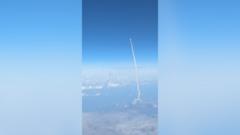
Imagine staring out a tiny, oval window at 35,000 feet and seeing a streak of fire punch through the atmosphere. It sounds like a scene from a big-budget sci-fi flick. But for a few lucky travelers on a commercial flight over the Atlantic, it was the real deal. They didn't just see a plane passing by. They watched the Artemis II mission blast off toward the moon. It’s one of those rare moments where the routine of air travel meets the absolute peak of human engineering.
Most people think you have to be standing on a mosquito-infested beach in Florida to see a rocket launch properly. That's a mistake. While the rumble at Kennedy Space Center is legendary, the perspective from an airplane provides something the ground crew can't get—a clear look at the rocket as it sheds the thickest part of the atmosphere.
The Physics of the SLS Ascent
When the Space Launch System (SLS) leaves the pad, it’s fighting gravity with $8.8$ million pounds of thrust. That's a massive amount of power. For the passengers on that commercial jet, the timing had to be perfect. You can't just stumble into a launch viewing while flying. Pilots often get notices about restricted airspace, known as NOTAMs (Notice to Air Missions), which keep planes away from the "drop zones" where rocket boosters fall back to Earth.
The view from the air is special because you’re already above the clouds. On the ground, a bit of overcast weather ruins the whole show. Up there, you see the plume expand. As the rocket climbs into thinner air, the exhaust trail doesn't look like a narrow pencil line anymore. It spreads out into a massive, glowing "space jellyfish." This happens because the atmospheric pressure drops, allowing the hot gases to push outward. It’s hauntingly beautiful.
Why Artemis II is Different from Everything Else
Artemis II isn't just another satellite delivery. It’s the first time humans have headed toward the lunar vicinity since 1972. We’re talking about a crewed mission. Reid Wiseman, Victor Glover, Christina Koch, and Jeremy Hansen are inside that capsule. When you see that light from a plane window, you aren't just looking at hardware. You're looking at four people strapped to a controlled explosion, venturing further than anyone in your generation.
The SLS rocket is the only vehicle currently capable of sending the Orion spacecraft and its crew to the moon in a single launch. It stands 322 feet tall. To put that in perspective, it’s taller than the Statue of Liberty. From a plane, it looks like a bright, rising star, but the speed is the giveaway. By the time it passes a cruising airliner, it’s already traveling thousands of miles per hour. It makes a Boeing 737 look like it’s standing still.
What It Takes to Catch a Launch from 35000 Feet
You might think catching a glimpse is pure luck. It isn't always. Aviation geeks and space nerds actually track flight paths against launch windows to see if they can snag a seat on the right side of the aircraft. It’s a gamble. A five-minute delay on the pad or a slight change in wind direction means you see nothing but empty sky.
The Seat Choice Strategy
If you're flying north to south along the East Coast during a Cape Canaveral launch, you want a window seat on the left side of the plane. If you're heading south to north, it’s the right side. You also need to hope the pilot doesn't have to bank away for weather. Honestly, even if you do everything right, the odds are still low. That's why the footage captured by passengers on this specific flight went viral. It’s the "holy grail" of window seat views.
Dealing with Window Glare
Capturing a rocket launch on a smartphone from a plane is notoriously hard. The triple-pane plexiglass on most jets creates reflections. To get a clear shot like the ones we've seen from Artemis II, you have to press your camera lens directly against the glass. This cuts out the cabin lights reflecting behind you. Use a dark jacket to cover your head and the window if you really want to be professional about it.
The Reality of the New Space Race
We're seeing more launches now than at any point in history. Between SpaceX, NASA, and private ventures, the Florida coast is a busy place. But Artemis II is the big one. It’s the "dress rehearsal" for landing on the moon with Artemis III. The mission profile involves a high Earth orbit first, then a lunar flyby.
The passengers who saw the SLS ascent saw the most violent and energetic part of the journey. Once those solid rocket boosters (SRBs) finish their job, they fall away. From an airplane, you can sometimes see these two points of light tumbling back toward the ocean while the main core stage continues its push to orbit. It’s a lesson in orbital mechanics happening right in front of your face.
The Logistics of Airspace Safety
NASA and the FAA work together to make sure that commercial flight didn't get too close. The "hazard areas" are huge. They account for the possibility of the rocket blowing up—which, let's be real, is always a risk in spaceflight. The fact that a plane was close enough for passengers to film the launch shows how precise modern tracking has become. They were in a safe corridor, but the height of the rocket makes it visible for hundreds of miles.
People often ask if the noise carries. Not really. At that altitude, with the roar of the jet engines and the pressurized cabin, you won't hear the SLS. You just see the silent, majestic power of the climb. It’s a visual experience that stays with you forever.
How to Track the Next One
If you want to try this yourself, you need to be obsessed with the schedule. Use an app like Space Launch Now or follow the NASA Artemis social media accounts. Check your flight path on a site like FlightAware. If your route takes you within 150 miles of the Florida coast within 30 minutes of a launch window, get your camera ready.
Don't expect the pilot to make an announcement. Often, they’re too busy talking to Air Traffic Control about the very launch you’re trying to see. They’re getting instructions to stay clear of specific sectors. You have to be your own spotter. Look for a vertical trail of white smoke during the day, or a brilliant orange flare at night.
The Artemis program is just getting started. We have years of launches ahead of us as we build a base on the lunar surface. While the lucky few on that flight have the best story to tell at dinner parties, there will be more chances. The SLS is a beast, and it’s hard to miss if you’re looking in the right direction.
Stop looking at the in-flight movie for a second. The real show is happening outside. Pack a portable battery for your phone, pick the correct side of the aisle, and keep your eyes on the horizon. If the timing aligns, you'll see the most impressive thing humans have ever built leave the planet behind.


