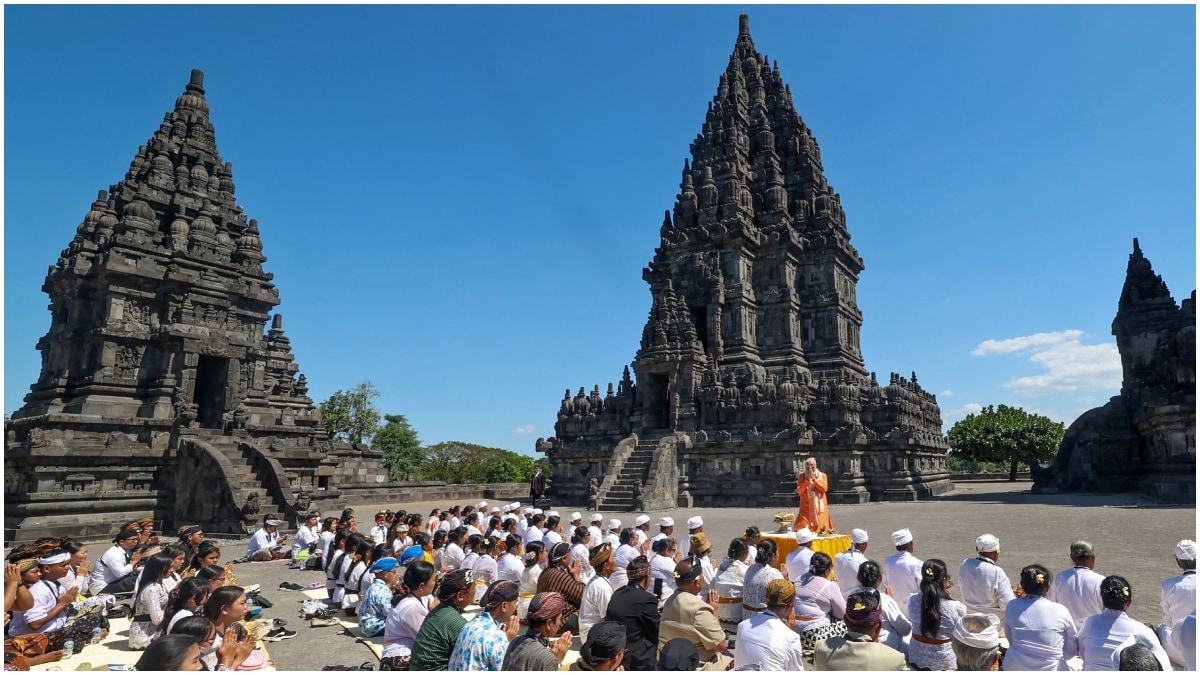
The survival of a highly fragmented pluralistic state depends on its structural capacity to balance absolute religious claims with administrative neutrality. Nations that treat secularism as the complete elimination of theological discourse from public policy frequently generate severe domestic friction. Conversely, states that yield structural control to a singular religious doctrine trigger institutional fragility, isolating minority demographics and degrading geopolitical capital. Indonesia rejects both paths. Instead, it operates on a framework of constitutional syncretism—a system where the apparatus of government is explicitly non-secular yet rigorously multi-confessional.
This model is codified via Pancasila, a five-part ideological synthesis designed to withstand factional polarization. While standard political commentary frames Indonesia's socio-political configuration as an idealistic mosaic of peaceful coexistence, a structural critique reveals a calculated optimization strategy. By institutionalizing religious identity rather than privatizing it, the state builds a complex administrative ecosystem designed to contain sectarian competition, manage majoritarian pressure, and leverage civilizational continuity for contemporary stability.
The Tri-Centric Historical Matrix
The resilience of the modern state is built upon three distinct historical layers that prevent any single theological framework from establishing an absolute monopoly over public administration. These historical layers operate as a structural stabilization mechanism.
[Phase 1: Maritime Thalassocracies] -> Infused Sanskritized statecraft & cultural grammar
       |
       v
[Phase 2: Islamic Trading Networks] -> Superimposed global commerce & legal frameworks
       |
       v
[Phase 3: Post-Colonial Synthesis]  -> Codified pluralism into the Pancasila system
1. The Thalassocratic Foundation
Between the 7th and 14th centuries, maritime empires like the Sri Vijaya Buddhist kingdom in southern Sumatra and the Majapahit Empire in eastern Java established the structural blueprints for regional integration. The Majapahit Empire operated as a Hindu-Buddhist thalassocracy, managing 98 tributary states across the archipelago. This era did not merely establish trade routes; it infused the linguistic and philosophical grammar of the region with a specific Sanskritized vocabulary. The linguistic continuity is measurable: thousands of modern Javanese words are derived directly from Sanskrit. This serves as a permanent cultural anchor, ensuring that the foundational concept of authority remains deeply linked to pre-Islamic traditions.
2. The Commercial Islamic Layer
The introduction of Islam—documented by a 1082 CE tombstone in Aceh and accelerated by the prosperity of port cities like Pasai and Perlak—did not occur via military conquest. It advanced through commercial alignment. Monarchs along the Malacca Straits embraced Islam to optimize political and economic relations with Indian Ocean trading networks. When the Sultanate of Demak displaced the weakened Majapahit Empire in 1527, the resulting Islamization of the archipelago did not erase the existing structural substrate. Instead, it was superimposed upon it. This created a dual-layer consciousness where Islamic jurisprudence had to coexist with deeply entrenched local customs and classical political philosophy.
3. The Pancasila Codification
During the constitutional formation of August 1945, the state rejected both a Western secular blueprint and an Islamic caliphate model. It established Pancasila as an explicit compromise. The system is anchored by five structural components:
- Belief in one Supreme God (Ketuhanan Yang Maha Esa)
- Just and civilized humanity (Kemanusiaan Yang Adil dan Beradab)
- The unity of Indonesia (Persatuan Indonesia)
- Democracy guided by inner wisdom and deliberation (Kerakyatan Yang Dipimpin oleh Hikmat Kebijaksanaan dalam Permusyawaratan/Perwakilan)
- Social justice for all citizens (Keadilan Sosial bagi Seluruh Rakyat Indonesia)
The first principle functions as a deliberate piece of structural engineering. By demanding a belief in monotheism without specifying a deity, the state legally accommodates multiple religions while explicitly denying special status to the Muslim majority. This establishes an institutional framework where religious legitimacy is tied directly to constitutional compliance.
The Bureaucratic Equilibrium: Mechanizing State Pluralism
The state maintains equilibrium through a process of heavily regulated inclusion. Instead of separating church and state, the administration uses its executive power to manage religious life, turning potential sources of conflict into orderly branches of the state bureaucracy.
Institutional Funding Equality
The state allocates fiscal resources to six officially recognized religious communities: Islam, Protestantism, Catholicism, Hinduism, Buddhism, and Confucianism. This funding flows through a specialized ministry that acts as an institutional filter. By directly financing higher education, infrastructure, and clerical training across all six recognized groups, the state enforces a standard of institutional parity. This operational spending gives the government significant leverage: it rewards moderate, state-aligned leadership within each community while denying financial support to radical factions.
The Problem of Identity Regulation
This state-managed harmony creates a distinct trade-off. The bureaucratization of faith requires every citizen to declare one of the six approved religions on their national identity card (KTP). This creates an immediate systemic bottleneck for millions of citizens practicing local, indigenous beliefs (Aliran Kepercayaan).
+------------------------------------+------------------------------------+
| Institutional Advantages           | Systemic Bottlenecks               |
+------------------------------------+------------------------------------+
| Neutralizes majoritarian dominance | Marginalizes unapproved faiths     |
| via balanced state funding         |                                    |
+------------------------------------+------------------------------------+
| Eradicates funding vectors for     | Promotes rigid identity policing   |
| radical theological factions       | over individual belief             |
+------------------------------------+------------------------------------+
This structural tension leads to a phenomenon where public religious identification remains high while personal theological belief fluctuates. Religion functions effectively as an official civic passport and a marker of national identity, even as personal devotion undergoes long-term secularization.
Comparative Fragility: The Structural Divergence
The stability of the Indonesian model becomes clearer when contrasted with states facing similar demographic pressures. For instance, India’s historical commitment to constitutional secularism has faced increasing pressure from majoritarian movements like Hindutva. This shift has altered state dynamics across several key areas:
Majoritarian Mobilization
In systems where the state is theoretically separated from religion, majoritarian groups can frame themselves as neglected outsiders, using populist messaging to capture state institutions. Once in power, they can use majoritarian dominance to reshape the secular consensus. Indonesia’s Pancasila avoids this vulnerability by integrating religion directly into the state identity. Because the state is explicitly built on multi-confessionalism, any attempt to transition into a mono-religious state requires dismantling the constitutional foundations of the republic itself. This design creates a much higher barrier to entry for majoritarian populism.
Institutional Protection
When secular principles weaken in a traditionally secular state, minority populations often experience rapid institutional disenfranchisement. This can show up as targeted voter removal, uneven law enforcement, or state tolerance of communal violence. Indonesia mitigates this vulnerability by using the Ministry of Religious Affairs as an administrative shield. Because the state's legitimacy is legally tied to protecting its six recognized religions, safeguarding minority institutions is a core national security priority rather than an optional political policy.
Systems-Level Vulnerabilities
The Indonesian model is not a flawless solution to pluralism; it contains structural vulnerabilities that pose ongoing risks to long-term stability.
The Local Veto Bottleneck
The decentralization of administrative power has given local majorities the ability to weaponize local zoning laws. Joint Ministerial Decrees require community approval and complex administrative sign-offs before a house of worship can be built. In practice, this creates a local veto that allows regional majorities to block minority infrastructure, generating localized instability that contradicts federal policy.
Radical Enclaves and Digital Networks
The rise of digital media has weakened traditional state-aligned clerical networks. Extremist groups bypass state-funded educational institutions by using decentralized digital spaces to spread their messages. This creates an ideological divide: the state maintains top-down control over formal religious institutions, but faces a growing challenge from unmonitored, bottom-up digital networks that reject the pluralistic baseline of Pancasila.
Strategic Recommendations
To preserve this equilibrium amid shifting demographics and digital polarization, the state must transition from a strategy of passive regulation to active structural adaptation.
- Expand the Legal Framework for Indigenous Faiths: The state should fully integrate indigenous beliefs into the national identity system to eliminate local discrimination and close the gap between constitutional principles and actual practice.
- Reform the Zoning Process for Houses of Worship: The power to approve religious infrastructure should be shifted from local community boards to a standardized, federal checklist managed by the state. This would remove local majoritarian vetoes and ensure equal protection under the law.
- Build Digital Oversight Mechanisms: The government must invest in digital monitoring systems to counter online radicalization, matching its traditional oversight of physical religious institutions with an active presence in digital spaces.
The Indonesian state relies on a complex, managed equilibrium where religious identity is structured and regulated by the government. This constitutional syncretism remains an essential mechanism for preserving stability across a highly diverse archipelago, demonstrating that long-term pluralism is achieved through deliberate institutional design.
Analyzing the Indonesian Model
This video provides an expert breakdown of the unique religious dynamics and constitutional structures that shape modern Indonesian society.