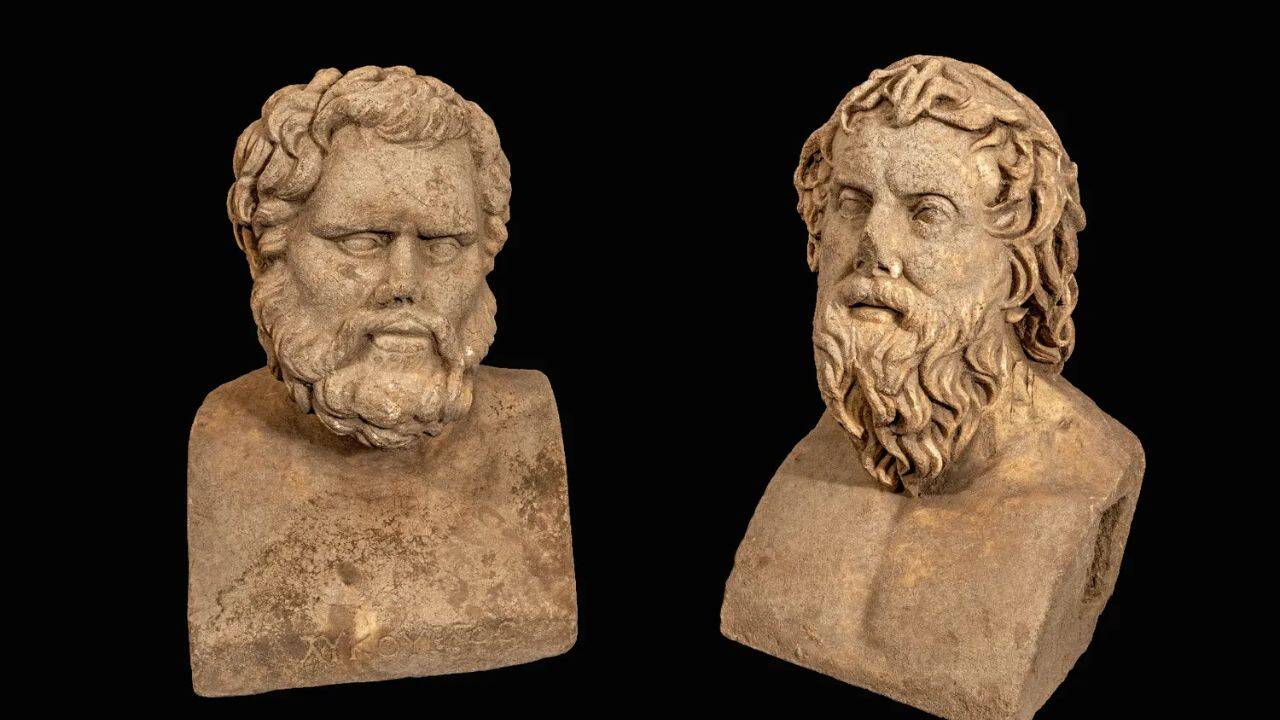
The mainstream media is swooning over a pair of 1,700-year-old Roman marble busts dug up near an ancient winepress in Israel. Academics are popping champagne. Journalists are typing up breathless reports about "rare glimpses into elite Roman life" and the "miraculous preservation" of late Roman artistry.
It is the same tired script the archaeological establishment churns out every time someone unearths a piece of polished stone. They look at a luxury artifact and immediately construct a romantic narrative about wealthy elites, cultural reverence, and sophisticated artistic curation.
They are missing the entire point.
The discovery of high-end Roman sculpture dumped next to a commercial winepress is not a celebration of Roman art. It is a crime scene of economic collapse and desperate recycling. If you want to understand the ancient world—and how societies actually fall apart—you need to stop looking at these busts as masterpieces. You need to start looking at them as scrap metal.
The Myth of the Art Connoisseur
The conventional narrative insists that these marble busts, carved from imported imperial stone, were cherished family heirlooms or public monuments proudly displayed by wealthy Roman-Byzantine citizens.
That is a fantasy.
By the late third and fourth centuries, the Roman economic engine was sputtering. Hyperinflation had gutted the currency. The cost of transporting heavy white marble from quarries in Carrara or Proconnesus had skyrocketed. The reality of the late empire was not one of pristine villas and philosophical contemplation; it was a gritty, survival-driven gig economy.
When you find two massive, high-quality marble busts buried in the dirt right next to an agricultural processing facility, you are not looking at a curated gallery. You are looking at an abandoned construction site or an illegal salvage operation.
Marble was not just art to the ancients. It was a primary source of industrial lime.
To create mortar for buildings, agricultural basins, and winepresses, workers needed calcium oxide. The fastest way to get it? Smash up old pagan statues, throw them into a kiln, and burn them down into paste. The proximity of these busts to a winepress does not mean the winery owner loved art. It means the winery owner was likely waiting for the kiln operator to show up so they could liquefy a couple of dead emperors to waterproof their fermentation vats.
The Archaeology Bureaucracy Cannot Handle Economic Reality
Academia suffers from an inherent bias toward romance over revenue. Excavation reports routinely over-index on the aesthetic value of finds while ignoring the brutal logistics of the ancient supply chain.
I have spent years analyzing how modern organizations misallocate resources based on flawed historical precedents, and the same intellectual blindness applies here. We project our modern museum culture backward onto an era that was fiercely utilitarian.
Consider the physical evidence the mainstream reports gloss over:
- The busts were found buried, not displayed.
- They were located in an industrial zone, not a residential atrium.
- They were intact, suggesting they were hidden or staged for processing rather than lost.
If an asset is hidden next to a factory, it is either stolen goods or raw material inventory.
Furthermore, the late Roman Empire was undergoing a massive ideological shift. As Christianity solidified its grip, the market for classic pagan-style portraits crashed to zero. Busts of old elites were suddenly toxic assets. They were political liabilities at best and sacrilegious idols at worst. The owners did not bury them to preserve them for 21st-century museums. They dumped them because keeping them on display could get them executed, or because they were waiting for a convenient time to turn them into concrete.
Why We Keep Asking the Wrong Questions
Go to any mainstream news site covering this find and look at the questions being asked.
- "Who do these busts depict?"
- "Which master sculptor carved them?"
- "What do they tell us about Roman fashion?"
These are fundamentally flawed questions that yield useless answers. They treat the artifact as an isolated piece of genius rather than a commodity subject to the laws of supply, demand, and depreciation.
Let us dismantle the premise of the standard "People Also Ask" queries regarding late Roman finds.
Were marble busts common in Roman provinces?
The establishment answer is always a nuanced lecture on provincial wealth and trade routes. The brutal truth is that they were corporate branding. The empire shipped these standardized images to the provinces to project power, much like a modern franchise requires every branch to hang the same corporate logos. When the corporation starts failing, those signs are the first things thrown into the dumpster.
Why are so few Roman statues found intact?
The lazy consensus blames the "ravages of time" or barbarian invasions. Nonsense. It was the locals. The vast majority of Roman statues did not survive because they were turned into walls, roads, and agricultural infrastructure. The intact busts found in Israel are the anomalies—the inventory that survived simply because the business went bankrupt before the workers could throw them into the fire.
The Downside of Seeing the World Clear-Eyed
Taking a cynical, economic-first approach to history ruins the magic for a lot of people. It strips away the poetry. It is far more comforting to imagine an ancient merchant admiring the lifelike curls of a marble toga by torchlight than it is to realize that the merchant viewed that same toga as twelve bags of high-grade plaster.
But if we do not accept the economic reality of the past, we cannot accurately read the warnings it leaves behind.
Societies do not transition smoothly from greatness to decay. The infrastructure of the elite is cannibalized by the working class long before the empire officially falls. The moment citizens start looking at great works of art and calculating their value in building materials, the game is already over.
Stop looking at the faces carved into the stone. Look at the dirt they were pulled from. Look at the winepress next door. The true story of those 1,700-year-old busts isn't that someone created them. It is that someone, faced with a collapsing economy, decided they were worth more as industrial scrap than as history.