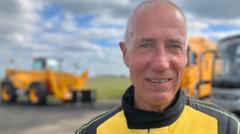
We've been stuck at the exact same land speed limit since 1997. Let that sink in. While commercial aviation crawled backward in speed after Concorde retired, and space travel went through massive private revolutions, the absolute barrier of terrestrial velocity has sat untouched for nearly thirty years. Nobody has gone faster than 763.035 miles per hour on wheels.
Andy Green did that. He strapped himself into a twin-turbofan fighter jet on wheels named Thrust SSC in the Black Rock Desert and punched a hole right through the sound barrier. It was loud. It was violent. It completely rewrote what we thought was mechanically possible on dirt.
People forget how close we came to absolute disaster that day. Breaking Mach 1 isn't just about raw thrust. It's about surviving shockwaves that want to rip a vehicle apart the second it crosses the transition zone.
Breaking the Sound Barrier on Dry Lakebeds
Most people assume driving fast is just about horsepower. It's not. Once you approach Mach 1, aerodynamics turn into a knife fight.
Thrust SSC wasn't really a car. It was a fighter jet without wings. It used two Rolls-Royce Spey 202 turbofan engines—the exact same powerplants used in the British Phantom fighter. We aren't talking about a tuned V8 engine. We're talking about fifty thousand pounds of thrust pushing a carbon-composite and aluminum shell across miles of cracked mud.
When Green hit 763.035 mph on October 15, 1997, the shockwave didn't just rattle windows miles away. It created immense pressure waves that threatened to stall the engine intakes and rip the steering control right out of his hands.
If you talk to aerospace engineers who worked on the project, they will tell you the scariest part wasn't going fast. It was stopping. Thrust SSC used drag chutes and wheel brakes, but at those velocities, deployment timing had to be absolute perfection. Pull the chute too early, and you destabilize the chassis. Pull it too late, and you run out of desert.
Why Nobody Has Broken It Yet
You might wonder why we are still talking about a record set in the nineties. Why hasn't Elon Musk or some billionaire-backed syndicate shattered it by now?
Because the economics of going supersonic on land are brutal.
Modern projects like the Bloodhound LSR program proved that funding supersonic engineering is an uphill battle. Bloodhound actually reached over 620 mph in South Africa a few years back, but securing steady corporate sponsorship for an endeavor that offers zero commercial utility is punishingly difficult.
Building a car that can withstand Mach 1.4 requires aerospace-grade tolerances. A microscopic alignment flaw at 800 miles per hour means instant vaporization. There is no margin for error. You cannot pull over to check a warning light.
The Mental Toll of Driving at Mach 1
Imagine sitting inches away from twin military jet engines while your steering wheels act basically as rudders because the tires are spinning too fast to grip the ground effectively.
Andy Green wasn't just a daredevil. He was an RAF fighter pilot with a degree in mathematics from Oxford. That combination is rare. You need someone who can calculate vector forces in their head while their eyeballs are vibrating back and forth from high-frequency G-forces.
During the record run, the right-hand engine surged, and the car violently yawed to the left. Most drivers would have instinctively lifted off the throttle, spinning the vehicle and turning it into shrapnel. Green held his nerve. He made micro-corrections, kept the burners lit, and powered through.
That is the difference between a stunt driver and an elite test pilot.
Lessons From the Desert
If you want to understand how engineering limits actually shift, look at how the Thrust SSC team solved the shockwave problem. They didn't guess. They used advanced computational fluid dynamics that were bleeding-edge for 1997.
They realized that standard automotive shapes fail completely at transonic speeds. The vehicle had to be designed so that the shockwave formed behind the front wheels, preventing loss of steering control.
This engineering philosophy bleeds into modern automotive design, even if your daily commuter car tops out at eighty miles per hour. Downforce management, high-speed stability control, and lightweight composite structures all trace their lineage back to extreme velocity testing grounds like Black Rock and Bonneville.
We will break the record eventually. Someone will push past 800 or 900 miles per hour on land. But until that day arrives, Andy Green's supersonic run remains one of the absolute greatest engineering and driving achievements in human history.
Stop waiting for someone else to push the envelope. Support the next wave of aerospace innovation, read the primary telemetry reports from the 1997 run, and appreciate just how hard it is to make metal fly across the dirt.