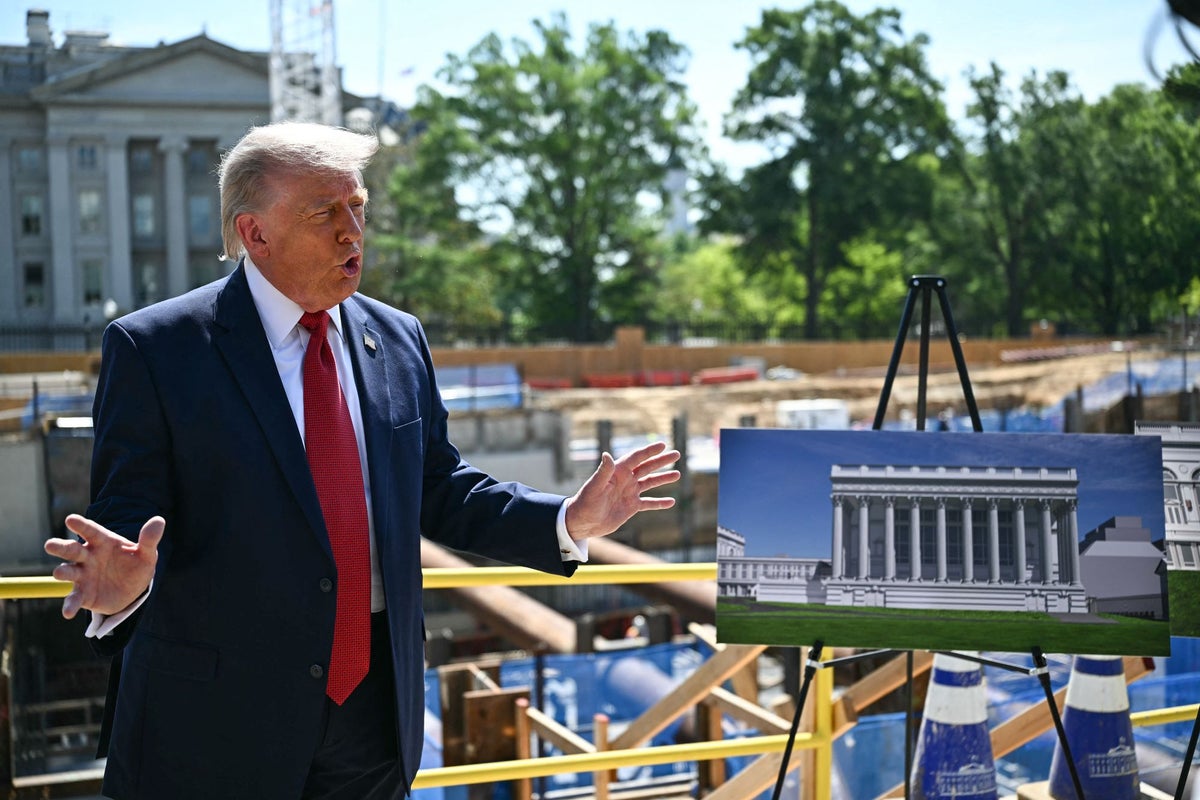
The announced scaling of the White House East Wing modernization project from a $200 million hospitality venue into a $400 million multi-layered facility reveals a profound shift in capital allocation strategy, asset definition, and public-private funding mechanics. To analyze this project as merely an expensive reception hall misinterprets the fundamental economic and structural principles at play. When a real estate asset is modified to serve simultaneously as state infrastructure, a defensive installation, and a diplomatic platform, standard valuation metrics fracture.
Evaluating this initiative requires moving past political rhetoric to dissect the underlying structural capitalization, the shifting of cost centers between private donors and public appropriations, and the long-term operational liabilities introduced to the executive branch.
The Dual-Use Asset Framework
The primary analytical error in contemporary assessments of the 90,000-square-foot structure is the failure to separate its commercial-aesthetic attributes from its defensive utility. The project operates under a classic dual-use asset model, where a single physical footprint yields two distinct classes of output.
       [ Private Donor Capital: $400M ] ──> Above-Ground Surface Layer (Ballroom)
                                                   │
                                        ======================= (Structural Interface)
                                                   │
[ Proposed Public Appropriation: $1B ] ──> Sub-Surface Infrastructure (6-Story Bunker & Security Shield)
The Above-Ground Surface Layer functions as a high-capacity hospitality asset capable of hosting up to 999 individuals. The economic value here is transactional and soft: it reduces reliance on off-site commercial venues for state dinners, eliminates external lease expenditures, and centralizes executive hospitality within a secure perimeter. This phase is capitalized through private donations, including direct capital injections from personal funds and private citizens.
The Sub-Surface and Structural Interface functions as a hardened military installation and defensive buffer, extending six stories underground. According to Justice Department court filings and executive briefings, this zone integrates missile-resistant steel columns, drone-proof roofing, blast-proof glass, bomb shelters, and a specialized medical facility.
The economic relationship between these two layers is governed by a structural cost function. The surface layer acts as a physical and legal "shield" for the complex subterranean infrastructure beneath it. Excavating and securing six stories of subterranean space in a high-density, high-security urban environment requires a massive structural cap over the top of the excavation site. The ballroom effectively serves as the roof of a military installation; the marginal cost of building a luxury reception hall on top of a mandatory blast shield is significantly lower than building either structure in isolation.
The Capital Subsidization Loophole
The assertion that the facility is a "free gift" that carries "no charge to the taxpayer" presents an incomplete economic picture. It overlooks the concept of joint production costs and the inevitable cross-subsidization that occurs when private infrastructure is integrated into a public security apparatus.
While the $400 million budget for the superstructure is drawing from private donor capital, the project has triggered a concurrent legislative request from Senate leadership for $1 billion in public funds over three fiscal years. This capital is earmarked for the United States Secret Service and military enhancements directly tied to the East Wing footprint.
This mechanism creates a clear capital distribution pattern:
- Core Structure Capitalization: Private capital covers the aesthetic and structural envelope ($400 million). This capital is fixed and non-recoverable for the donors.
- Peripheral Security Externalities: The public sector absorbs the cost of integrating the asset into the broader defense network ($1 billion). This includes Secret Service technology upgrades, specialized communications infrastructure, and ongoing tactical defense mechanisms.
This structure allows the executive branch to leverage private capital to expand physical real estate footprints while shifting the far larger burden of operational security, technology integration, and structural hardening onto the state. The private gift acts as a catalyst that forces a billion-dollar public capital expenditure that would not have otherwise occurred.
Structural Capital Variance and Scale
The cost trajectory of the project—doubling from an initial estimate of $200 million to a finalized projection of just under $400 million—reflects classic mega-project scoping dynamics. The executive branch attributes this variance to two primary vectors: a 100% increase in total square footage and an escalation in material specifications.
In standard construction economics, doubling the scope of a high-security civic asset does not yield a linear 1-to-1 cost increase due to fixed mobilization expenses. However, when the asset requires military-grade components, the cost curve bends upward sharply. The introduction of blast-resistant materials, specialized concrete reinforcement, and specialized drone-deflection architecture introduces a high degree of structural complexity.
Cost Function: C = F + V(S) * Q
Where:
- C = Total Project Cost
- F = Fixed Mobilization and Legal Costs
- V(S) = Variable Security Factor (Exponential scaling based on hardening specifications)
- Q = Volumetric Scale (Square footage and subterranean depth)
As the variable security factor ($V(S)$) increases alongside volumetric scale ($Q$), the cost function accelerates. The $400 million price tag is the mathematical output of this compounding complexity, not a arbitrary cost overrun.
Institutional Risk and Legal Bottlenecks
A comprehensive asset analysis must account for the legal and regulatory risks that threaten execution schedules. The project faces two significant institutional bottlenecks that complicate its projected completion in September 2028:
The first limitation is judicial intervention. A federal district court order temporarily halted above-ground work following litigation from historical preservation organizations. Because the demolition of the historic East Wing occurred via unilateral executive action rather than the standard congressional approval pipeline, the project carries a high degree of regulatory non-compliance risk. If the judicial stay is upheld, the capital efficiency of the project drops to zero as idle machinery and protracted litigation consume resources.
The second bottleneck is legislative dependency. While the White House maintains that the ballroom itself requires no public funds, the sub-surface military and Secret Service components are entirely dependent on the passage of a highly contested border and security spending package. If Congress rejects or downsizes the $1B appropriation, the structural integrity of the dual-use framework is compromised. The project would be left with a privately funded surface asset sitting on top of an incomplete, unfunded subterranean void, halting the operational utility of the entire complex.
Long-Term Operational Valuation
The true return on investment for this infrastructure cannot be measured by traditional real estate yields or public approval ratings, which current polling places at a low 28% support level. Instead, the asset must be evaluated on its long-term depreciation cycle and utility transfer.
Because the current executive term concludes less than six months after the projected September 2028 completion date, the immediate capital allocator will capture virtually none of the operational utility of the venue. The asset represents a massive transfer of non-taxpayer capitalized infrastructure to future administrations.
The strategic play here is institutional lock-in. By completing a highly fortified, multi-use structure using private capital, the current administration permanently alters the physical and security layout of the White House. Future executives inherit a highly secure command and diplomatic asset at zero initial acquisition cost to their own budgets, yet they will be structurally bound to maintain, garrison, and operate a 90,000-square-foot military-hospitality hybrid for the next half-century.