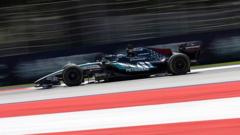
Free practice times in Formula 1 are frequently misconstrued as direct indicators of qualifying performance, yet they are heavily modulated by distinct variables: fuel mass, engine mapping modes, and thermal management. Kimi Antonelli completing a Friday practice sweep at the Red Bull Ring with a benchmark lap of 1:07.014 offers a valuable data set, but isolating real performance requires stripping away the operational noise. At an altitude of approximately 700 meters and with track temperatures approaching 50°C, the Spielberg circuit alters aerodynamic efficiency and internal combustion metrics, meaning true performance is hidden within tire degradation rates and thermal saturation limits rather than low-fuel single laps.
Deconstructing the competitive hierarchy requires analyzing three core operational pillars:
- Engine optimization under atmospheric reduction
- Thermal saturation of the Pirelli C5 compound
- Fuel-load corrections and asymmetric run profiles
Aerodynamic and Thermodynamic Discrepancies
The Red Bull Ring features an atmospheric pressure profile that reduces air density by roughly 7%. This atmospheric thinning forces turbochargers to spin faster to maintain baseline oxygen delivery to the internal combustion engine, which increases thermal loads across the power unit.
Mercedes managed this thermodynamic bottleneck more effectively than its rivals during Friday sessions. Antonelli's 1:07.014 lap time represents an efficiency advantage that relies heavily on electrical deployment strategies along the uphill sectors from Turn 1 to Turn 4.
Red Bull Racing, by contrast, introduced an extensive aerodynamic upgrade package but operated under restricted engine maps. Max Verstappen finished 0.550 seconds adrift of the benchmark, complaining of engine lag. In high-altitude environments, turbocharger lag usually indicates conservative turbine mapping designed to preserve the power unit during extreme track temperatures. The gap between Mercedes and Red Bull is therefore an artifact of operational parameters rather than a definitive deficit in downforce.
Compound Degradation and Thermal Saturation Matrix
Spielberg’s track surface reached nearly 50°C during Free Practice 2, presenting an operational hurdle for the Pirelli C5 soft tire. The C5 has a narrow thermal window, making it prone to surface overheating when subjected to high longitudinal traction demands out of slow corners like Turn 3 and Turn 4.
The operational differences between Mercedes and McLaren center on how their chassis architectures distribute these thermal loads:
- Mercedes W17 Chassis: The vehicle demonstrated superior immediate thermal activation. Antonelli achieved his optimal tire temperature profile by the apex of Turn 1, maintaining tread stability through the high-energy sweeps of Turns 7 and 8. The primary limitation of this setup is the risk of premature thermal degradation during longer stints.
- McLaren MCL38 Chassis: Oscar Piastri and Lando Norris showed a more gradual tire-warming curve. Piastri’s lap of 1:07.251—0.237 seconds behind Antonelli—was achieved with lower peak tread temperatures in the first sector, preserving the tire for the final sector. Norris experienced a snap-oversteer spin at Turn 3 early in the session and ran off-track at Turn 8, showing that the McLaren platform was operating closer to its mechanical compliance limits in the extreme heat.
The data suggests that while Mercedes holds a single-lap advantage under peak track temperatures, McLaren's gradual thermal activation will yield lower degradation rates during extended race stints.
Strategic Asymmetry and Component Failure Modes
The reliability failures seen on Friday highlight the tight tolerances dictated by the Spielberg environment. Cadillac experienced a double mechanical failure, with Sergio Pérez stopping due to a recurring powertrain issue and Valtteri Bottas retiring with an open fire on the car floor caused by a damaged suspension that led to localized overheating.
These failures show the risks of running tight packaging configurations in high-ambient conditions. Teams that fail to allocate sufficient cooling capacity to mechanical components face catastrophic thermal runaways.
Mercedes also managed its garage resources unevenly. George Russell lost the opening minutes of Free Practice 2 to mechanical adjustments, ending the session sixth fastest and over six tenths of a second off his teammate's pace. This variance between identical chassis reveals how sensitive modern ground-effect cars are to minor setup variations. A half-millimeter adjustment in ride height or a slight shift in anti-roll bar stiffness can cause a car to drop out of its optimal aerodynamic window, changing the mechanical balance across high-speed corners.
Predictive Models for Qualifying and Race Configurations
Accounting for fuel-weight penalties—where every 10 kilograms of fuel costs roughly 0.15 seconds per lap at Spielberg—and assuming conservative engine mapping from Ferrari and Red Bull, the competitive order will shift ahead of competitive sessions. Ferrari's Lewis Hamilton and Charles Leclerc ran conservative power profiles, ending the day fifth and seventh respectively. Historically, Scuderia Ferrari runs higher baseline fuel loads during Friday soft-tire simulations than Mercedes, which masks their true single-lap performance.
The definitive forecast for the weekend depends on track temperature trends. If ambient temperatures remain above 30°C, McLaren's superior management of rear-tire slip angles will likely erase Mercedes' single-lap advantage during long runs.
The strategic imperative for Mercedes is to lock down the front row during qualifying, where their rapid tire activation provides a clear edge. If they fail to secure clean air at the start, the thermal sensitivity of the W17 chassis will leave them vulnerable to undercut strategies from McLaren and a re-mapped Red Bull lineup.