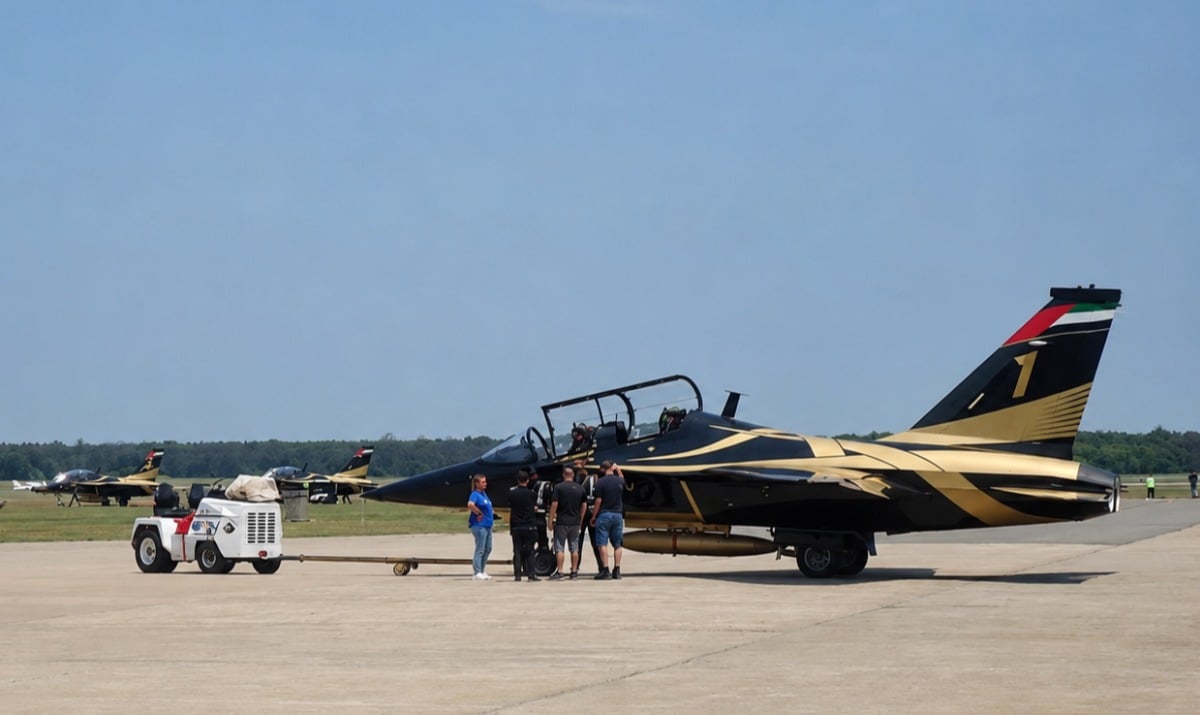
The arrival of Chinese-built Hongdu L-15 advanced jet trainers on American soil at a Long Island airfield marks a structural shift in global defense procurement, signaling the collapse of traditional Western monopolies over Tier 1 aerospace markets. Operating under the colors of the United Arab Emirates (UAE) Air Force, these airframes represent the first deployment of a contemporary Chinese-designed military aircraft within the United States. This event cannot be dismissed as a routine logistics stop or airshow appearance; it is a tangible manifestation of a multi-decade industrial strategy designed to challenge Western aerospace dominance via high-performance, lower-cost tactical platforms.
To understand the strategic friction generated by this deployment, the event must be decoupled from the spectacle of aviation diplomacy and analyzed through three distinct lenses: the mechanical capabilities of the L-15 platform, the geopolitical logic of middle-power procurement strategies, and the security implications of integrating Chinese hardware within Western-aligned defense architectures.
The Performance-to-Cost Function of the L-15 Platform
The Hongdu L-15—designated the JL-10 within the People's Liberation Army Air Force (PLAAF)—is not a secondary technology product; it is a highly optimized Lead-In Fighter Trainer (LIFT) designed to bridge the training gap between basic flight regimes and high-G, network-centric fifth-generation air superiority fighters. The aircraft utilizes a twin-engine aerodynamic configuration with large leading-edge root extensions (LERX), providing high-alpha flight characteristics analogous to modern frontline fighters like the F-16 or the J-10.
The economic and operational viability of the platform relies on a specific cost-performance equation:
- Avionics Architecture: The L-15 incorporates a full digital fly-by-wire (FBW) flight control system and an open-architecture glass cockpit. Advanced variants feature a Passive Electronically Scanned Array (PESA) or Active Electronically Scanned Array (AESA) radar, enabling the simulation of complex beyond-visual-range (BVR) engagements without expending the flight hours of premium frontline airframes.
- Propulsion Economics: The airframe has historically relied on Ukrainian-designed Ivchenko-Progress AI-222K-25 afterburning turbofans. While China has actively transitioned toward domestic powerplants like the WS-17 to insulate its supply chain from external vulnerabilities, the current export models offer an efficient balance of supersonic capability and thermal efficiency.
- Payload and Versatility: With seven hardpoints capable of deploying short-range air-to-air missiles (such as the PL-8), precision-guided munitions (such as the LS-6), and electronic warfare pods, the L-15 functions effectively as a light attack aircraft.
This dual-use capability alters the procurement math for developing air forces. For a capital cost estimated at roughly one-third of a Western equivalent—such as the Leonardo M-346 or the Boeing T-7A Red Hawk—the L-15 delivers 85% of the operational training envelope alongside an inherent light-combat capability.
Middle-Power Hedging and Procurement Diversification
The UAE’s acquisition of 12 L-15 jets (with an option for 36 more) under a contract valued at approximately $440 million illustrates a calculated geopolitical hedging strategy. Middle powers are increasingly rejecting single-source defense dependencies to insulate themselves from Western political mandates and export controls.
When Western nations condition defense sales on domestic policy compliance or restrict access to source codes, they inadvertently lower the barrier to entry for strategic competitors. China exploits this dynamic by offering high-tier military hardware free from political contingencies or human rights oversight. By integrating Chinese-built L-15s into an inventory that simultaneously features French Rafales and American F-16 Block 60s, the UAE establishes a diversified defense ecosystem.
This multi-vector procurement strategy provides two distinct advantages:
- Negotiating Leverage: The physical presence of Chinese military hardware in a Gulf nation’s inventory acts as a bargaining chip, forcing Western suppliers to moderate their technology transfer restrictions or risk losing market share entirely.
- Strategic Autonomy: By operating parallel logistics pipelines, a nation can sustain domestic pilot production pipelines even if a diplomatic dispute triggers a cutoff of Western spare parts or technical support.
The Security Paradox of Interoperable Hardwares
The appearance of these aircraft at a Long Island airfield brings the structural risks of this diversification strategy directly into the Western hemisphere. The primary systemic risk is not kinetic; it is signals intelligence and data security. Modern military aircraft are mobile data collection nodes that continuously broadcast, receive, and process information across multiple spectrums.
The integration of Chinese aerospace hardware into Western-adjacent operating environments creates a fundamental data-isolation challenge. When an L-15 operates within the same airspace as Western assets, its passive sensors, radar systems, and data links inevitably interface with local electromagnetic environments. For defense intelligence agencies, this creates an acute vulnerability: the potential for embedded telemetry or back-door communication channels within Chinese-manufactured components to transmit sensitive electromagnetic signatures back to sovereign data centers in China.
This risk is compounded during international exercises or airshows where foreign-operated Chinese platforms fly alongside domestic infrastructure. The proximity allows for the precise mapping of civilian and military radar networks, air traffic control protocols, and transponder signatures.
Structural Bottlenecks and Platform Limitations
While the L-15 represents a major milestone for Chinese defense exports, the platform faces systemic industrial constraints that limit its ability to entirely displace Western aerospace systems.
The foremost limitation resides in global logistics and lifecycle support. Western defense consortiums rely on established, multi-decade support networks capable of deploying parts, technicians, and software updates globally within hours. China’s defense export framework lacks this maturity. Operating a fragmented fleet of Chinese airframes alongside Western infrastructure increases the maintenance burden on foreign air forces, requiring distinct maintenance protocols, unique tooling, and non-interoperable diagnostic software.
Furthermore, the transition from foreign powerplants to indigenous Chinese engines introduces a layer of engineering risk. The WS-17 must prove its time-between-overhaul (TBO) metrics and structural reliability under high-utilization training cycles. Until these engineering metrics are validated through thousands of operational flight hours, the L-15 remains exposed to supply-chain vulnerabilities that could ground fleets during localized geometric disputes.
Strategic Realignment Protocols
The presence of Chinese-built tactical jets on a United States runway demands an immediate reassessment of Western export control policies and defense industrial capacity. To counter this asymmetric market entry, Western defense prime contractors must pivot away from hyper-expensive, over-engineered training platforms that price out middle-power partners. The defense industrial base must accelerate the production and lower the acquisition costs of platforms like the T-7A to provide an economically viable alternative to Chinese state-subsidized hardware.
Simultaneously, regulatory frameworks must adapt. Western defense agencies must establish strict electromagnetic isolation protocols for any joint environment where Chinese-built airframes operate. This requires the development of localized "clean rooms" within the electromagnetic spectrum—deploying advanced electronic shielding and selective sensor degradation to ensure that during multi-national public appearances, the operational data signatures of nearby Western infrastructure remain entirely secure.