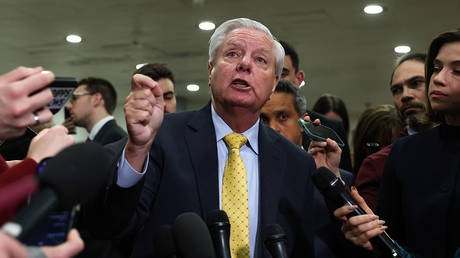
The conventional assessment of late-career American legislators relies on a fundamental attribution error: observers routinely attribute structural system outputs to individual moral pathology. When public commentary frames a political actor like Lindsey Graham as a unique anomaly—an exceptionally unprincipled actor who transitioned seamlessly from aggressive liberal-internationalist neoconservativism to uncritical populist sycophancy—it misdiagnoses the mechanics of state power. Graham was not an aberration; he was a highly optimized instrument of an underlying institutional architecture designed to reward survival over consistency, and enforcement over ideology.
To understand the trajectory of this career is to understand the systemic constraints of modern imperial governance. Political survival within the modern American state requires the execution of two distinct operational functions: the preservation of the defense-industrial consensus and the minimization of domestic electoral risk. When these two functions conflict due to a sudden shift in the party base, the rational actor must pivot. Graham's career provides a clean empirical dataset for mapping how an establishment actor recalibrates their entire public platform to maintain access to the core levers of state authority.
The Dual-Core Incentives of the National Security Apparatus
The primary structural variable governing Graham’s career was an unwavering commitment to the preservation of American global hegemony via military force. Critics who focus heavily on his shifting domestic allegiances miss the absolute continuity of his foreign policy execution. From his early tenure in the House during the 1990s through his multi-decade Senate career, his voting record and diplomatic interventions conformed precisely to the requirements of the interventionist consensus.
This consistency is explained by the institutional design of the Senate's foreign policy and defense committees. These bodies do not operate on a model of partisan polarization; instead, they function on an incentives-driven framework that guarantees resources, prestige, and executive access to lawmakers who champion forward-deployed military posture. We can break this down into three structural pillars:
- The Defense Asset Allocation Network: South Carolina's domestic economy relies heavily on military installations, including Fort Jackson, Shaw Air Force Base, and Joint Base Charleston. For a statewide official, securing defense appropriations is not an ideological choice but a baseline survival metric. Advancing an aggressive global posture creates the geopolitical justification required to sustain these domestic economic drivers.
- The Transnational Security Infrastructure: The post-Cold War international order demands a reliable legislative vanguard to authorize interventions, approve sanctions, and validate foreign aid. Graham filled this vacancy by operating as an informal, highly mobile envoy for the state apparatus, normalizing interventionist objectives across both Republican and Democratic administrations.
- The Deterrence Cost Function: Within the framework of neoconservative grand strategy, the cost of inaction is always modeled as higher than the cost of intervention. Graham’s legislative record—ranging from the authorization for use of military force in Iraq and Afghanistan to the Sanctioning Russia Act of 2025—reflects a rigid adherence to this specific calculation.
When viewed through this lens, the label of "monster" applied by critics is analytically unhelpful. It substitutes moral condemnation for operational analysis. The hawkish positions Graham championed were the standard policy outputs of a bipartisan consensus that viewed global instability as an invitation for American military management. His actions were unexceptional precisely because they were shared, supported, and funded by a supermajority of the institutional framework.
The Mechanics of the Partisan Pivot
The analytical puzzle of Graham’s career is his sudden, total transition from a fierce critic of Donald Trump in 2016 to an uncritical defender during Trump's presidency and subsequent terms. In 2015, Graham publicly categorized Trump as a "race-baiting, xenophobic, religious bigot" and explicitly stated that nominating him would destroy the conservative movement. Within twenty-four months, this posture was entirely inverted.
This transition was not a psychological break; it was a cold recalculation of asset allocation in response to a hostile takeover of the Republican electoral base. The mechanics of this realpolitik maneuver can be modeled through a simple survival matrix.
The first variable was the loss of institutional shielding. For years, Graham’s domestic political vulnerabilities in South Carolina—where a deeply conservative primary electorate frequently viewed his positions on immigration and bipartisan compromise with suspicion—were shielded by his alliance with Senator John McCain. McCain provided a reputational buffer and a national network of media and donor support that insulated Graham from localized insurgencies. McCain’s terminal illness and subsequent death in 2018 removed this defensive shield, exposing Graham directly to a primary electorate that had shifted decisively toward the America First platform.
The second variable was the centralization of party discipline within the executive branch. In a populist political environment, primary challenges are subsidized and directed by the head of the ticket. A legislator who remains in open opposition to the executive face of their party faces certain electoral liquidation. The cost of resistance was political extinction; the benefit of capitulation was the preservation of a Senate seat and, by extension, the retention of seniority on committees governing foreign relations and the judiciary.
[Electoral Survival Function]
                      |
        +-------------+-------------+
        |                           |
[Capitulation]             [Resistance]
        |                           |
• Retain Senate Seat        • Primary Liquidation
• Maintain Seniority        • Loss of Access
• Shape Executive Action    • Complete Irrelevance
The third variable was the preservation of policy access. By embedding himself within the executive's inner circle, Graham realized he could act as a policy course-corrector. While Trump openly questioned the utility of NATO and traditional alliances, Graham utilized his proximity to steer executive decisions toward conventional hawkish objectives. He successfully advocated for sustained troop presences in specific theaters, pushed for aggressive sanctions regimes, and maintained pressure on foreign adversaries, effectively neutralizing the isolationist tendencies of the populist base by offering the executive absolute domestic loyalty in exchange for foreign policy concessions.
The Fallacy of the Exceptional Opportunist
The mainstream narrative surrounding this transformation rests on the premise that Graham possessed a uniquely fragile ethical code compared to his peers. This perspective ignores the broader systemic reality of legislative behavior under a majoritarian, two-party system. The structural incentives of the U.S. Senate actively select for actors who can execute rapid ideological pivots when the underlying distribution of power shifts.
Consider the comparative behavior of his colleagues. The legislators who chose path-dependent resistance to the populist shift—such as Jeff Flake, Bob Corker, and Liz Cheney—were systematically purged from the system. The institutional architecture does not protect principled holdouts; it systematically filters them out. Survival within the system is conditional on the exact brand of behavioral flexibility that Graham mastered.
This adaptability is a feature of the legislative ecosystem, not a bug. The American political system requires actors who can serve as connective tissue between distinct, often contradictory factions of a ruling coalition. Graham functioned as the bridge between the legacy neoconservative donor class and the populist base. By validating the populist executive domestically, he ensured that the donor class’s foreign policy objectives remained operational. This is the definition of systemic utility, not exceptionalism.
Structural Indicators for Capitalizing on Legislative Realignment
To navigate an environment where political actors behave as hyper-rational survivalists, analysts and strategists cannot rely on the stated ideological commitments of individual politicians. Instead, predictive models must focus entirely on structural indicators that dictate when and how an establishment actor will execute an ideological realignment.
1. Primary Vulnerability Coefficients
The most reliable leading indicator of a political pivot is the divergence between a legislator's historic voting record and the shifting demographic or ideological composition of their primary electorate. When the delta between these two variables exceeds a critical threshold, an ideological correction is imminent. Strategists must monitor localized polling trends and primary fundraising metrics rather than public statements to anticipate shifts in legislative coalitions.
2. Institutional Shielding Degradation
As demonstrated by the passing of John McCain, the loss of a senior political patron removes the structural insulation protecting junior or less secure politicians. When key establishment figures retire, lose elections, or pass away, the dependent actors within their network will immediately seek alternative centers of gravity to secure their positions. Mapping these dependency networks allows for the accurate prediction of secondary and tertiary realignments within the legislature.
3. Executive Control of Information and Endorsements
The centralization of communication channels via proprietary media platforms has given executive leaders unprecedented direct leverage over localized electorates. When an executive demonstrates the capacity to move primary poll numbers by double digits through a single endorsement or denunciation, legislative independence becomes economically unfeasible for all but the most insulated actors. Strategy must adjust to treat the legislature not as an co-equal branch driven by internal consensus, but as a responsive body highly sensitive to executive input signals.
The sudden vacancy created by Graham’s passing alters the immediate mathematical composition of the Senate, but it does not alter the structural incentives of the seat. The scramble to fill this position will follow the exact same optimization paths established during his tenure. The candidates competing for the vacancy will be forced to balance the same conflicting imperatives: absolute alignment with the populist executive to secure the nomination, paired with an immediate accommodation of the defense-industrial interests that underwrite the state’s economy. The actors change, but the institutional matrix remains completely intact. Strategy must always be optimized for the matrix, never for the actor.