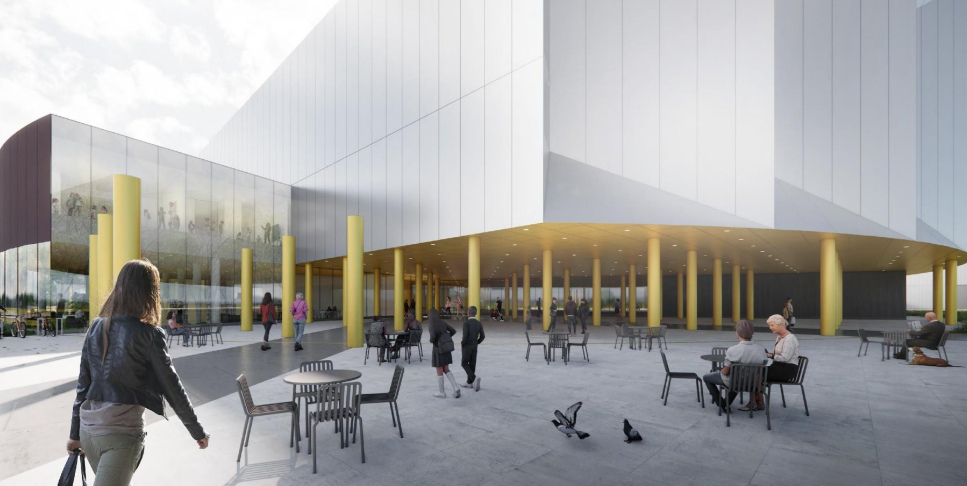
Large-scale civic infrastructure projects routinely fall into predictable traps of scope creep, inflationary shocks, and delayed realization. Analyzing the trajectory of Edmonton’s mistahaya wîkihk Community Recreation Centre—formerly known as the Lewis Farms Facility and Park Project—provides an unvarnished blueprint of how municipal capital allocation interacts with macroeconomic reality. Examining the structural friction behind this 343-million-dollar development reveals the fundamental cost functions that govern public mega-projects, shifting the perspective from surface-level construction updates to a rigorous post-mortem of public sector asset delivery.
The Mechanics of Value Engineering and Scope Compression
When municipal budgets face severe inflationary pressure, project delivery agencies face a binary choice: inject fresh capital or compress the scope. In the case of this west Edmonton development, initial projections ballooned toward 427 million dollars as supply chain disruptions and labor market volatility compounded post-pandemic. Rather than absorbing the variance entirely through taxpayer debt, the project team initiated a value engineering phase that stripped approximately 90 million dollars out of the baseline design.
This compression strategy relied on material substitution, footprint reduction, and the systematic elimination of high-performance sport specifications. For instance, the aquatic component was recalibrated away from international competition standards. High-performance diving infrastructure and maximum-depth pools were down-scoped to favor high-volume community utilization.
This trade-off exposes a core principle of public asset management: utility maximization under capital constraints. By shifting the design target from elite sports tourism to high-frequency grassroots recreation, the municipality traded specialized economic impact for broad-based community access. However, value engineering is rarely frictionless. Savings extracted via reduced specifications often reappear later as operational inefficiencies or premature lifecycle maintenance liabilities.
The Cost Function of Municipal Delays
The timeline of the facility illustrates the economic penalty of project deferral. Originally conceptualized over a decade prior to its targeted 2028 operational launch, the development endured multiple funding freezes, most notably an 18-month suspension during budget deliberations and subsequent macroeconomic dislocations.
Every month a capital asset spends in the pre-construction pipeline incurs an implicit carrying cost driven by construction price index inflation. When municipal councils defer funding to balance short-term operating budgets, they expose future capital budgets to compounding cost escalation.
- The Capital Freeze Penalty: Halting a project during detailed design invalidates engineering estimates, requiring costly redesign loops once funding is unfrozen.
- The Inflationary Wedge: Material costs historically outpace general consumer price indices during periods of industrial demand spikes, turning a deferred expense into an inflated liability.
- Contractor Risk Premiums: Unpredictable municipal procurement schedules force general contractors like PCL Construction to price higher contingency margins into bids to hedge against administrative stops and starts.
Despite these hurdles, the final approval required an additional 32 million dollar contingency injection, lifting the finalized budget to 343 million dollars. This variance demonstrates the limits of predictive budgeting in an era of structural supply chain volatility.
Operational Intent Versus Engineering Reality
A common analytical error in civic reporting is treating a recreation centre as a monolithic block of concrete and steel rather than a complex ecosystem of revenue-generating and cost-absorbing sub-units. The Lewis Farms footprint—incorporating a twin arena, a 50-metre aquatic space, a public library, a fitness hub, and a double gymnasium—must balance disparate operational cost functions.
Arenas and aquatic spaces operate at high energy-intensity baselines, demanding heavy mechanical and electrical subsystems. By integrating a public library and childcare facilities into the same structural envelope, the municipality attempts to flatten the facility’s demand curve. Day-time traffic from library patrons offsets the evening-heavy peak loads of the twin arenas and fitness circuits.
Yet, this multi-use density introduces architectural friction. Mechanical isolation between the high-humidity aquatic hall and the dry-air library spaces requires rigorous engineering precision, driving up upfront mechanical capital expenditures to protect long-term asset integrity.
The Strategic Play
To optimize future civic capital allocation, municipal planning bodies must abandon static budgeting models in favor of dynamic threshold provisioning. Project pipelines should incorporate hard circuit-breakers: if macroeconomic inflation indices exceed baseline assumptions by a pre-determined percentage, projects must automatically trigger modular scale reductions rather than entering indefinite administrative limbo. Locking in design parameters alongside guaranteed multi-year funding tranches eliminates the redesign penalty entirely, ensuring that large-scale community assets transition efficiently from blueprint to operation.
Lewis Farms Rec Centre is $32M over budget
This video provides a direct visual breakdown of the financial adjustments and council debates surrounding the recent budget increases for the development.
http://googleusercontent.com/youtube_content/1