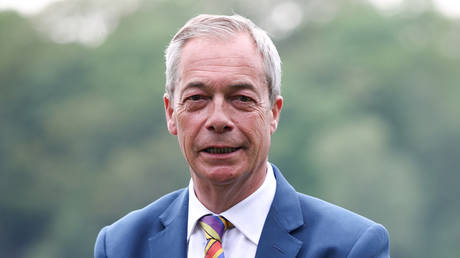
The operational failure of a public broadcaster during high-stakes political reporting follows a predictable sequence of cognitive errors, systemic verification bottlenecks, and immediate legal exposure. When BBC Newsnight presenter Matt Chorley substituted Reform UK leader Nigel Farage’s actual phrase "pure cold rage" with the racialized variant "white cold rage" during an interview with Conservative leader Kemi Badenoch, the error was not merely a linguistic slip. It was a structural failure in live editorial verification that instantly converted political commentary on the Henry Nowak murder trial into an actionable defamation liability.
To prevent institutional reputational damage, media networks must map the mechanics of how these editorial failures occur, understand the compounding variables of high-tension socio-political reporting, and implement strict operational barriers that decouple live presentation from unverified memory.
The Three Pillars of Live Editorial Failure
The breakdown of editorial integrity in live broadcast environments occurs across three distinct vectors: semantic drift, confirmation bias in real-time interpretation, and the absence of a real-time verification loop.
1. Semantic Drift and Memory Contamination
The error originated from a "misremembering" of a quote that occurred three distinct times on camera. In cognitive logistics, this is known as semantic drift—where an individual alters an original statement to fit the thematic context of the surrounding discussion. Because the broader political debate surrounding the Henry Nowak case involved explicit racial components—specifically Farage’s references to "two-tier policing" and statements regarding "white lives matter"—the presenter’s memory retroactively integrated the word "white" into a distinct quote about "pure cold rage."
2. The Multiplier Effect of Repetition
Repeating an unverified quote multiple times on air represents a failure of internal real-time correction. The first iteration is a cognitive error; the second and third iterations confirm that the anchor’s internal feedback loop is entirely uncoupled from editorial control rooms. When a production team fails to flag an explicit misquote via the presenter's earpiece (talkback system) after the first occurrence, the institutional liability scales exponentially with each subsequent broadcast delivery.
3. The Structural Mechanics of the Original Event
To evaluate the severity of the broadcast error, the media organization must benchmark the misquote against the objective facts of the underlying legal case. The broader controversy involved the murder of 18-year-old Henry Nowak in Southampton by Vickrum Digwa. The operational failure of the local police—who handcuffed the dying victim based on the perpetrator's false claims of a racial assault—created an incredibly volatile public narrative.
[Perpetrator False Claim] -> [Police Operational Error (Handcuffing Victim)] -> [Public Instability]
                                                                                      |
[Presenter Substituted Quote ("White cold rage")] <- [Media Cognitive Drift] <--------+
By introducing a racialized adjective ("white") into Farage's generalized call for "pure cold rage," the broadcaster fundamentally altered the legal nature of the statement. The misquote shifted the commentary from a populist critique of state institutional incompetence into an explicit, state-enforced incitement of racial division, meeting the threshold for corporate defamation.
The Defamation Risk Function in National Broadcasting
The legal exposure generated by an institutional misquote is a function of the target's political capital, the severity of the semantic alteration, and the audience reach of the medium.
The legal vulnerability of the broadcaster in this scenario can be expressed through a basic risk framework:
$$L_R = E_S \times A_R \times T_P$$
Where:
- $L_R$ is the Total Legal Liability Risk.
- $E_S$ is the Error Severity (the distance between the literal quote and the broadcasted quote).
- $A_R$ is the Audience Reach of the platform.
- $T_P$ is the Target's Litigious Propensity and political leverage.
The substitution of "white" for "pure" maximized $E_S$ by applying an explicit racial framework to a public figure already navigating intense national scrutiny over identity politics. Because the target was a party leader with a proven history of challenging public service broadcasters, $T_P$ was exceptionally high, culminating in immediate legal correspondence demanding an on-air retraction and a formal internal investigation.
The institutional response required to mitigate this risk involves a total scrub of digital distribution networks. The BBC immediately executed:
- The removal of the Newsnight episode from all digital catch-up platforms (BBC iPlayer and BBC Sounds).
- The issuance of a formal, written institutional apology.
- The scheduling of a mandatory on-air correction during the subsequent broadcast cycle.
While these actions minimize ongoing damages in a potential defamation suit, they represent a severe loss of operational velocity and compromise the historical archive of the newsroom.
Structural Countermeasures for Live Newsrooms
To eliminate the systemic vulnerabilities that lead to high-profile retractions, media organizations must shift away from relying on a presenter's memory and move toward automated, hard-linked verification architectures.
Implementing Direct-to-Screen Transcription Buffers
Production workflows must mandate that any political quote used as the basis for an aggressive interview question must be displayed verbatim on the presenter’s confidence monitor or explicitly read from a verified script. Anchors should be restricted from paraphrasing controversial statements from memory. If a quote is not verified by the gallery research desk and logged into the electronic newsroom system (ENPS), it cannot be deployed as a premise during live cross-examination.
Real-Time Editorial Intervention Protocols
The gallery must feature a dedicated compliance or standards editor whose sole responsibility is monitoring outgoing audio against a live-updating text database of primary sources. When a discrepancy is detected, a mandatory intervention protocol must override the presenter's audio feed within 30 seconds, forcing an immediate, mid-broadcast correction before the conclusion of the segment. This caps the repetition multiplier at one, significantly reducing the severity of any subsequent legal claims.
Decoupling Identity Politics from General Analytical Frameworks
When newsrooms cover highly sensitive criminal cases that intersect with systemic institutional criticism (such as "two-tier policing" claims), editorial teams frequently over-index on identity frameworks. This over-indexing distorts basic journalistic accuracy. Newsrooms must enforce strict analytical segregation: separate the verified actions of judicial and law enforcement entities from the rhetorical strategies used by political actors. Failing to maintain this boundary leads directly to editorial confirmation bias, where staff assume an actor used racialized language because it aligns with their broader political profile.
The strategic imperative for public and private media networks alike is clear: memory is an unacceptable single point of failure in high-risk political broadcast environments. Without the immediate implementation of digital guardrails and strict verification protocols, institutional credibility will continue to degrade under the pressure of real-time, high-velocity commentary.