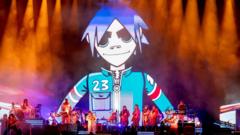
Executing a single-destination stadium concert introduces operational risks and financial variables that differ fundamentally from a multi-city touring campaign. When Gorillaz staged their massive, one-off stadium performance, the production bypassed the traditional cost-amortization models that sustain standard tours. In a typical touring structure, fixed costs—such as stage design, engineering blueprints, visual rendering, and initial rehearsals—are distributed across fifteen to forty dates. A single-occupancy stadium event forces the entire fixed-cost burden onto a solitary evening's box office revenue. To achieve profitability and maintain performance quality under these constraints, management must optimize three core operational variables: spatial-audio synchronization, localized supply-chain logistics, and multi-performer integration.
The Fixed Cost Compression Framework
The economic architecture of a one-off stadium show requires a compressed financial model. In standard touring, the total cost function ($C_{total}$) is expressed as:
$$C_{total} = F + vN$$
Where $F$ represents fixed preparation costs, $v$ represents variable costs per show, and $N$ represents the number of shows. When $N = 1$, the fixed costs ($F$) cannot be diluted, requiring a highly aggressive revenue generation strategy or an ultra-efficient operational blueprint.
Capital Allocation Shifting
Because fixed assets cannot be depreciated over time, capital allocation shifts heavily toward immediate infrastructure. Standard tours invest in lightweight, highly transportable steel rigs designed for rapid assembly and teardown. A one-off event, conversely, relies on local infrastructure procurement. Renting regional staging assets reduces transport overhead but introduces variable engineering tolerances. Technicians must calibrate the artists' specific visual and audio demands to a physical structure they have not tested on previous tour stops.
The Single-Point Failure Hazard
A multi-date tour allows for iterative optimization; logistical errors on night one inform corrections on night two. A single-destination stadium event offers no such grace period. A single critical failure—such as a primary server crash hosting the video elements or a customs delay on specialized backline equipment—results in immediate cancellation without the possibility of making up lost revenue on subsequent dates. The risk mitigation strategy requires complete redundancy across all primary technical lines, effectively doubling the infrastructure footprint behind the scenes.
Spatial Audio Engineering in High-Volume Enclosures
Stadium acoustics present a hostile environment for complex, multi-layered musical arrangements. The presence of expansive concrete surfaces, open-air wind currents, and massive physical distances creates severe acoustic reflection and signal degradation. For an act like Gorillaz, which blends acoustic drums, electronic sub-bass, live choral elements, and spoken-word guest vocals, the primary technical challenge is maintaining transient clarity while preventing low-frequency accumulation.
Managing Phase Cancellation and Time Alignment
Sound travels at approximately 343 meters per second. In a stadium measuring 150 meters from the stage to the rear seats, audio originating from the main stage speakers takes over 400 milliseconds to reach the furthest audience members. If delay towers are deployed to boost volume in the back rows without precise time-calibration, the sound from the main stage will arrive later than the sound from the delay towers, causing catastrophic phase cancellation and a muddy acoustic experience.
To solve this, audio engineers map the venue using predictive three-dimensional acoustic modeling software. They divide the stadium into discrete zones, introducing digital delays measured in milliseconds to every speaker array moving backward from the stage. This ensures that the acoustic wavefront expands outward as a single, coherent wave, preserving the sharp attack of the percussion and the intelligibility of the vocals.
Low-Frequency Directional Control
Standard subwoofers emit sound omnidirectionally, sending massive amounts of low-frequency energy backward onto the stage. This creates an acoustic feedback loop that interferes with the musicians' monitors and degrades the front-of-house mix. Engineers counter this by deploying cardioid subwoofer arrays. By spacing subwoofer enclosures at precise physical intervals and applying inverted electronic delays to the rear-facing units, they cancel out the sound waves traveling backward while reinforcing the bass frequencies projected toward the audience.
Logistical Orchestration of Guest Artist Rosters
The creative identity of Gorillaz relies on a rotating collective of guest performers spanning diverse genres. Managing a high-density lineup of external talent for a single performance introduces human-resource and logistical bottlenecks that can destabilize the event's timeline.
Rehearsal Compression Dynamics
On a standard tour, guest artists join for specific legs or are replaced by pre-recorded stems and synchronized video elements. For a high-profile, one-off stadium event, the expectation is a high concentration of live appearances. This compresses the rehearsal schedule into a narrow window, often spanning just forty-eight to seventy-two hours before showtime.
The production team manages this by implementing a modular rehearsal system. The core band rehearses the foundational tracks independently weeks in advance. Guest artists are then integrated in isolated, time-blocked segments. This minimizes downtime for the main band and ensures that high-value guest performers are utilized efficiently without exhausting the production staff.
Backstage Infrastructure Expansion
The presence of dozens of distinct performers requires an exponential expansion of backstage infrastructure. Each guest artist brings independent management, security, and styling personnel. The production team must build a temporary backstage ecosystem, converting stadium locker rooms and auxiliary spaces into discrete operational zones.
- Zonal Access Control: Standard security passes are insufficient. The production utilizes color-coded, RFID-enabled credentials to regulate flow between the main stage, quick-change wings, and private dressing quarters, preventing overcrowding in critical performance funnels.
- Technical Input Agility: The monitoring engineer must manage dozens of unique in-ear monitor mixes. A master digital console matrix is required to instantly recall specific equalization and volume preferences as different artists rotate onto the stage, eliminating manual adjustments during the performance.
Synchronizing Physical and Virtual Realities
The defining operational characteristic of Gorillaz is the duality between the live musicians and the virtual, animated personas that represent the band. This requires absolute synchronization between the physical performance on stage and the high-resolution visual assets displayed on massive stadium screens.
Master Timecode Architecture
To prevent discrepancies between the live music and the pre-rendered animations, the entire show runs on a unified master timecode system, typically utilizing SMPTE (Society of Motion Picture and Television Engineers) timecode. The timecode acts as a digital heartbeat, distributed simultaneously to:
- The Lighting Console: Triggering specific cues, color shifts, and strobe sequences precisely on the beat.
- The Video Servers: Advancing the animated narrative frames in perfect lockstep with the musical arrangement.
- The Musicians' Click Tracks: Delivering a metronome pulse to the drummer and musical director to ensure the live tempo never drifts from the pre-rendered video rate.
Structural Bottlenecks of Timecode Reliance
While timecode ensures visual precision, it introduces artistic rigidity. If a performer wishes to extend a chorus, improvise a solo, or interact spontaneously with the crowd, they cannot do so without breaking synchronization with the automated video playback. The production must build explicit "vamp loops" into the timecode sequence—designated sections where the video and lighting loops repeat indefinitely until the musical director manually triggers the next linear timecode block.
Strategic Recommendation for Future One-Off Formats
To mitigate the financial volatility and operational stress inherent in the one-off stadium model, future productions should transition toward a localized residency framework. Instead of mounting a single performance in a primary market, operations should scale to a three-to-five-night run within the same venue.
This adjustment keeps fixed preparation costs constant while distributing them across a larger revenue base, significantly lowering the financial break-even point per night. Furthermore, it allows the technical crew to optimize audio propagation and visual synchronization based on real-world data gathered during night one, guaranteeing maximum production quality for the remainder of the engagement.