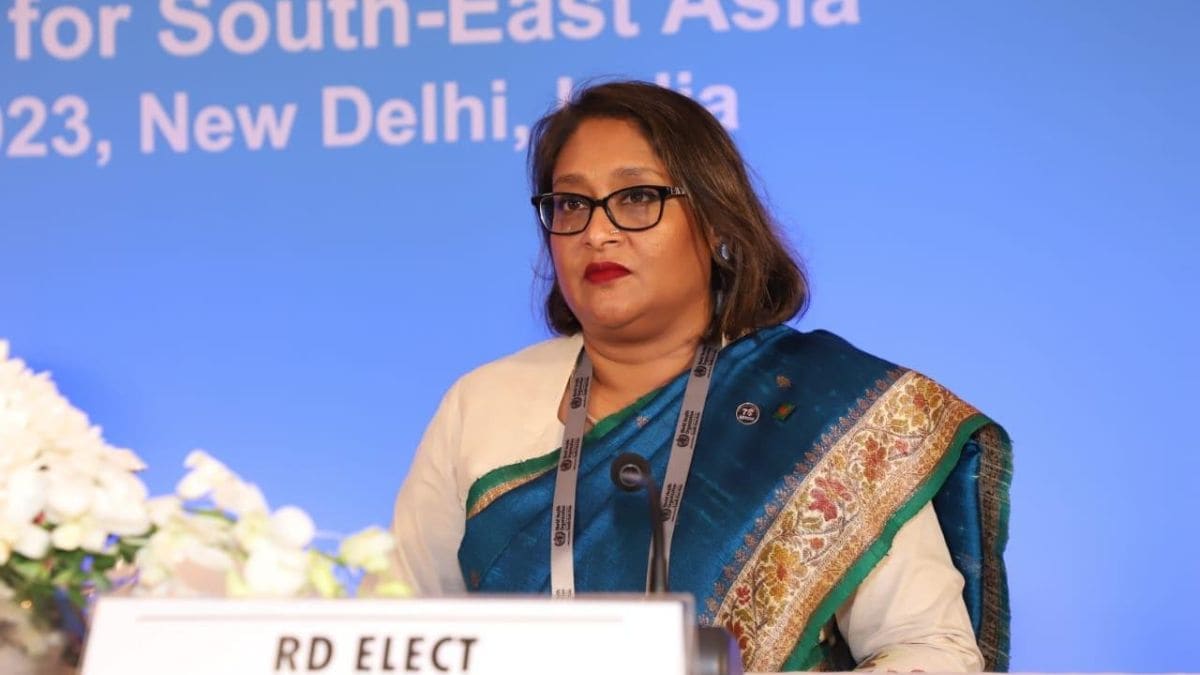
Institutional governance relies on a delicate balance between sovereign political influence and multilateral administrative compliance, a equilibrium that shatters when domestic regimes undergo abrupt systemic failure. The resignation of Saima Wazed as the World Health Organization Regional Director for South-East Asia exposes the structural fragilities inherent in international body appointments when backstopped by dynastic political capital. Deconstructing this administrative crisis requires examining the convergence of state-level anti-corruption mechanisms, internal United Nations disciplinary procedures, and the friction points of bureaucratic accountability.
The timeline of the crisis highlights the systemic delay between political shocks at the state level and operational interventions within multilateral agencies. Following the ouster of Bangladeshi Prime Minister Sheikh Hasina in August 2024, the subsequent interim administration initiated broad legal reviews of aligned political figures. By March 2025, the Anti-Corruption Commission of Bangladesh filed formal charges encompassing forgery, fraud, and misuse of power against Wazed. This external legal shock forced an internal administrative response from the World Health Organization, which transitioned Wazed to unpaid administrative leave by July 2025.
Multilateral organizations operate under rigid immunities and internal oversight mandates that rarely interface cleanly with sudden national regime changes. When the World Health Organization leadership evaluated the exposure, the organization confronted a triad of formal administrative accusations that formed the baseline of the disciplinary inquiry:
- Financial irregularities centered on a contested reimbursement claim regarding official travel to China, valued at approximately nine hundred dollars.
- Qualifications scrutiny regarding academic credentials submitted during the initial 2024 candidature phase, specifically challenging the classification of honorary recognitions versus earned doctorates.
- Property acquisition compliance concerning real estate holdings in Bangladesh obtained prior to her multilateral tenure but scrutinized under state-level asset recovery statutes.
The defense architecture deployed by legal counsel representing Wazed attempted to isolate each allegation into minor administrative variance or external political persecution. On the travel expense dispute, the defense framed the discrepancy as a clerical error executed by a junior assistant handling routine processing. Regarding academic credentials, the defense asserted complete transparency with the Director-General regarding her professional background in developmental psychology and public advocacy. Concerning the contested land acquisition, legal filings argued statutory protection under domestic laws designated for families of foundational state leaders.
Despite these defenses, the structural cost function of maintaining an executive on indefinite unpaid leave created an untenable operational deadlock for both parties. For the multilateral agency, an absentee regional head governing a sector comprising over two billion individuals compromises regional disease surveillance, emergency response coordination, and policy adaptation. For the individual, nearly a year of zero remuneration combined with blocked internal investigation requests transformed the administrative suspension into an enforced financial and professional attrition.
The terminal phase of the tenure culminated in a resignation letter directed to WHO Director-General Tedros Adhanom Ghebreyesus, marked by a formal declaration of institutional distrust. Rather than bowing to a forthcoming formal removal process—which internal sources indicated was slated to initiate structural nominations and a fresh electoral cycle—Wazed elected to frame her departure around retaliatory administrative overreach and institutional bias. This tactical maneuver reframes her exit from a dismissal driven by corruption charges to a contested severance driven by institutional governance failures.
The mechanics of this crisis offer clear predictive indicators for future multilateral appointments tied to dynastic or politically volatile state actors. When home-state political protection evaporates, international civil servants lose both their informal lobbying leverage and their shield against domestic legal exposure. International organizations must therefore institute real-time vetting filters that decouple regional executive legitimacy from the shifting political fortunes of appointing sovereign states, ensuring operational continuity independent of geopolitical shocks.