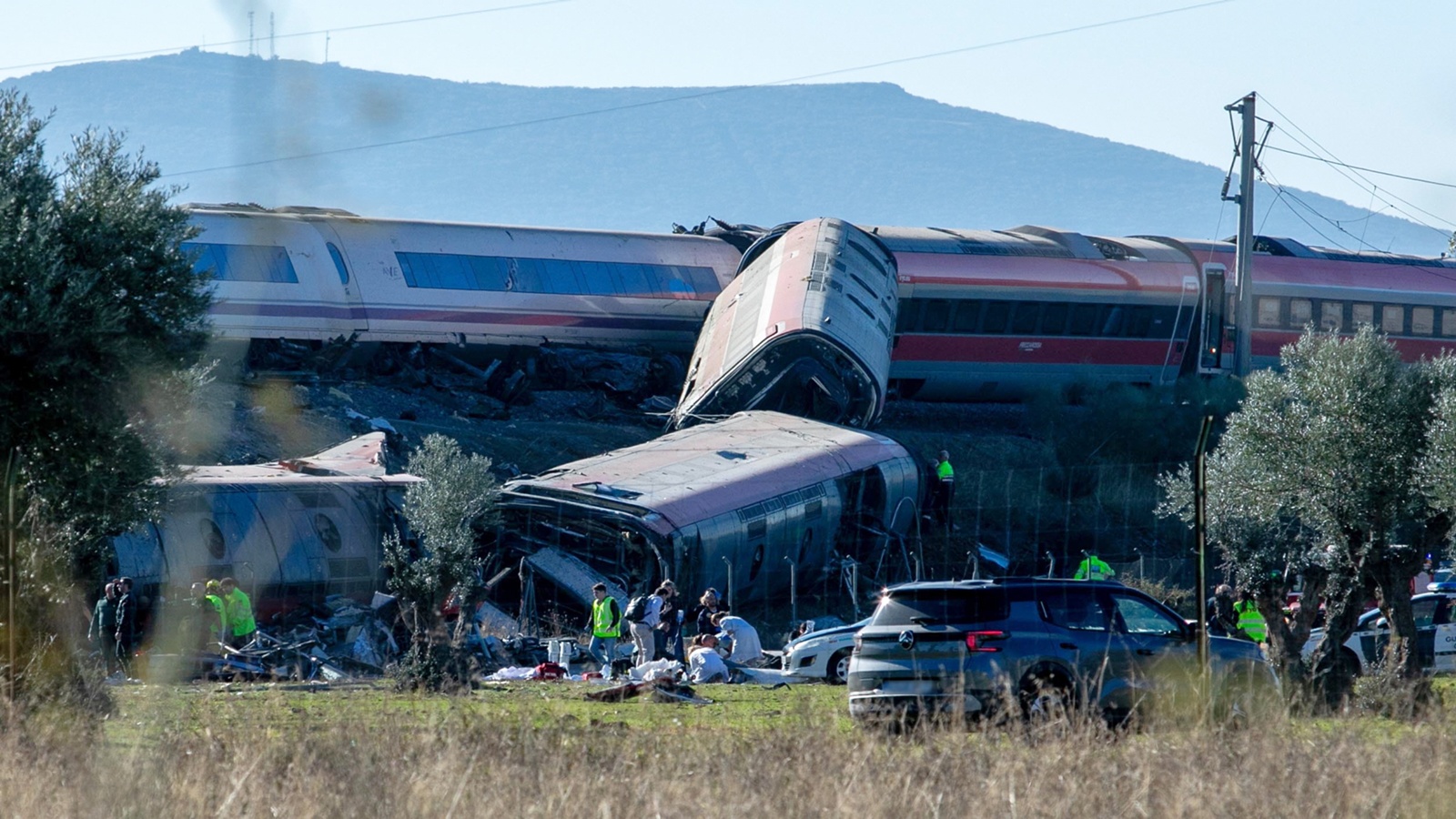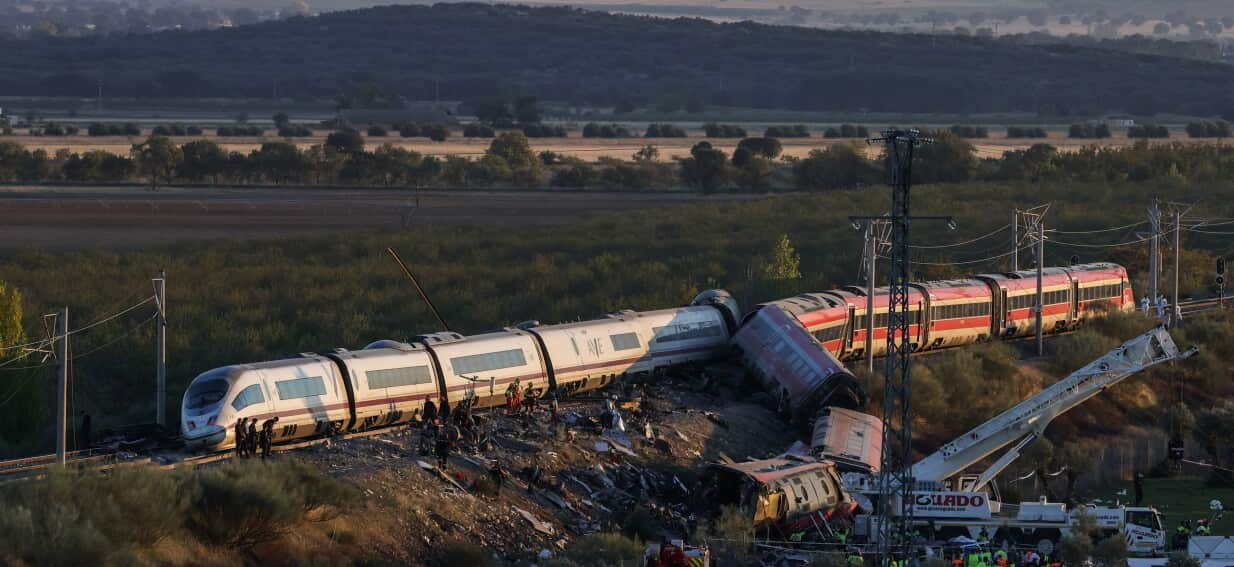
High-speed rail systems operate on razor-thin margins of error where kinetic energy scales exponentially with velocity, turning minor mechanical or human deviations into catastrophic structural failures. When a high-speed train derails at operational speeds exceeding 200 kilometers per hour, the resulting loss of life—such as the tragedy in Spain claiming at least 68 lives—is rarely the result of a single isolated error. Instead, it represents the convergence of systemic vulnerabilities across infrastructure signaling, rolling stock physics, and human-machine interface protocols. Understanding this event requires stripping away emotional reporting to examine the failure modes of modern rail transit, the physics of high-velocity derailment, and the institutional response mechanisms triggered when a premier transportation network suffers a mass-casualty breakdown.
The Physics of High-Velocity Derailment
To understand the lethality of a high-speed rail crash, one must examine the kinetic energy formula, $E_k = \frac{1}{2}mv^2$. Because velocity is squared, doubling a train's speed quadruples the kinetic energy that must be dissipated during an uncontrolled deceleration. Modern passenger trains carry tens of thousands of tons of mass; when that mass leaves the steel guideway at high speed, the energy transfer destroys passenger compartments within milliseconds.
Lateral Force and Curve Geometry
Rail vehicles rely on the conical geometry of steel wheels interacting with steel rails to self-center on straight tracks. When entering a curve, centrifugal force pushes the train outward. Track engineers counteract this through superelevation—banking the outer rail higher than the inner rail—and by calculating precise speed limits based on curve radius.
If a train enters a curved segment significantly above the engineered design speed, the lateral force exerted by the wheel flanges exceeds the restraining capacity of the railhead or overcomes the gravitational downward force holding the inner wheels to the track. This initiates one of two primary derailment mechanisms:
- Wheel Climb: The lateral-to-vertical force ratio ($L/V$) crosses a critical threshold, causing the outer wheel flange to ride up and over the top of the rail.
- Rollover: The center of gravity shifts outside the outer rail, causing the entire carriage to tip laterally before the wheels even leave the track bed.
Once the lead power car derails, the trailing articulated or coupled carriages experience violent jackknifing. The accordion effect compresses passenger zones, breaches structural survival spaces, and converts loose internal fixtures into high-velocity projectiles.
Systemic Failure Modes in Rail Signaling
Modern European rail networks, including Spain's extensive high-speed corridors, rely on layered safety architectures designed to eliminate single-point human failure. When a catastrophe of this magnitude occurs, forensic investigators immediately audit the interface between three distinct operational layers: trackside infrastructure, onboard train control systems, and human operators.
The Transition Zone Vulnerability
Rail networks frequently combine dedicated high-speed lines with legacy conventional tracks near urban centers or complex junctions. These transition zones represent the highest statistical risk profile in rail operations. Dedicated high-speed corridors typically utilize continuous cab signaling—such as the European Rail Traffic Management System (ERTMS) or Spain's LZB—which continuously transmits speed limits to the driver's console and automatically applies emergency brakes if the train exceeds the braking curve.
Legacy lines or transitional approaches often rely on intermittent signaling systems, such as Spain's ASFA (Anuncio de Señales y Frenado Automático). Intermittent systems only update the train's onboard computer when the locomotive passes over specific trackside beacons (balises). Between beacons, the system assumes compliance. If a train accelerates or fails to decelerate after passing a beacon, or if the transition between continuous and intermittent control is improperly mapped in the trackside database, a blind spot emerges. In that gap, human error goes unchecked until the kinetic threshold for survival has already been crossed.
Cognitive Overload and Automation Bias
As rail operations become increasingly automated, human drivers shift from active controllers to passive monitors. This creates a well-documented operational hazard known as automation bias: operators become conditioned to expect the system to intervene before a critical boundary is breached.
Simultaneously, cab environments concentrate multiple communication streams—radio dispatches, acoustic alerts, visual speed indicators, and trackside signage. During high-workload transitions, such as approaching a major terminal or navigating a speed restriction zone, an auditory distraction (such as an incoming dispatch call) can induce inattentional blindness. The operator misses a visual trackside marker, assumes the onboard automatic braking system is supervising the speed profile, and fails to initiate manual braking until the train enters a low-radius curve at full line speed.
The Three Pillars of Post-Crash Crisis Management
When a mass-casualty rail disaster occurs, the state and the rail operator execute a standardized, high-pressure crisis protocol. While public communication focuses on national mourning, operational teams divide their response into three distinct, parallel workstreams: acute triage, forensic preservation, and network stabilization.
1. Acute Triage and Extraction Logistics
The immediate priority at the crash site is resolving the golden hour constraint under severe structural hazards. Derailments destroy overhead catenary wires carrying 25,000 volts of alternating current. Before heavy rescue equipment can approach twisted aluminum and steel carriages, utility teams must confirm the de-energization and grounding of the traction power grid.
Once the site is electrically safe, emergency responders establish a three-tier triage perimeter:
- Immediate Extraction: Deploying hydraulic spreaders and heavy cranes to lift derailed carriages off trapped survivors, prioritizing structural stabilization to prevent secondary collapses during lifting operations.
- Field Stabilization: Establishing forward medical posts adjacent to the right-of-way to manage crush syndrome, severe hemorrhage, and traumatic amputations before transport.
- Hospital Load Balancing: Distributing casualties across regional trauma centers rather than overwhelming the nearest municipal hospital, preventing localized medical system collapse.
2. Forensic Preservation and Data Recovery
Simultaneously, judicial authorities and independent rail accident investigation commissions lock down the site to preserve perishable evidence. Unlike aviation disasters, where wreckage is often scattered over miles, rail derailments concentrate debris within a tight linear corridor, complicating the separation of rescue operations from forensic documentation.
Investigators prioritize securing the Juridical Recording Unit (JRU)—the rail equivalent of an aircraft's black box. The JRU logs millisecond-by-millisecond telemetry: wheel rotation speed, throttle position, brake pipe pressure, signal aspect acknowledgments, and cab audio. Alongside the JRU, forensic teams extract data logs from trackside interlocking cabinets to verify whether the signaling infrastructure transmitted accurate speed commands or suffered a hardware fault.
3. Network Stabilization and Contagion Control
A major derailment immediately severs a critical economic artery. Rail operators must isolate the affected corridor while preventing cascading delays across the national grid. Dispatchers reroute long-distance traffic onto parallel conventional lines, institute bus bridges around the severed segment, and manage rolling stock imbalances caused by trains trapped on either side of the blockage.
At the corporate and governmental levels, public mourning periods serve a dual purpose: they acknowledge the collective psychological shock of a mass-casualty event in a system perceived as ultra-safe, while creating a structured window to manage public expectations before preliminary technical findings are legally permitted for release.
Economic and Reputational Fallout
High-speed rail networks require massive capital expenditure and rely on sustained high load factors to amortize construction costs. Safety is the foundational value proposition that allows high-speed trains to capture market share from short-haul aviation.
A catastrophic crash disrupts this economic equilibrium through three direct channels:
- Demand Shock: In the immediate aftermath, passenger bookings drop sharply as travelers shift back to air or road transport, compressing operating margins on the network's most profitable routes.
- Insurance and Liability Exposure: State-backed operators and infrastructure managers face tens of millions of euros in immediate statutory compensation payouts, followed by multi-year civil litigation over gross negligence if systemic safety gaps are uncovered.
- Capital Expenditure Reallocation: To restore public confidence and satisfy regulatory mandates, transport ministries are forced to divert capital from network expansion projects into accelerated retrofitting—installing continuous automatic train protection across legacy transition zones and upgrading onboard cab monitoring systems.
Strategic Mandates for Rail Infrastructure Operators
Preventing the recurrence of high-velocity derailments requires eliminating the architectural gaps between human supervision and automated enforcement. Operators and transport regulators must execute three specific technical upgrades across all high-speed and mixed-traffic corridors:
- Eliminate Intermittent Signaling on High-Speed Approaches: Transition zones where trains decelerate from high-speed lines into conventional terminals must be fully equipped with continuous speed-supervision systems (such as ETCS Level 2). Relying on spot-transmission beacons in areas requiring steep braking curves leaves an unacceptable margin for human error.
- Enforce Sterile Cab Protocols: Adapt aviation's sterile cockpit rules to rail operations. All non-essential radio communications from dispatch centers must be automatically suppressed by the signaling network whenever a train is within five kilometers of a major speed reduction, junction, or signaling transition.
- Deploy Automated Cab Distraction Monitoring: Integrate non-intrusive optical sensors and dead-man vigilance systems that monitor operator gaze and responsiveness during active braking phases, triggering an automatic graduated brake application if the driver fails to acknowledge a speed restriction within two seconds of visual alert presentation.