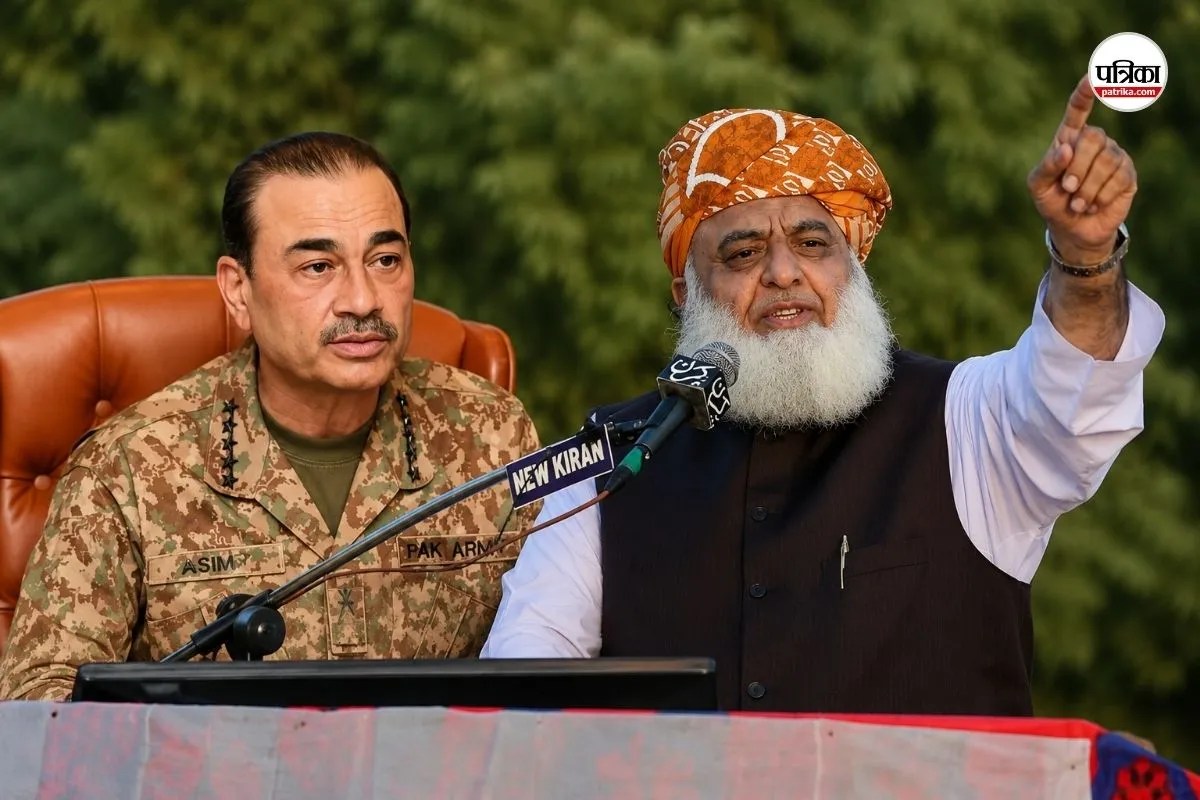
The traditional structural equilibrium of Pakistani politics relies on a predictable distribution of friction: mainstream civilian parties posture against the military establishment, while religious factions act as structural stabilizers or tactical proxies for the General Headquarters (GHQ) in Rawalpindi. The public ultimatum delivered by Jamiat Ulema-e-Islam-Fazl (JUI-F) chief Maulana Fazlur Rehman to Army Chief Field Marshal Asim Munir—demanding he shed his uniform, establish a political entity, and test his actual popularity at the ballot box—breaks this long-standing operational model.
This confrontation is not mere political rhetoric. It signals a deep structural crisis within the Pakistani state machinery. When the foundational leader of the country's most entrenched Deobandi clerical network shifts from institutional alignment to open defiance, it indicates that the military's current strategy of civil-military synthesis has reached its breaking point.
The Tri-Border Network: Quantifying JUI-F’s Structural Leverage
To understand why a public challenge from Rehman carries more systemic risk for the military than protests from mainstream secular parties, one must analyze the JUI-F through an operational lens. Mainstream parties rely on fluctuating urban voter turnouts and superficial media campaigns. In contrast, Rehman commands a deep, self-sustaining socio-religious infrastructure.
The Madrassa Infrastructure as a Political Base
The operational core of JUI-F’s power is its vast network of Deobandi seminaries (madrassas) concentrated across the strategic borderlands of Khyber Pakhtunkhwa (KP) and Balochistan. This infrastructure functions as a highly disciplined political mechanism characterized by specific operational traits:
- Insulated Mobilization Channels: The student and alumni networks of these madrassas provide Rehman with an independent mobilization capability that bypasses state media bans or digital blockades.
- Transnational Ideological Affiliation: Rehman's network has historically provided the ideological and educational foundation for the Afghan Taliban. Many senior figures in Kabul graduated from JUI-affiliated institutions like Darul Uloom Haqqania.
- Cross-Border Geopolitical Weight: Because of these deep ties, Rehman operates as a critical informal diplomatic channel between Islamabad and Kabul. This gives him unique international leverage that typical civilian politicians lack.
The Borderland Electoral Geographies
JUI-F's electoral strength is structurally optimized for the complex security layout of Pakistan's periphery. By winning seats in Pashtun-majority regions and strategic nodes of Balochistan, the party controls the exact geographic corridors where the Pakistani state’s sovereign control is most heavily contested.
The Cost Function of State Delegated Security
The immediate catalyst for Rehman’s direct pushback was the military establishment’s public appeal urging civilian populations to form local militias (Lashkars) and take up arms to counter the resurgence of the Tehreek-e-Taliban Pakistan (TTP) and regional insurgencies. From a strategic perspective, Rehman’s sharp refusal exposes a fatal flaw in the state’s counterterrorism framework.
The Failure of the Sovereign Defense Monopoly
When a state requests its citizens to form private militias, it formally admits that its formal security apparatus can no longer maintain a monopoly on the legitimate use of force. Rehman exposed this institutional failure by analyzing the financial and structural contracts binding the citizen to the state:
$$\text{Tax Extraction} \rightarrow \text{State Budget Allocations} \rightarrow \text{Institutional Defense Monopoly}$$
Rehman dismantled the military's narrative by pointing out that the civilian population pays taxes explicitly to fund a professional standing army. Outsourcing kinetic combat to under-equipped civilian militias while continuing to extract economic resources is an unsustainable strategy.
The Mechanism of Local Vendetta Cycles
Rehman’s strategic warning focused heavily on the long-term destabilization caused by state-sponsored civilian arming. In tribal and peripheral societies, introducing state-backed irregular militias triggers a toxic transformation:
$$\text{Ideological/State Conflict} \longrightarrow \text{Inter-Tribal and Inter-Generational Vendettas}$$
Once counter-insurgency tasks are delegated to civilian factions, local conflicts stop being about state security and mutate into highly personalized feuds over land, resource access, and historical grievances. The military leadership eventually rotates out of the conflict zone, leaving local communities trapped in self-perpetuating cycles of violence that outlast the initial insurgency.
Territorial Fragmentation: Assessing State Atrophy in Balochistan
A central pillar of Rehman’s public critique is his explicit confirmation that the Pakistani state has lost effective territorial control over large swaths of Balochistan. While mainstream state media systematically downplays the extent of the crisis, an objective security assessment validates the structural collapse he describes.
[State Sovereignty Lifecycle in the Periphery]

   Kinetic Military Sweep
             │
             ▼
   Temporary Area Cleared
             │
             ▼
   Inability to Establish Civil Governance
             │
             ▼
   Insurgent Shadow Administration Re-entry
             │
             ▼
   Complete Loss of Territorial Writ
This structural decay follows a predictable, repeating cycle. The military relies on kinetic operations—such as sweeps, checkpoints, and heavy deployments—to temporarily disrupt insurgent activity. However, because the state fails to establish legitimate, functioning civilian governance or provide basic economic security, it cannot maintain these gains. As a result, insurgent groups easily re-enter these zones and set up shadow administrations, leading to a total loss of government authority.
Rehman’s warnings about this systemic breakdown carry immense weight because his own political apparatus operates directly within these contested areas. When an elite political actor publicly states that the government's authority is hollowed out, it signals to local populations and regional rivals that the military's strategy of maintaining control through force alone has failed.
The Civil-Military Bottleneck: The Cost of Formalized Intervention
The fundamental driver behind the growing friction between traditional politicians like Rehman and the military high command is the formalization of the army's role in civilian administration. Under Field Marshal Asim Munir, the military has shifted from exercising indirect influence to directly taking over core civilian policy portfolios.
The Dilution of Strategic Focus
The military's expanding presence in civilian governance—marked by its formal inclusion in economic, agricultural, and demographic committees—creates a severe institutional bottleneck. This aggressive expansion produces two distinct vulnerabilities:
- Diminishing Returns on Defense Capabilities: As the high command devotes significant intellectual, organizational, and personnel resources to managing complex civilian issues like economic planning and population growth, its focus on core defense duties naturally declines.
- Total Exposure to Governance Failures: Historically, the military protected its elite status by operating behind a civilian facade, allowing puppet governments to take the blame for economic and social crises. By stepping directly into the administrative driver's seat, the military establishment inherits full public accountability for policy failures, inflation, and administrative collapse.
This systemic exposure explains why Rehman's dare to "take off the uniform and contest elections" is so effective. It cuts right through the military's carefully constructed narrative of superior administrative competence. Rehman forces a stark logical realization: if the army chief wishes to exercise absolute executive authority over civilian policy, he must submit to the same democratic survival metrics as traditional politicians.
Strategic Forecast: The Collapse of Managed Democracy
The open rebellion of JUI-F against the military establishment indicates a coming structural shift in Pakistan's political landscape. For decades, the military maintained its dominance by manipulating a fragmented political ecosystem, using religious parties to counter secular nationalists, and vice versa.
Rehman's refusal to play his assigned role as a stabilizing proxy reveals that the military's strategy of "managed democracy" is running out of options. With the mainstream urban opposition already alienated, the military cannot afford a simultaneous, long-term confrontation with the country's most powerful religious networks.
As security conditions worsen along the western border and economic challenges mount, the military will face a critical decision. It must either double down on outright authoritarian control, which risks further destabilizing the country's periphery, or orchestrate a genuine, painful retreat from civilian administration back to its traditional defense mandate.