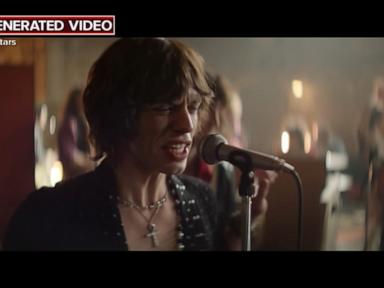
The Rolling Stones’ integration of generative artificial intelligence in their recent visual media represents a strategic pivot from traditional high-cost physical production to a scalable, data-driven brand extension. This is not a creative whim; it is an exercise in managing the Legacy Asset Lifecycle. When a band enters its seventh decade, the primary business constraint is the physical availability and aging of the human principals. Generative AI solves this bottleneck by decoupling the band’s iconic visual identity—the "Stones" brand—from the physical limitations of Mick Jagger, Keith Richards, and Ronnie Wood.
The Economic Logic of Generative Music Videos
The decision to utilize AI-generated imagery in music videos serves three distinct commercial functions that traditional cinematography cannot match: Also making waves recently: Why Flock Surveillance Cameras Are The Least Of Your Privacy Worries.
- Temporal Arbitrage: AI allows the brand to present "prime" versions of the artists (circa 1969–1972) without the uncanny valley risks associated with traditional CGI or de-aging VFX. By training models on specific archival datasets, the production team minimizes the Uncanny Valley Penalty, where audience revulsion typically tracks with high-but-imperfect realism.
- Asset Liquidity: Traditional video shoots require months of pre-production, physical sets, and high-intensity labor. Generative workflows convert these capital expenditures into operational expenditures, allowing for rapid iteration and the generation of infinite "b-roll" from a single prompt architecture.
- Cross-Generational Capture: By blending classic rock iconography with modern algorithmic textures, the band signals technical relevance to younger demographics who consume media through the lens of short-form, filter-heavy platforms like TikTok and Instagram.
Technical Mechanisms of the Stones AI Integration
The visual output seen in the Hackney Diamonds era suggests a synthesis of Diffusion Models and ControlNet-based Temporal Consistency. The primary challenge in music video production is maintaining "flicker-free" motion. Standard generative tools struggle with spatial coherence between frames. To bypass this, the production likely employs a hybrid pipeline:
- Source Reference Mapping: Using existing live-action footage of the band as a "bone structure" or wireframe.
- Latent Space Translation: Overlaying the generative style (whether it is neo-psychedelia or hyper-realism) onto the motion vectors of the original performance.
- Latent Consistency Models (LCMs): Reducing the sampling steps required to generate high-fidelity frames, which drastically cuts the render time and cost compared to traditional 3D rendering.
The result is a visual product that maintains the kinetic energy of a Jagger performance while shedding the costs associated with a physical shoot. The "Mess It Up" video, specifically featuring Nicholas Hoult, demonstrates this layering—using a younger actor as the physical vessel while the environment or secondary assets are manipulated via algorithmic tools to maintain the "Stones" aesthetic. Further insights on this are explored by Engadget.
The Brand Equity Paradox
Every time a legacy act uses AI, they engage in a high-risk trade-off between Authenticity Capital and Efficiency. The Rolling Stones have built their brand on "grit," "sweat," and "analog soul." AI is, by definition, a mathematical approximation—a "clean" derivative of "dirty" inputs.
This creates a structural tension. If the audience perceives the AI as a shortcut, the Authenticity Capital depreciates. However, if the AI is framed as a "New Tool for Old Masters," it reinforces the band’s status as pioneers. The Stones are effectively testing the elasticity of their brand: can the "Stones feel" exist independent of a human hand on a guitar or a physical camera lens?
The Three Pillars of Generative Artist Strategy
To understand why this specific video is a precursor for the entire music industry, we must categorize the strategy into three functional pillars:
I. The Archival Feed-Forward Loop
Legacy acts possess massive quantities of proprietary data (photos, concert films, studio outtakes). In the current market, this data is an underutilized asset. By feeding these archives into private LoRA (Low-Rank Adaptation) models, the Stones can "own" their digital likeness in a way that is mathematically distinct from public-domain AI models. This creates a legal and commercial moat.
II. Cost Function Compression
A traditional music video of the scale required for a global rollout typically costs between $200,000 and $1,000,000. By shifting the production into the generative space, the marginal cost of "complexity" drops to near zero. In a generative environment, rendering a flaming skyscraper costs the same as rendering a blank wall. This allows for a density of visual information that would otherwise be bankrupting.
III. The Synthetic Touring Model
The music video is the "Minimum Viable Product" for a larger strategic goal: synthetic residency. Following the success of ABBA Voyage, the Rolling Stones are likely using these AI-integrated videos as R&D for a permanent digital presence. If a video can successfully simulate the charisma of the band through a neural network, the barrier to a billion-dollar digital tour disappears.
Identified Bottlenecks and Risks
Despite the strategic advantages, the "AI-embrace" is not without friction. There are three primary bottlenecks currently limiting the total transition to algorithmic media:
- The Resolution Gap: While AI excels at 1080p or 4K textures, the temporal stability at high frame rates (60fps+) often breaks down, leading to "morphing" artifacts that break immersion.
- Intellectual Property Contagion: If the models used to create the video are trained on "stolen" or un-cleared data, the final music video becomes a liability. The Stones’ team must ensure a closed-loop data environment to protect the copyright of the final work.
- Emotional Compression: Current AI models are trained on the "average" of human expression. They often miss the micro-expressions—the "imperfections"—that make Keith Richards’ stage presence compelling. This "averaging effect" can result in a product that feels visually impressive but emotionally hollow.
The Shift from Creator to Curator
The role of the director in the Stones’ new music videos has fundamentally shifted. They are no longer managing lighting rigs; they are managing Prompt Weights and Seed Iterations. This represents a broader shift in the entertainment industry from direct creation to "Curated Selection." The director generates 1,000 variations of a scene and selects the one that best fits the brand’s "Legacy Vibe."
This transition demands a new set of KPIs (Key Performance Indicators) for music videos. Instead of measuring "Production Value" in terms of dollars spent on-screen, the industry will measure "Algorithmic Fidelity"—how accurately the AI captured the essence of the artist while minimizing artifacts.
Strategic Forecast: The Post-Physical Era
The Rolling Stones are not "using AI" because it is trendy; they are using it because they are the first generation of rock stars to face the reality of a post-physical career. The music video is the laboratory where the band is refining their digital ghosts.
The move signifies the end of the "Music Video as Documentation" and the beginning of the "Music Video as Generative Environment." In the next 24 to 36 months, expect the following developments based on the Stones' current trajectory:
- Dynamic Music Videos: Videos that change their visual style based on the viewer’s personal data or geographic location, powered by real-time generative engines.
- The Privatization of Likeness: Artists will begin licensing their "Model Weights" to fans or creators, turning their physical likeness into a tradable software asset.
- The Death of the "Hiatus": AI allows for the continuous release of high-quality visual content even when the band is not on tour or in the studio, maintaining a constant presence in the digital attention economy.
The Rolling Stones have survived by being more adaptable than their peers. By embracing AI, they are attempting to solve the final problem of the music business: the mortality of the performer. The strategic play is to transform the band from a group of humans into a permanent, algorithmic aesthetic that can generate revenue indefinitely.
The success of this transition will be determined not by the technology itself, but by the band's ability to maintain the "human" brand narrative while using a "machine" delivery system. This requires a precise calibration of the Human-to-AI Output Ratio, ensuring that the technology amplifies the legend rather than replacing it with a generic digital mask.