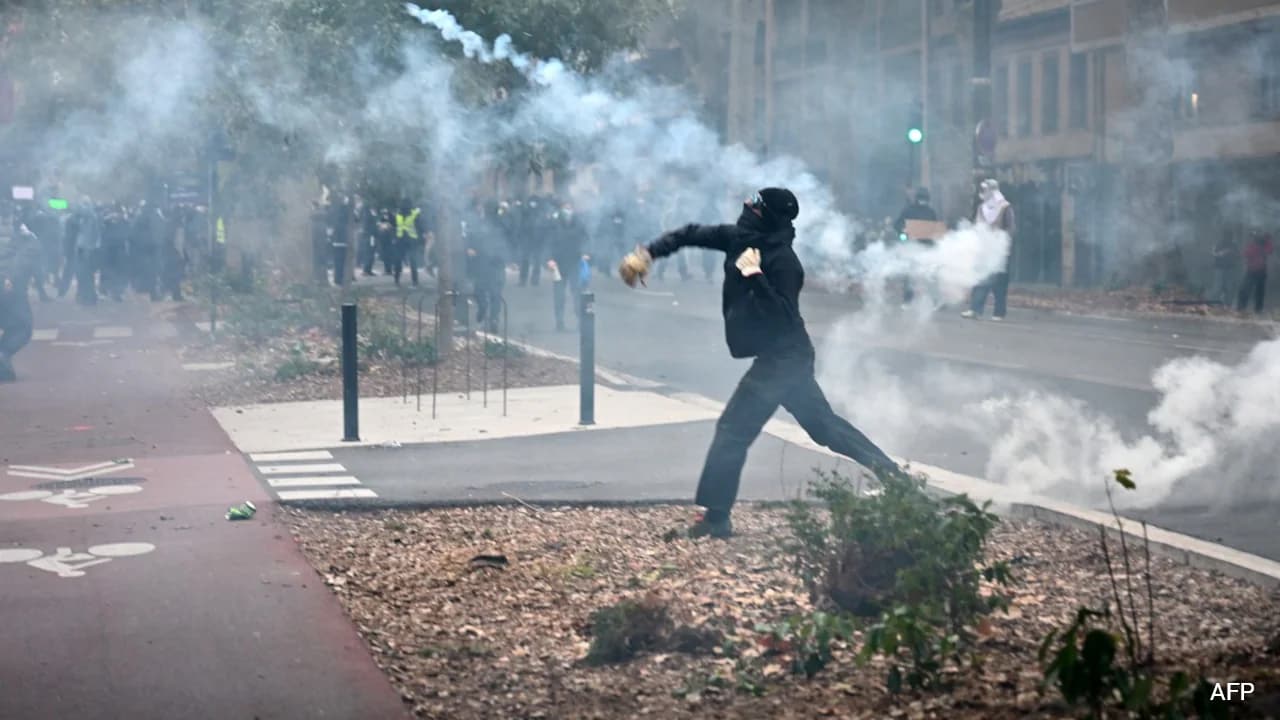
The smell of tear gas does not wash out of a wool coat. It clings to the fibers for days, a sharp, metallic reminder of what happens when a generation realizes the game was rigged before they even rolled the dice.
If you stood on the cobblestones of the Latin Quarter in Paris during the height of the student blockades, or watched the barricades go up outside campuses from Rennes to Toulouse, the headlines made it look like standard French theater. Young people angry. Police in riot gear. The government eventually blinking.
To dismiss those weeks of chaos as mere youthful rebellion is to miss the quiet, devastating heartbreak that fueled them. The students weren't throwing paving stones because they hated the state. They were throwing them because the state had reduced their entire adolescence—every late-night study session, every quiet sacrifice made by working-class parents, every wild ambition—into an opaque, merciless line of code.
For years, France promised its youth a sacred bargain. Pass the baccalauréat, the grueling national high school exit exam instituted by Napoleon himself, and the doors of higher education would swing open. It was a point of fierce egalitarian pride. Unlike the Ivy League checkbooks of America or the rigid tier systems of Britain, the French republic swore that a baker’s daughter from a sleepy village in Brittany had the exact same right to study law at the Sorbonne as a diplomat’s son from the sixteenth arrondissement.
Then came the algorithms.
First, there was Admission Post-Bac, known simply as APB. When it ran out of seats in popular majors like psychology, law, and sports science, it resorted to a literal lottery. Imagine spending eighteen years building a life, only to watch your future decided by a digital coin flip. The outrage was immediate, forcing the government to scrap APB in 2018 and replace it with a shiny new platform called Parcoursup.
Parcoursup was supposed to be the fix. Instead, it became a monster.
The Architecture of Anxiety
To understand why French teenagers eventually took to the streets in fury, you have to understand the psychological torture of the Parcoursup calendar. It is not merely a website; it is a season of collective dread that hijacks the spring of every senior year.
Consider a hypothetical student—let’s call her Léa—sitting at a battered kitchen table in a suburb outside Lyon. Léa has a solid B average. She works a weekend shift at a local bakery to help her single mother pay for heating. She dreams of becoming a nurse. Under the old republican promise, her baccalauréat was her golden ticket. Under Parcoursup, it is merely a suggestion.
In January, Léa logs onto the portal. She is allowed to select ten primary wishes, or vœux. She submits her grades, her teachers' evaluations, and a series of carefully agonized-over cover letters explaining why she deserves a seat in a public university. Then, she waits.
For months, the screen stays blank. While she is supposed to be preparing for the most important exams of her life, the anxiety hums in the background like a faulty fluorescent light. When May finally arrives, the results begin to trickle out—not all at once, not with clean clarity, but in a slow, agonizing drip.
En attente.
On the waitlist.
Léa refreshes the browser at six in the morning before school. She checks it under her desk during philosophy class. She stares at the glowing screen at midnight, watching her position on the waitlist tick down by three spots, then freeze, then inexplicably stall as thousands of other anxious teenagers across the country accept, decline, or hoard offers.
She is number 1,402 for a program with 120 seats.
What the algorithm actually does behind the curtain is a closely guarded secret. Unlike APB’s transparent, if absurd, lottery, Parcoursup empowers individual universities to rank applicants using local criteria—algorithms within the algorithm—whose exact weighting remains hidden from the public. Suddenly, the name of your high school matters. Your postal code matters. Whether your parents knew how to game the system by hiring private consultants to polish your application essays matters.
Selection, the great taboo of French higher education, had crept in through the back door, disguised as modernization.
When the Pressure Cooker Blows
I remember the exact moment the quiet despair of living under this system curdled into public rage. It wasn't during a grand political speech. It was on a gray Tuesday morning outside a university lecture hall, watching a nineteen-year-old boy with dark circles under his eyes tape a handwritten cardboard sign to an iron gate.
The sign didn't demand lower taxes or higher wages. It read: We are not lines of code.
When the protests erupted across France, spilling out of university courtyards and clashing violently with riot police in the streets, politicians on television spoke in sterile metrics. They cited demographic bulges—the simple, undeniable math that France had produced roughly 40,000 more high school graduates each year than its public universities had desks to hold. They argued, not without reason, that letting every student enroll in overcrowded first-year lectures had led to a catastrophic 60 percent failure rate. Something had to give. You cannot pour two liters of water into a one-liter bottle.
The officials were right about the math. They were catastrophically wrong about the soul.
By attempting to solve a funding and infrastructure crisis with a software patch, the government committed a cardinal sin of governance: it automated rejection while hiding the human hands responsible. When a student is rejected by a person, there is an argument to be had, a flaw to appeal, a system to challenge. When a student is rejected by a faceless digital queue that updates every morning at seven, the rejection feels cosmic, indisputable, and deeply personal.
The streets burned because the youth felt betrayed by the very adults who had preached meritocracy to them since kindergarten. They saw a system where elite preparatory schools—the classes préparatoires that funnel the children of the wealthy into the country's ruling Grandes Écoles—remained lavishly funded, receiving roughly three times as much public money per student as the crumbling public universities where the rest of France was forced to fight for scraps.
Trash bins blazed on boulevards. Lecture halls were occupied for weeks, turning academic buildings into makeshift communes where students debated constitutional law by candlelight while helicopters circled overhead. The violence that flared at the edges of these demonstrations—shattered bank windows, clouds of stinging gas, clashes between masked protesters and armored police—was ugly, terrifying, and exhaustively filmed by cable news networks.
Yet beneath the smoke lay a simple, undeniable truth. The government had lost control of the narrative, and worse, it had lost the trust of an entire generation.
The Anatomy of a Retreat
Governments rarely admit they are wrong; they announce "evolutions."
Facing paralyzing blockades, plummeting approval ratings, and the terrifying prospect of an entire academic year dissolving into chaos—which would have invalidated diplomas and stranded hundreds of thousands of young adults—the French Ministry of Higher Education finally blinked.
Officials stepped up to the microphones and promised to overhaul the admissions machinery. They pledged to scrap the hated mechanisms of the current system, open the black box of algorithmic selection, and build a new framework that restored transparency and human oversight to university placements.
It was a stunning capitulation, a rare moment where street pressure forced a modern bureaucracy to reconsider its reliance on automated sorting.
Skepticism, however, hangs over the promise like morning fog over the Seine. History teaches us that replacing an acronym is vastly easier than fixing the rot underneath it. When France killed APB and birthed Parcoursup, ministers promised the exact same things: fairness, clarity, an end to the nightmare. They merely traded a blunt lottery for an opaque sorting machine.
Consider what happens next if the root problem goes untouched. You can write the most elegant, transparent, compassionate admissions software on earth, and it will still break hearts if there are only ten chairs for fifteen qualified students.
For decades, successive French administrations expanded access to the baccalauréat—pushing the pass rate from roughly 30 percent in the 1980s to nearly 90 percent today—without building the lecture halls, hiring the professors, or funding the laboratories required to absorb that triumphant wave of ambition. They widened the funnel at the top and welded it shut at the bottom, then acted surprised when the pressure blew the pipes apart.
The Human Cost of Waiting
To really grasp the stakes of this promised reform, step away from the ministries in Paris and return to that kitchen table outside Lyon.
In the real world, the delay caused by a broken admissions portal isn't just an administrative hiccup. For a student from a low-income family, not knowing where you will be living in September until late August is a logistical catastrophe. Student housing in university towns like Bordeaux, Lille, or Montpellier evaporates in June. Rental deposits require guarantors. Financial aid applications cannot be finalized without an official enrollment certificate.
While wealthy families can casually sign a lease in Paris in May and eat the deposit if their child chooses another city, working-class families are paralyzed. Every week spent en attente on a government website narrows their options, forcing brilliant young minds to abandon their first-choice degrees simply because they cannot afford to wait for the algorithm to make up its mind. They settle for local community programs they never wanted, or drop out of the race entirely before the starting gun even fires.
That is the invisible violence of a bad system. It leaves no broken glass on the sidewalk and draws no television cameras, yet it quietly rearranges the future of a nation, sorting children back into the exact social classes they were trying to outgrow.
Beyond the Code
If France actually intends to keep its promise—not just to placate angry students until summer vacation cools their tempers, but to genuinely repair the broken bridge between high school and adulthood—the solution cannot live inside a server rack.
It requires abandoning the seductive lie that technology can substitute for political courage. Algorithms are magnificent at optimizing delivery routes and recommending movies. They are catastrophic when used to disguise scarcity as merit.
True reform means opening the books. If a university department uses specific criteria to rank applicants, those criteria must be published in plain French before a single application is filed. It means injecting real, living human beings back into the appeals process—counselors with the authority to look at a student's file, see the resilience behind a bumpy sophomore year, and override a cold mathematical score.
Above all, it means pouring concrete and hiring faculty. A republic that tells its children to dream big, and then meets those dreams with a loading screen and a riot shield, is living on borrowed time.
Late at night, long after the barricades are cleared and the street sweepers have washed the ash from the cobblestones, the quiet returns to the university districts. Somewhere in a small apartment, a seventeen-year-old is still awake, the blue light of a laptop illuminating their face, staring at a webpage and waiting for a machine to tell them what their life is worth.


