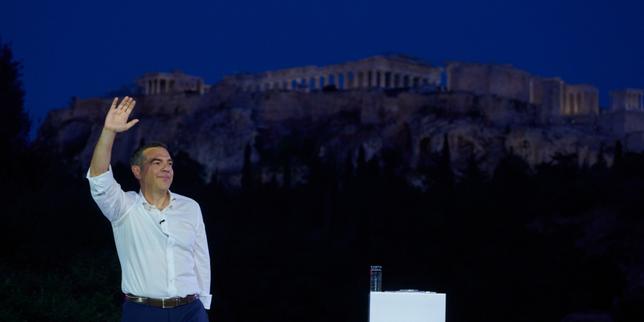
The European media is falling for the same old narrative. Alexis Tsipras is launching a new political project in Greece, and observers are dusting off the old playbook. They call him the "providential man" of the Greek left. They wonder if he can recreate the magic of 2015, heal a fractured progressive movement, and mount a serious challenge to Kyriakos Mitsotakis.
It is a comforting story. It is also entirely wrong.
The premise that Greece needs a resurrected leftist savior to balance its political ecosystem misunderstands the structural reality of the country's economy and European constraints. Tsipras is not the solution to the Greek left’s irrelevance; he is the architect of it. Launching a new party is not a bold forward march. It is a desperate branding exercise by a politician who ran out of ideas a decade ago.
The mainstream press views this through the lens of horse-race politics. Let us look at it through the lens of economic reality.
The 2015 Trauma Was Not a Strategic Retreat
To understand why a Tsipras comeback is dead on arrival, we have to dismantle the revisionist history surrounding his tenure as Prime Minister. The prevailing narrative among sympathetic commentators is that Syriza's 2015 capitulation to the Troika—the European Commission, European Central Bank, and International Monetary Fund—was a tragic, necessary compromise. The story goes that Tsipras looked into the abyss of a Drachma exit, chose maturity over martyrdom, and managed the austerity program with a "human face."
This is pure fiction.
What happened in 2015 was not a calculated retreat; it was an intellectual bankruptcy. The Syriza government spent months banking on the assumption that European authorities would blink if faced with the threat of a systemic Eurozone meltdown. When the Eurogroup, led by Germany’s Wolfgang Schäuble, made it clear they were perfectly willing to cut Greece loose, Tsipras had no plan B.
Imagine a scenario where a corporate CEO stakes the entire company's survival on a single negotiation, fails to read the adversary's leverage, signs a deal worse than the predecessor’s, and then asks shareholders to celebrate his pragmatism. That CEO would be ousted, not heralded as a future savior.
By signing the Third Economic Adjustment Programme, Tsipras did something far more damaging than just adopting austerity. He codified the idea that there is no alternative. He normalized the exact policies he was elected to destroy. The subsequent crushing defeats of Syriza in 2019 and 2023 were not flukes. They were the natural consequence of an electorate realizing that the radical left, when handed power, operates exactly like the center-right, only with worse administrative competence.
The Flawed Premise of the "Providential Leader"
The media loves a comeback story because personality-driven journalism is easy. It is much simpler to profile a charismatic 50-year-old leader than it is to analyze structural deficits or the shifting dynamics of the Greek labor market.
This focus on the "man of destiny" ignores how political movements actually build power. Syriza did not rise in the early 2010s because Alexis Tsipras was a generational communicator. It rose because the Greek middle class was obliterated in a matter of months, Pasok collapsed under the weight of its own corruption, and the social fabric was tearing apart. Tsipras was the beneficiary of a historical tectonic shift, not the cause of it.
Today, those conditions do not exist. Greece is not in a state of acute, chaotic collapse. Instead, it is locked in a state of stagnant stabilization.
- Growth is surface-level: GDP numbers look better on paper, driven by tourism and real estate investments, even if real wages remain painfully low.
- The electorate is exhausted: The Greek public is no longer looking for a grand ideological crusade. They are looking for basic competence, predictable governance, and lower inflation.
- The fragmentation is permanent: The current splintering of the Greek left into Syriza, Pasok, New Left, and various Marxist micro-parties is not a temporary disagreement that a charismatic leader can fix. It is a permanent divorce over the very definition of what opposition looks like.
When a politician tries to build a party around his personal brand rather than a distinct social class or a coherent economic theory, it invariably turns into a vanity project. We have seen this play out across Europe. Look at Matteo Renzi in Italy or Benoît Hamon in France. They leave their parent parties, declare themselves the new center of gravity, and end up polling in the low single digits. Tsipras is repeating a failed script.
The Eurozone Straitjacket Cannot Be Charismad Away
Let us address the core question that every commentator avoids: What would a new Tsipras party actually do differently?
The reality of governing a Eurozone nation with a public debt-to-GDP ratio hovering around 160% is that your fiscal policy is largely written for you in Brussels and Frankfurt. The European fiscal rules, reinforced by the post-pandemic economic governance framework, leave virtually zero room for the kind of sweeping, transformative public investment programs that traditional leftist parties promise.
If Tsipras takes power again, he faces the exact same constraints:
- Primary Surplus Targets: Greece is locked into generating consistent primary surpluses to service its debt. Every Euro spent on social welfare must be matched by a Euro collected in taxes or cut from elsewhere.
- Market Discipline: The moment a Greek government hints at defying fiscal targets, borrowing costs spike. The country only recently regained its investment-grade credit rating. No Greek prime minister, left or right, will risk throwing that away and triggering a capital flight.
- Lack of Monetary Tools: Without control over currency or monetary policy, domestic economic engineering is limited to supply-side tweaks and tax structures.
Therefore, any new party launched by Tsipras will inevitably be a center-left, technocratic entity disguised in progressive rhetoric. It will promise "better management" of the existing system rather than a challenge to it. But if the goal is simply competent, market-friendly management within European parameters, the Greek electorate already has an incumbent who does that exceptionally well: Kyriakos Mitsotakis.
Mitsotakis does not win because Greeks are passionately in love with neoliberalism. He wins because he represents stability to a society traumatized by the volatility of the Tsipras years. Expecting voters to abandon the original manager of stability for a reformed radical who claims he can manage the same stability better is a profound miscalculation.
Stop Trying to Revive 2015
The obsession with Tsipras reveals a deeper malaise within European political analysis. There is a refusal to accept that certain political brands are spent.
I have watched political operations blow millions of Euros trying to re-engineer washed-up leaders, convinced that a new logo, a fresh social media strategy, and a vague manifesto about "social justice" can wipe the slate clean. It never works. Voters have long memories. To the conservative and centrist voters Tsipras needs to win over, he remains the man who almost pushed the country out of the Euro. To the principled left, he remains the man who surrendered to the banks. He is trapped in a political no-man's-land.
If the Greek left wants to become a viable force again, it needs to stop looking backward. It needs to stop searching for a messiah in an open-collared shirt. It needs to do the boring, unglamorous work of building policy frameworks that address the actual grievances of modern Greece: a broken healthcare system, an economy overly reliant on low-wage tourism, a massive brain drain of young professionals, and a profound demographic crisis.
That work requires new faces, new ideas, and an admission that the strategies of the past decade failed. By stepping back into the arena with a new party vehicle, Tsipras is not helping the progressive movement. He is crowding out the space where an actual alternative could grow. He is holding the Greek left hostage to his own ego.
The political establishment will continue to analyze his every speech, speculate on his coalition prospects, and write breathless pieces about the return of the rebel prince. Ignore them. The launch of this new party is not the start of a political renaissance. It is the final, predictable whimper of a political era that ended long ago.