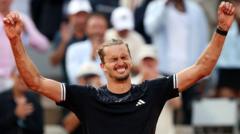
Alexander Zverev stood on the red clay of Court Philippe-Chatrier, tears blurring his vision as the crowd roared. It looked like the ultimate redemption. For years, critics claimed the German lacked the mental fortitude to win the biggest prizes in tennis. They said his second serve would always crumble under pressure. They argued his passive baseline play would keep him stranded in the shadow of the Big Three.
He proved them wrong. By capturing his maiden French Open title, Zverev didn't just win a tennis match. He conquered a ghost that had haunted him for four long years. For another view, read: this related article.
Sports writers love a comeback story, but they usually oversimplify them. They focus on the physical grind of rehab or the tactical tweaks a player makes with a new coach. The real story is always psychological. It's about what happens in your head when you return to the exact square inch of earth where your career almost ended.
The Brutal Reality of the Injury That Changed Everything
To understand why this victory matters, you have to look back at the 2022 semifinal against Rafael Nadal. It was one of the most brutal, physical matches in recent tennis history. Three hours of absolute warfare on clay, and they hadn't even finished the second set. Zverev was playing the best tennis of his life. He was moving Nadal around the court, hitting his backhand with terrifying velocity. Further coverage regarding this has been shared by The Athletic.
Then came the slide.
A horrific ankle roll resulted in three torn lateral ligaments. The sound of Zverev screaming in agony echoed through a silenced stadium. He left the court in a wheelchair. At that moment, his ranking was at a career-high number two in the world. He was peaking. In an instant, he went from challenging for world number one to wondering if he'd ever walk without a limp.
Most fans don't realize how difficult it is to recover from ligament surgery. Muscle heals quickly because it has a direct blood supply. Ligaments don't. The rehab process is tedious, painful, and painfully slow. You spend months just learning how to balance on one leg again. When you finally get back on the court, your brain actively fights you. Every time you slide on clay, your nervous system flashes a warning light. It remembers the trauma.
Overcoming the Mental Hurdles of Elite Sport
Zverev frankly admitted that his return wasn't just about fitness. It was about trust. For the first twelve months of his comeback, he played with a subconscious handbrake. He was a split second slower moving to his right. In elite tennis, a split second is the difference between a clean winner and a forced error.
- The Hesitation Factor: Players who suffer catastrophic joint injuries often struggle with lateral movement on slippery surfaces like clay and wet grass.
- The Scoreline Panic: When matches get tight, the mind naturally wanders back to the moment of injury, causing physical tightness.
- The External Noise: Media scrutiny regarding Zverev's inability to close out Grand Slam finals created an immense burden of expectation.
He had to reinvent his movement mechanics. Working with his team, Zverev shifted his weight distribution to take the pressure off his right ankle during heavy slides. He also altered his training regimen, prioritizing explosive agility over raw endurance. It worked. During his title run, he looked quicker and more balanced than he did before the injury.
Why This French Open Title Disrupts the Tennis Hierarchy
The tennis landscape is in transition. Carlos Alcaraz and Jannik Sinner are widely viewed as the leaders of the new generation. Meanwhile, Novak Djokovic continues to defy time, even as injuries begin to slow him down. Zverev was risk of becoming the forgotten man of men's tennis. He was the guy who won Masters titles and Olympic gold but couldn't cross the finish line at a Major.
This victory changes the entire narrative. By winning in Paris, Zverev proved that the window for the mid-generation players isn't closed. He showed that experience, patience, and tactical maturity can still triumph over youthful exuberance.
Look at the data from the tournament. Zverev won an astounding 78% of his first-serve points throughout the fortnight. His second serve, long considered his Achilles' heel, held up under intense pressure. He hit fewer double faults in the entire tournament than he used to hit in a single bad match. He stayed aggressive. Instead of waiting for his opponents to miss, he stepped up inside the baseline and dictated play with his forehand.
Moving Past the Ghost of New York 2020
For years, Zverev's career was defined by a single match. The 2020 US Open final. He was two sets up against Dominic Thiem. He was two points away from the trophy. Then, he choked. There's no other way to put it. His game fell apart, his serve deserted him, and he lost in a fifth-set tiebreak.
That loss broke something in his tennis psyche. Every time he reached the semifinal or final of a big event, that New York collapse loomed large. Fans expected him to fold. Opponents knew if they stayed close enough, he might beat himself.
Winning this title exorcised that demon. In the critical moments of the final, when the pressure was suffocating, Zverev didn't play scared. He served big, hit his targets, and refused to let history repeat itself. He finally showed the mental toughness required of a Grand Slam champion.
What This Means for Your Own Fitness Comebacks
You don't need to be an Olympic athlete to understand the lessons of Zverev's journey. Anyone who has suffered a major injury knows the psychological toll it takes. Whether you tore your ACL in a weekend soccer league or blew out your shoulder lifting weights, the path back is identical.
First, accept that progress isn't linear. You will have weeks where you feel great, followed by days where everything hurts. That's normal. Second, you have to train your brain just as much as your body. Trusting your healed joints takes time. You can't rush the psychological healing process.
Stop comparing your current self to your pre-injury self. Focus entirely on incremental gains. Track your daily wins. If you can move a little better today than you did last week, you're winning. Zverev spent four years rebuilding his career block by block. He didn't give up when his form dipped or when the doubts crept in. He kept showing up.
If you're currently rehabbing an injury, take a page out of his book. Stop looking at the mountain you have to climb. Focus entirely on the next step. Put in the boring, repetitive work behind closed doors. Trust the process, listen to the medical professionals, and give your mind the time it needs to catch up with your body.