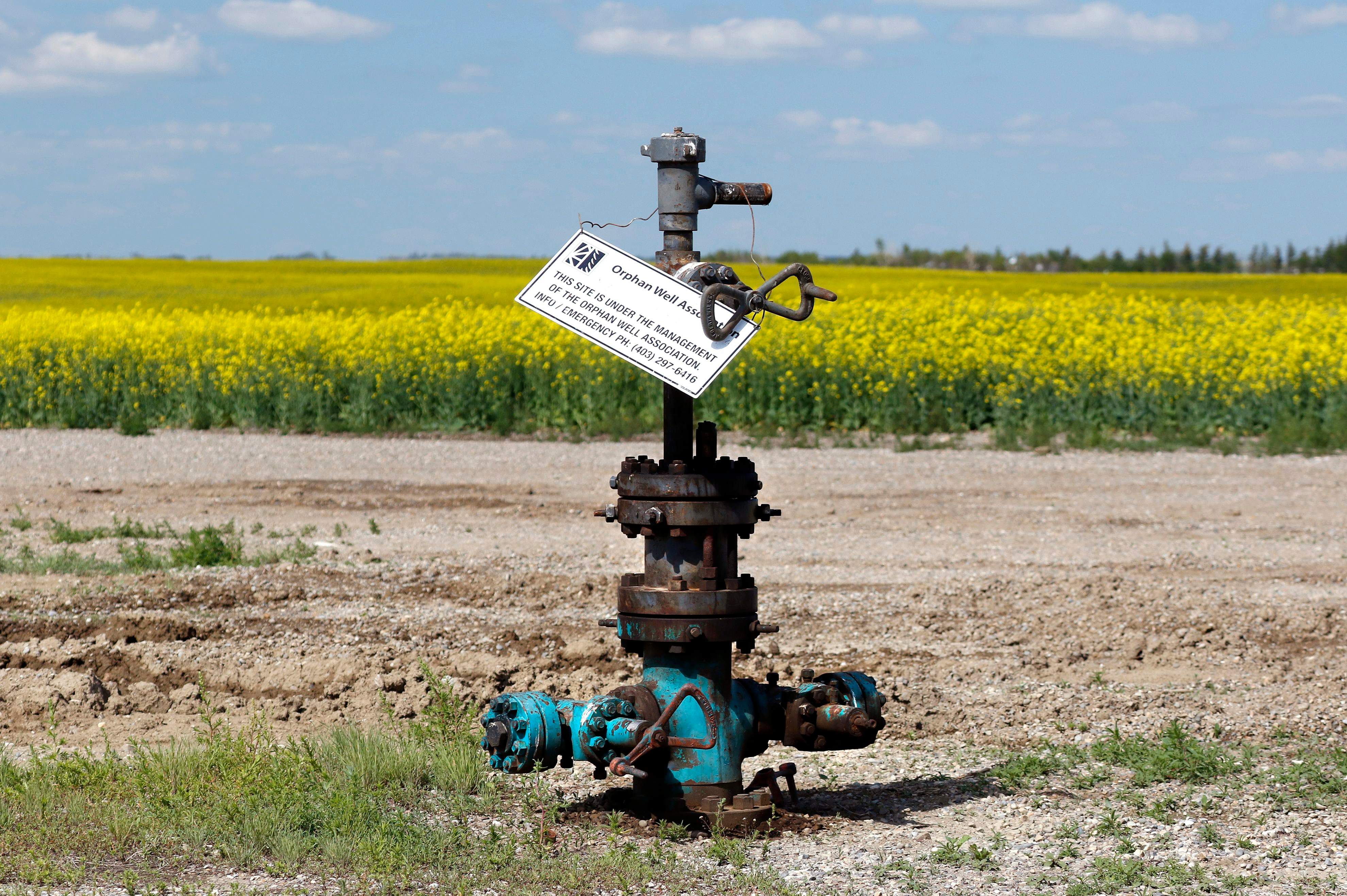
Every time another multibillion-dollar orphan well cleanup fund gets announced in Alberta, the mainstream press trots out the exact same script. A weary rancher stares across a barbed-wire fence at a rusted pumpjack, nods slowly, and calls the new government program a "positive step"—while listing off a dozen predictable complaints about soil compaction, unpaid surface leases, and slow bureaucracy.
It is comforting. It is predictable. And it completely misses the heist happening in broad daylight. If you liked this article, you might want to check out: this related article.
Calling Alberta’s well-remediation funding models—whether federal stimulus packages like the Site Rehabilitation Program or provincial levy structures through the Orphan Well Association—a "positive step" isn't just overly optimistic. It is an endorsement of the single greatest transfer of private corporate liability onto the public balance sheet in Canadian history.
While landowners and journalists argue over whether the cleanup crews are moving fast enough or paying enough for ruined pastureland, the oil and gas industry has quietly executed a structural miracle. They have convinced the public that cleaning up their own mess is a charitable public-works project rather than a basic, non-negotiable cost of doing business. For another perspective on this event, check out the recent coverage from The Motley Fool.
The Myth of the "Orphan" Well
To understand why the current debate is rigged, you have to dismantle the industry's favorite euphemism: the orphan well.
In standard regulatory parlance, an orphan well is an oil or gas site that no longer has a legally or financially viable owner to pay for its decommissioning and reclamation. The word "orphan" does heavy psychological lifting. It implies tragedy. It suggests an unforeseen accident where a parent tragically passed away, leaving a helpless child for the village to raise.
There are no accidents here. There is only balance-sheet engineering.
Under the polluter-pays principle—a foundational pillar of Canadian environmental law upheld repeatedly by the Supreme Court of Canada, most notably in the landmark 2019 Orphan Well Association v. Grant Thornton Ltd. (Redwater) decision—the entity that profits from resource extraction is strictly liable for returning the land to its equivalent land capability. That liability sits ahead of secured creditors in bankruptcy.
Yet, across the Western Canadian Sedimentary Basin, tens of thousands of inactive and abandoned wells sit rotting on prime agricultural land. Why? Because for decades, Alberta’s regulatory apparatus—specifically the Alberta Energy Regulator (AER) and its predecessor, the Energy Resources Conservation Board—allowed profitable producers to offload late-life, low-producing wells to undercapitalized junior operators.
Imagine a scenario where a major restaurant chain sells its greasiest, most dilapidated kitchens—complete with condemned plumbing and massive back-taxes—to a shell company with ten dollars in the bank, right before that shell company declares bankruptcy. You wouldn't call those restaurants "orphans." You would call it a fraudulent conveyance.
In the oil patch, we call it standard asset rationalization. Senior producers stripped the high-margin flush production out of reservoirs, booked the profits, paid out dividends, and then bundled the terminal liabilities into packages sold to tiny operators who couldn't survive a six-month dip in West Texas Intermediate crude prices. When the inevitable downturn hit, the juniors folded, the wells became "orphans," and the executives walked away clean.
Why Subsidizing Cleanup Destroys Market Discipline
When the government steps in with public money—or forces the broader industry to cross-subsidize bankrupt bad actors through stretched-out, decades-long levy timelines—it doesn't solve the crisis. It pours gasoline on the moral hazard.
I have sat in boardrooms and watched asset-retirement obligations (AROs) get treated like Monopoly money. On corporate balance sheets, a well’s decommissioning liability is discounted over thirty, forty, or fifty years. By playing with discount rates and pushing the theoretical abandonment date out to 2060, an operator can make a $150,000 liability look like a $12,000 footnote today.
When Ottawa or Edmonton injects hundreds of millions of dollars into well-site rehabilitation grants, they validate that accounting fiction. Every public dollar spent reclaiming a well that had a solvent corporate parent five years ago signals to every CEO in Calgary that if you stall long enough, lobby hard enough, and let your liabilities pile up high enough, the taxpayer will blink first.
The competitor narrative frames the issue around execution: The fund is good, we just need better oversight, faster payouts to landowners, and stricter timelines.
That is like praising a bank robber for donating ten percent of the loot to the local food bank, and then quibbling over whether the canned goods are expired.
You cannot fix a structural incentive problem with better administrative plumbing. As long as an operator can defer abandonment indefinitely by claiming a dead well is merely "inactive" and might magically become economic again if oil hits $120 a barrel, they will never spend capital to plug it. Why spend $100,000 today to permanently cement a wellbore—an expense that generates zero return on invested capital—when you can pay a minimal annual surface lease, let the weeds grow over the wellhead, and wait for the next government bailout program?
The Landowner Trap: Bargaining for Crumbs
Ranchers and farmers in Alberta have every right to be furious. Under Alberta’s Surface Rights Act, landowners do not own the minerals beneath their soil; the Crown does. When an energy company wants to drill, the landowner cannot simply say no. If they refuse access, the Land and Property Rights Tribunal can grant a Right of Entry order anyway.
In exchange for surrendering control of their property, landowners are promised two things: annual compensation for the loss of use and adverse effect, and the eventual restoration of their land to its original agricultural capability—certified by a formal Reclamation Certificate.
Today, landowners are getting burned on both ends.
First, when operators go belly-up or simply stop paying, landowners are forced to apply to the provincial government under Section 36 of the Surface Rights Act just to get their unpaid rent covered by taxpayers. Meanwhile, solvent operators routinely demand rent reductions, threatening cash-strapped farmers with prolonged tribunal battles if they don't accept thirty cents on the dollar.
Second, the physical cleanup itself is frequently a superficial cosmetic job. Pouring a concrete plug down a wellbore and scraping off the top six inches of gravel does not fix deep soil compaction, sterilized earth from historical brine spills, or fractured aquifers.
Yet, by accepting the premise that government-backed cleanup funds are a "positive step," landowner advocates accidentally trap themselves in a weaker negotiating position. Once you accept public charity to clean up private corporate damage, you lose the moral and legal high ground to demand full, uncompromising restitution from the companies that actually caused the damage. You stop being a creditor owed a legal debt and become a petitioner begging a bureaucrat for a slice of a capped budget.
Dismantling the Industry’s Favorite Excuses
If you challenge the current cleanup consensus in Calgary, you will immediately hit a wall of rehearsed talking points. Let’s take a sledgehammer to the three most common ones.
"Strict upfront bonding would kill junior producers and destroy jobs."
This is the oldest hostage-taking tactic in resource economics. Look at how offshore oil and gas or hard-rock mining operate in mature jurisdictions: if you want to dig a hole, you post full, liquid financial security upfront—letters of credit, cash bonds—covering the exact cost of plugging and reclaiming that site before a single drop of oil flows.
If a company’s business model only works when it is allowed to operate without collateralizing its environmental liabilities, that company is already insolvent. It is merely running a Ponzi scheme where today's cash flow pays yesterday's operating costs while the environmental debt compounds off-book. Killing zombie companies isn't job destruction; it is basic capital hygiene. When zombie operators stay alive, they depress local service rates, tie up mineral rights, and dump massive cleanup bills onto the solvent, responsible operators who actually pay their taxes and levies.
"The scale of the problem is too big for industry to pay all at once."
Nobody is asking the industry to reclaim 170,000 inactive and abandoned wells by next Tuesday. The problem isn't the timeline of physical execution; it is the absence of ring-fenced financial security.
Right now, Alberta’s Liability Management Framework relies on mandatory minimum spend targets—requiring operators to spend a tiny percentage of their total estimated liability each year on closure work. On paper, it looks like steady progress. In reality, because the spending requirement is tied to an operator’s ongoing cash flow and self-reported liability estimates, a company can easily game the system. They cherry-pick the cheapest, easiest, shallowest wells in dry pastureland to hit their annual spending quota, while leaving the deep, sour-gas nightmares in forested wetlands untouched for another generation.
"Public funds keep oilfield service workers employed during downturns."
This was the primary justification for the $1 billion federal Site Rehabilitation Program during the 2020 pandemic crash. And what happened? As the Parliamentary Budget Officer and independent economists later documented, public money largely substituted for private capital that companies would have spent anyway. Instead of accelerating net cleanup, the grants padded corporate profit margins, inflated the cost of service rigs, and rewarded the worst offenders—companies that had deliberately dragged their feet on reclamation—with free federal cash. Subsidizing service companies by bailing out oil producers is the most expensive, inefficient jobs program imaginable.
What Actual Accountability Looks Like
If Alberta wants to end the orphan well crisis—and stop forcing ranchers to beg for basic property rights—it needs to abandon incrementalist funds and enforce hard-nosed financial reality.
- Mandatory, Non-Negotiable Asset Retirement Trusts: Every producing well in the province must contribute a fixed dollar-per-barrel or dollar-per-MCF levy directly into an irrevocable, third-party reclamation trust tied to that specific wellbore—not the corporate entity. If the well is sold to a sketchy junior operator, the cash stays with the well. When the well stops producing, the money to plug it is already sitting in the bank, earning interest, untouchable by bankruptcy courts or corporate raiders.
- Hard Time Limits on "Inactive" Status: End the fiction that a well sitting idle for twelve years is "temporarily suspended." Under current rules, wells can linger in inactive limbo indefinitely as long as the operator conducts basic integrity tests. Implement a strict five-year clock: after sixty months of zero production, the operator must either put the well back on stream or execute full downhole abandonment within twenty-four months. No extensions. No excuses.
- Full Piercing of the Corporate Veil on Liability Transfers: Implement strict trailing liability laws modeled on the UK North Sea regime. If a major producer sells a late-life field to a smaller operator, and that smaller operator goes bankrupt ten years later without reclaiming the sites, the liability snaps straight back onto the original senior producer. Overnight, the practice of dumping liabilities onto shell companies would vanish, because majors would vet buyers with ruthless due diligence rather than handing keys to anyone with a pulse.
- Landowner Veto on Reclamation Certificates: Strip the regulator of its rubber stamp. A Reclamation Certificate—which permanently extinguishes the operator's surface lease obligations—should never be issued without the explicit, independent sign-off of a third-party agrologist hired by the landowner and paid for by the operator. If the topsoil is mixed with subsoil, if the drainage is wrecked, or if crop yields lag adjacent land, the operator keeps paying full surface rent until the dirt is actually fixed.
The Uncomfortable Trade-Off
Let’s be brutally honest about the downside of enforcing real polluter-pays rules: it will shrink the margins of Alberta’s oil patch.
Forcing operators to collateralize liabilities upfront, imposing trailing liability on asset sales, and cutting off public subsidies will lower the net present value of marginal fields. Some aging wells will be shut in earlier. Some over-leveraged junior companies will go bust immediately rather than five years from now. Capital will complain that regulatory tightening hurts competitiveness against jurisdictions like Texas or North Dakota, where thousands of orphaned wells also rot unchecked.
Good. Let them complain.
An industry that generates tens of billions of dollars in annual revenue does not need to panhandle from taxpayers or stiff rural ranchers to afford a cement truck and a backhoe. The only reason this crisis exists is because successive governments treated environmental liabilities as an optional social credit line rather than a hard debt.
Stop applauding every new cleanup fund as a "positive step." Until the money comes exclusively from locked corporate trusts instead of public budgets, and until ranchers hold the power to reject shoddy patch-ups, every dollar spent is just paying the ransom on a hostage the industry never had the right to take.