Dirt gets under your fingernails when you garden, when you plant roots, when you look for something ordinary. Most of the time, dirt is just dirt. It stains knees and yields worms. But sometimes, buried just inches beneath the topsoil, eight centuries of silence are waiting to be broken by the scrape of a common garden tool.
Consider the morning on Mörkö island outside Södertälje, near Stockholm. A woman stepped out into the damp earth, searching for nothing more complicated than fishing bait. She needed worms. She expected mud. Instead, her shovel struck something solid, dull, and entirely unyielding. It wasn't a root. It wasn't a stray stone left over from the last glacier retreat.
It was the rim of a decayed copper cauldron.
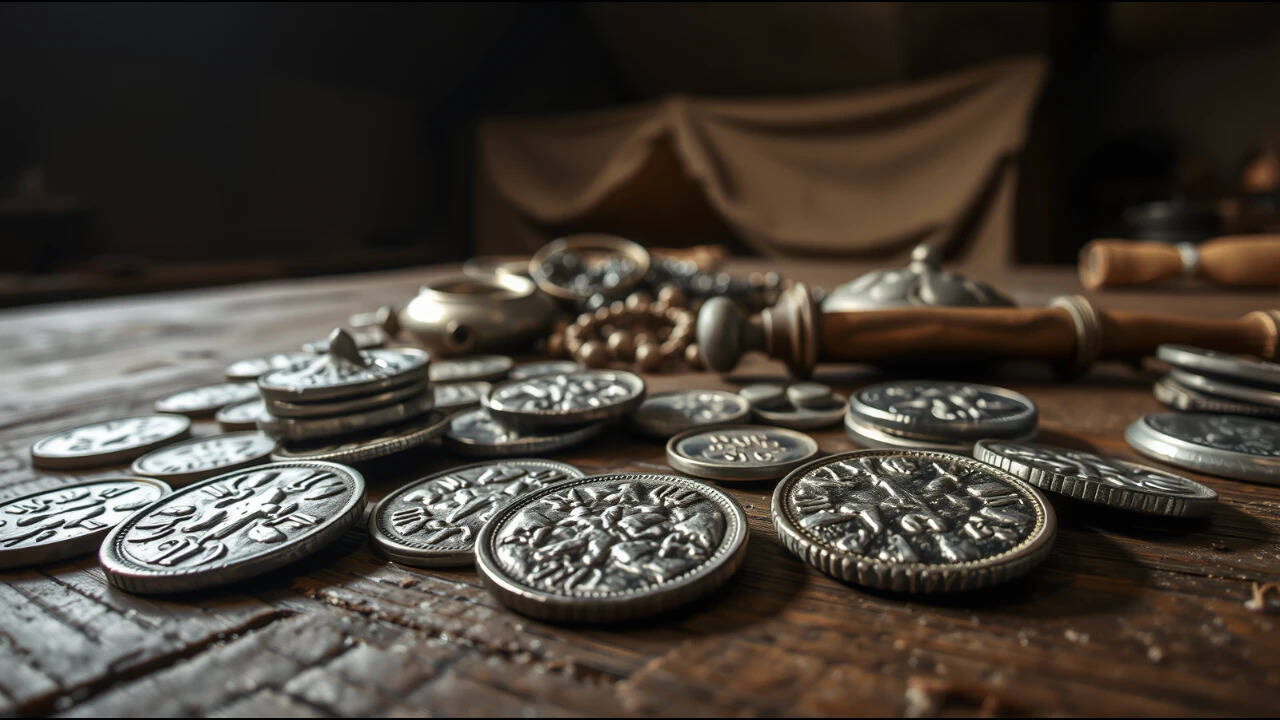
When she and her husband finally cleared away the surrounding soil and notified the authorities, they had no idea they had just cracked open a vault left sealed since the twelfth century. Inside that weather-worn metal vessel lay an astonishing archive: roughly 24,100 silver coins alongside 144 precious objects, including gold rings, pearls, pendants, and silver beads, all tipping the scales at around six kilograms.
It became the largest medieval coin hoard ever discovered in Sweden.
History books often feel like flat parchment—ink on dry pages, neat timelines of kings and battles that happened to other people in distant centuries. Yet history is actually an accumulation of hidden panics. Imagine the person who buried this cauldron. Picture the frantic afternoon in the late 1100s, an era when Stockholm did not even exist as a city yet, and the region was a volatile patchwork of shifting powers, nascent kingdoms, and violent border skirmishes.
Whoever placed that copper pot in the dirt was hiding a life's work. Perhaps it was a merchant hedging against a looming raid, or a family fleeing the sudden approach of warring factions. They dug a hole, lowered the heavy metal vessel into the dark, and covered it up with dirt, fully intending to return the next week, the next month, or when the war passed.
They never came back.
The silver stayed down there through the rise and fall of dynasties, through the freezing winters and long Scandinavian summers, completely oblivious to the modern world taking shape above it. Generations walked across that exact patch of land. Cows grazed on it. Trees grew old and rotted away. And all the while, silent and heavy, thousands of silver coins sat packed tightly together.
When the Swedish National Heritage Board stepped in to analyze the find—officially designated as the Hörningsholm hoard—they realized the true scale of what had been unearthed. Most of the coins date back to the 1100s, bearing the stamp of King Knut Eriksson, who ruled Sweden during its turbulent transition into a unified state. Among them are rare bishop coins, minted by religious authorities rather than the crown, featuring figures holding croziers alongside architectural designs linked to Gotland.
This strange mixture of royal, ecclesiastical, and regional coinage offers a rare window into a period for which written records are painfully scarce. It tells a story of commerce, religious influence, and invisible trade networks that tied early medieval Sweden to the wider European world.
By May 2026, the state officially stepped in to acquire the entire treasure, awarding the finder four million Swedish kronor. Chief antiquaries noted that the payout had to be carefully weighed: substantial enough to properly reward an honest citizen, yet balanced to ensure the discovery of historical artifacts never triggers illicit looting. The treasure now belongs to the public trust, destined for museums where its secrets can be studied rather than melted down in private obscurity.
Most of us go through life assuming that everything worth finding has already been found. We map the globe with satellites, photograph distant galaxies, and digitize every library on earth. We forget that the ground beneath our feet is a vast, quiet archive, holding our collective past just out of reach.
All it takes is a garden shovel, a search for fishing bait, and a moment of pure, unadulterated coincidence to remind us that yesterday is never truly gone. It is simply waiting for someone to look down.