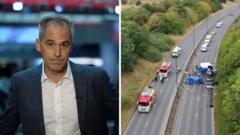
Seven lives ended in a matter of seconds on a dark stretch of the A66 near Middlesbrough. When a Volkswagen Passat rocketed down the wrong side of the dual carriageway at 3:39 in the morning, it collided head-on with a marked Cleveland Police armed response vehicle. Both vehicles were crushed instantly. All seven occupants across the two cars died at the scene.
The horror of that night didn't stay on the asphalt. It triggered a massive, cross-agency investigation, multiple arrests, and a fierce national debate about online behavior, police pursuits, and road safety. If you only read the initial flash headlines, you missed the structural reality of how this disaster unfolded and why it shook emergency services to their core.
The Timeline of a Seven-Minute Pursuit
Let's look at the sequence of events because accuracy matters. The Independent Office for Police Conduct (IOPC) laid out the framework of what happened. Officers had flagged a Volkswagen Passat moving on cloned plates after it tripped an ANPR camera.
Police chased the vehicle for roughly seven minutes. During that high-stress window, the fleeing car made a catastrophic decision. It turned onto the A66 against the flow of traffic, driving headlong into oncoming lanes.
Trained protocols kicked in immediately. Realizing the extreme danger of a wrong-way pursuit, the chasing officers cut their lights and sirens, officially aborting the chase. But physics doesn't pause for protocol. Only ten seconds later, the Passat slammed directly into a separate police vehicle carrying PC Matthew Blades and PC Tom Clough. That second police car wasn't even part of the active pursuit; it was simply positioned in the area to help intercept the suspect vehicle.
The impact killed everyone inside both vehicles instantly. The five young men in the Passat were later identified as Cole Robert Worthy (17), Theo Rae (17), Makai Saddington (18), Michael Robert Cahill (23), and Jacob Matusiak (23). PC Blades (37) and PC Clough (38) left behind devastated families and a grieving police force.
The Dangerous Culture Behind the Wheel
Whenever a catastrophe like this happens, armchair experts rush to conclusions. In this case, public scrutiny quickly turned toward whether online stunts played a role. Driving the wrong way down a motorway or dual carriageway isn't just an erratic mistake; investigators across the UK and Ireland have noted alarming spikes in dangerous driving incidents mirroring viral social media challenges.
While Cleveland Police stated they found no immediate evidence that this specific incident was filmed live for platforms like TikTok, government officials and regulators have faced intense pressure to clamp down on digital content that glorifies reckless driving. Downing Street publicly backed media regulators to take aggressive action against platforms hosting clips of motorists speeding against traffic. When algorithms reward shock value, real people pay with their lives on physical roads.
The tragedy also reopened the broader conversation about organized criminality on local roads. Following the crash, authorities didn't just walk away. They launched sweeping raids, arresting twelve people—nine men and three women ranging from ages 19 to 61—tied to wider offenses including firearm possession and organized crime group activities linked to the network surrounding the vehicle. Investigators also recovered a Volvo XC60 connected to the suspects. This was never just a random late-night joyride. It was a node in a deeper criminal web.
Why Police Accountability and Support Matter
When law enforcement officers die on duty, the institutional response is mandatory and rigorous. The IOPC stepped in right away, as is legally required whenever a fatality intersects with police operations.
People often misunderstand these watchdog investigations. They aren't designed to find scapegoats by default; they are built to dissect every second of telemetry data, radio logs, and dashcam footage to see if policies failed or if procedures need rewriting. Did the tactical decision-making match the threat level? Could the intercept have been handled differently? These questions are painful, but they are necessary to protect the officers who pull on the uniform tomorrow.
Chief Constable Victoria Fuller and local leaders faced difficult press briefings in the days following the crash, describing an all-consuming grief across the region. This incident marked a grim milestone for British policing, standing out as one of the deadliest single-incident losses of on-duty officers in recent years.
If you drive for a living, or if you simply commute down major dual carriageways at odd hours, incidents like this underline how fragile highway safety really is. You share the asphalt not just with ordinary commuters, but with erratic drivers running from the law, vehicles operating on cloned plates, and high-stakes law enforcement responses trying to balance public protection with catastrophic risks.
Stay alert behind the wheel. Respect the closures when emergency services lock down a highway, and stop treating dangerous road maneuvers as digital entertainment before another community has to bury its protectors.