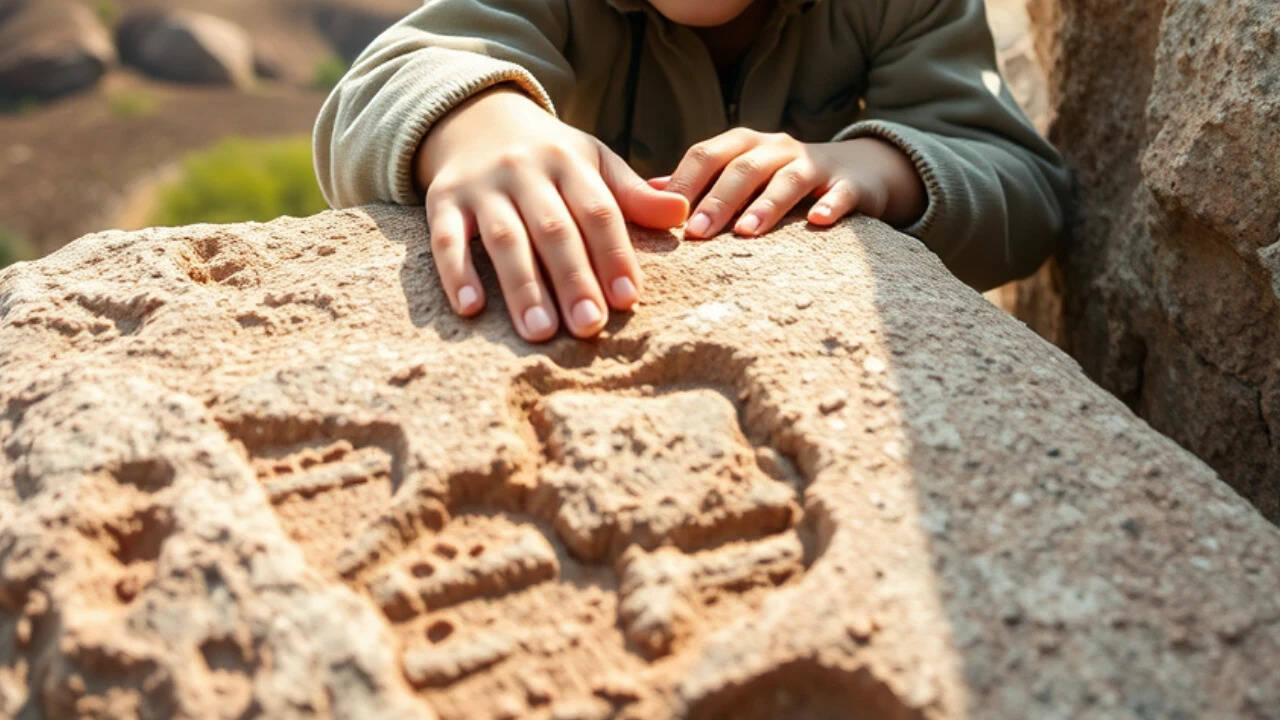
A single rock slab near a roadside slope in Beijing's Mentougou district has fundamentally altered how paleontologists view Asia's ancient ecosystems. The slab, bearing two impressions barely larger than a postage stamp, marks the first scientifically documented Jurassic amphibian track ever discovered in Asia. Unearthed in strata dating back roughly 160 million years to the Middle Jurassic Yaopo Formation, these tiny tracks bridge a glaring gap in the continental fossil record. For decades, researchers cataloging the region's Mesozoic vertebrate history had amassed thousands of records belonging to towering dinosaurs and heavy-shelled turtles, yet the micro-fauna of the underbrush remained completely invisible.
That silence broke because a twelve-year-old schoolboy looked down when others walked past.
The Anatomy of a Phantom Footprint
Finding vertebrate trackways from small, soft-bodied animals is an extraordinary statistical anomaly. Flesh does not preserve easily. Amphibians, lacking the robust bones of archosaurs or the armor of turtles, rarely leave behind skeletal remains in terrestrial sediment layers. When they do move across mudflats, their light weight usually fails to depress sediment deeply enough to survive millions of years of tectonic upheaval, erosion, and diagenesis.
Yet, the Mentougou specimen achieved the impossible.
The find consists of two impressions preserved in tandem on a single block of stone near Longquan town. The better-preserved impression represents a left forefoot, measuring a mere 1.5 centimeters long and 1.3 centimeters wide. It displays four slender, sharply pointed digits arranged in a distinct fan-like pattern. Just behind it lies a fainter, five-digit impression interpreted as the matching hind foot.
To extract data from features smaller than a thumbnail, a research team led by China University of Geosciences associate professor Xing Lida bypassed traditional physical casting methods. They deployed photogrammetric three-dimensional modeling, generating high-resolution digital reconstructions that revealed microscopic displacement rims in the ancient mud. These digital elevations allowed specialists to analyze how weight shifted across the palm. The anatomical arrangement pointed directly to Salamandroidea, the suborder containing modern tailed amphibians like salamanders and axolotls.
This was not a water-bound swimming trace. It was the footprint of a land-adapted walker traversing a subaerial surface.
Rewriting the Middle Jurassic Paleoecology
To understand why two centimeters of indented mud matters, one must examine the physical reality of northern China during the Middle Jurassic period. Paleogeographic reconstructions of the Yaopo Formation paint a picture vastly different from the arid or temperate landscapes dominating modern Beijing. One hundred and sixty million years ago, the region was a sprawling, humid lake-swamp environment.
Dense canopies of ferns, towering ginkgoes, and primitive cycads choked the damp lowlands. It was a world dominated structurally by massive sauropods and predatory theropods, but the ecological engine relied just as heavily on the microscopic tier of the food web. Until this discovery, structural models of these Jurassic wetlands suffered from a ghost lineage problem. Zoologists knew that modern salamander lineages must have ancient roots extending deep into the Mesozoic, but the Asian fossil record offered zero physical validation.
Trace fossils change the equation. Bones can be washed downstream into foreign environments, decoupled from their original habitats by fast-moving rivers. Footprints cannot. A trackway is an absolute spatial anchor. It proves that a living, breathing amphibian stood on that exact patch of mud, in that exact swamp, interacting with that specific substrate.
The Mentougou discovery elevates amphibians from hypothetical inhabitants to verified, active participants in the complex communities of Jurassic North China. They were scurrying through the undergrowth beneath the feet of giants.
The Citizen Science Reality Check
The path from a roadside slope to the pages of the peer-reviewed journal Ichnos underscores a quiet structural shift in modern paleontology. Professional field expeditions operate with finite budgets, restricted manpower, and specific target formations. They cannot scan every square meter of exposed bedrock on a suburban hillside.
When twelve-year-old Ni Jingchen explored the Mentougou district with his parents, he brought no surveying equipment, only an established fascination with paleontology and a smartphone. Noticing anomalous geometric depressions on an exposed rock face, he photographed the slab and uploaded the images to social media.
In previous decades, that image would have vanished into the digital noise. Instead, it crossed paths with Xing Lida’s digital footprint monitoring, triggering an academic mobilization that turned an informal snapshot into a type-locality record.
This incident highlights an uncomfortable truth about academic field geology. Professional institutions hold the analytical monopoly, but the sheer volume of suburban development and road construction exposes millions of square meters of rock that professional teams will never visually inspect. Amateurs and children, moving slowly across local terrain, possess a localized distribution advantage.
The transition from a casual online post to a formal anatomical classification demonstrates that the barrier to entry for contributing baseline data to historical science has collapsed. Every exposed roadside cut is a potential archive. Every observant walker is a potential chronicler of deep time.
The rock slab remains in its geological context, but the invisible fauna of the Mesozoic undergrowth is finally stepping into the light