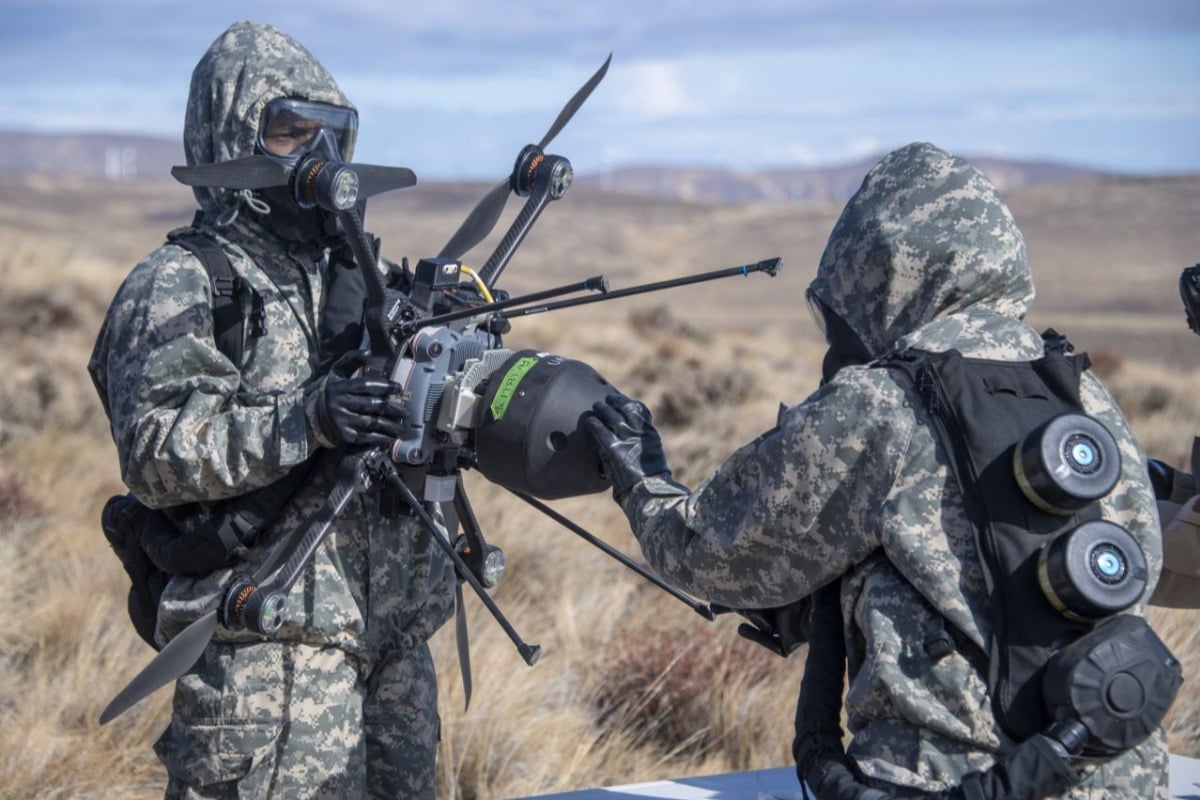
The defense procurement echo chamber is celebrating a brand-new victory. The headlines look impressive: Teledyne FLIR Defense secured an $11.2 million contract from the U.S. Army to deliver over 45 advanced Chemical, Biological, Radiological, and Nuclear (CBRN) unmanned aerial system kits. The consensus among defense analysts is uniform. They claim this integration of R80D SkyRaider drones with specialized sensor payloads, like the MUVE B330 biological sensor, is a massive win for force protection. They tell you it keeps soldiers out of harm’s way by autonomously mapping toxic plumes.
They are completely missing the point. Discover more on a similar issue: this related article.
This contract exposes a deep structural flaw in how modern militaries prepare for asymmetric threats. Buying handfuls of high-end, hyper-expensive drone kits to solve the chemical and biological threat matrix is an obsolete strategy. It is an industrial-age solution applied to a digital-age attrition crisis. Relying on boutique, multi-million-dollar drone platforms for front-line hazard detection is a tactical mistake that will fail when the first electronic warfare switch is flipped.
The Luxury Drone Fallacy
Militaries continue to buy quadcopters as if they are permanent hardware assets. They are not. On the modern battlefield, a small unmanned aerial system is ammunition. It has a lifespan measured in hours, sometimes minutes. More reporting by MIT Technology Review delves into similar perspectives on this issue.
The U.S. Army is spending $11.2 million for "more than 45" kits. Do the simple math. That equates to roughly $240,000 per drone setup. I have seen procurement teams spend years ruggedizing systems to survive a decade in a depot, only for those exact systems to get knocked down by a $50 commercial jammer or a blast of buckshot within ten minutes of deployment.
The R80D SkyRaider is a highly capable aircraft. It features impressive payload capacities and semi-autonomous flight controls. But assigning a quarter-million-dollar asset to fly directly into a suspected toxic cloud is a terrible utilization of resources. If the drone encounters heavy electronic warfare, a localized GPS spoofing attack, or basic small-arms fire, a vital capabilities asset vanishes instantly.
Militaries do not need boutique sensor platforms. They need disposable, cheap swarm capability.
Instead of 45 ultra-luxury systems that operators will be terrified to lose, the military requires thousands of low-cost, modular sensor blocks strapped to generic, open-source airframes. If an operator loses a $2,000 drone to contamination or intercept, they can launch another one immediately. If they lose a $240,000 SkyRaider kit, the entire unit loses its CBRN sensing capability for the duration of the operation.
The Autonomy Myth in Contaminated Airspace
The defense establishment loves to throw around words like "autonomous search and survey" to justify these price tags. The narrative suggests that these drones will fly perfectly ordered search patterns, map out a chemical plume using algorithms, and stream clean data back to a Stryker vehicle or an infantry squad.
Real combat environments do not cooperate with clean algorithms.
Imagine a scenario where a near-peer adversary deploys a persistent chemical agent like VX or a weaponized biological particulate. They will not do this in an electromagnetic vacuum. The deployment of weapons of mass destruction will always be paired with intense, saturated electronic attack suites.
When the local GPS signal is spoofed to read three miles to the West, and the command-and-control radio frequencies are completely flooded with static, how does that semi-autonomous drone navigate? It relies on inertial navigation systems that drift over time, or it drops out of the sky.
The MUVE B330 biological sensor and its chemical counterparts are engineering marvels. They accurately count particles and identify agent classes. But a sensor is only as useful as the data link returning its findings to the human commander. Squeezing complex, real-time telemetry through highly jammed, contested radio bands is an unsolved bottleneck. The assumption that advanced sensing payloads equal survival ignores the reality that radio waves are the first casualty of modern peer conflict.
The Wrong Focus for Combat Units
The primary question being asked by the Army’s Capability Program Executive for CBRN Defense is: "How do we map the hazard from a distance?"
This is the wrong question. The real question is: "How does an attritable, mass-produced infantry force maintain maneuverability when an environment is dirty?"
A handful of specialized kits distributed across select units creates a bottleneck. If a regular infantry company encounters an unknown industrial chemical leak or a suspected agent release, they cannot wait for the specialized brigade asset to bring up their custom SkyRaider kit. CBRN defense must be demilitarized from a specialized luxury asset down to an ubiquitous, simple infantry tool.
The downside to this decentralized approach is obvious to any procurement officer: lower data fidelity. A cheap, mass-produced sensor might give you a simple binary response (hazard present or absent) instead of a detailed spectrographic breakdown of the exact agent purity. But on a fast-moving battlefield, a soldier does not need a scientific research paper streamed to their tactical tablet. They need to know whether to don their protective mask immediately or steer their vehicle twenty degrees to the left.
The Institutional Incentives Driving Bloated Contracts
Why does the procurement system keep buying massive, expensive, low-volume kits? Look at the institutional incentives.
Prime contractors prefer building high-margin, low-volume systems because they lock the military into a proprietary ecosystem of spare parts, specialized training, and exclusive software maintenance agreements. The Teledyne FLIR contract is tied to the broader Nuclear, Biological, and Chemical Reconnaissance Vehicle (NBCRV) Stryker platform upgrade program. It is an architecture designed around a small number of incredibly expensive hubs.
This centralized structure is incredibly fragile. In modern high-intensity conflict, high-value command vehicles and recognizable specialized drones are targeted ruthlessly. Loitering munitions seek out the unique thermal signatures and radio profiles of high-end defense assets. By concentrating $11.2 million of capability into just 45 kits, the military creates a set of high-priority targets for enemy reconnaissance teams.
True battlefield resilience comes from mass, redundancy, and cheap expendability. Until defense acquisition executives stop treating drones like traditional aircraft and start treating them like smart batteries, these multi-million-dollar contracts will remain expensive answers to the wrong tactical problems. Stop buying exquisite reconnaissance platforms to fly into toxic clouds. Build a thousands-strong fleet of cheap, disposable sensors that can be abandoned on the battlefield without a second thought.