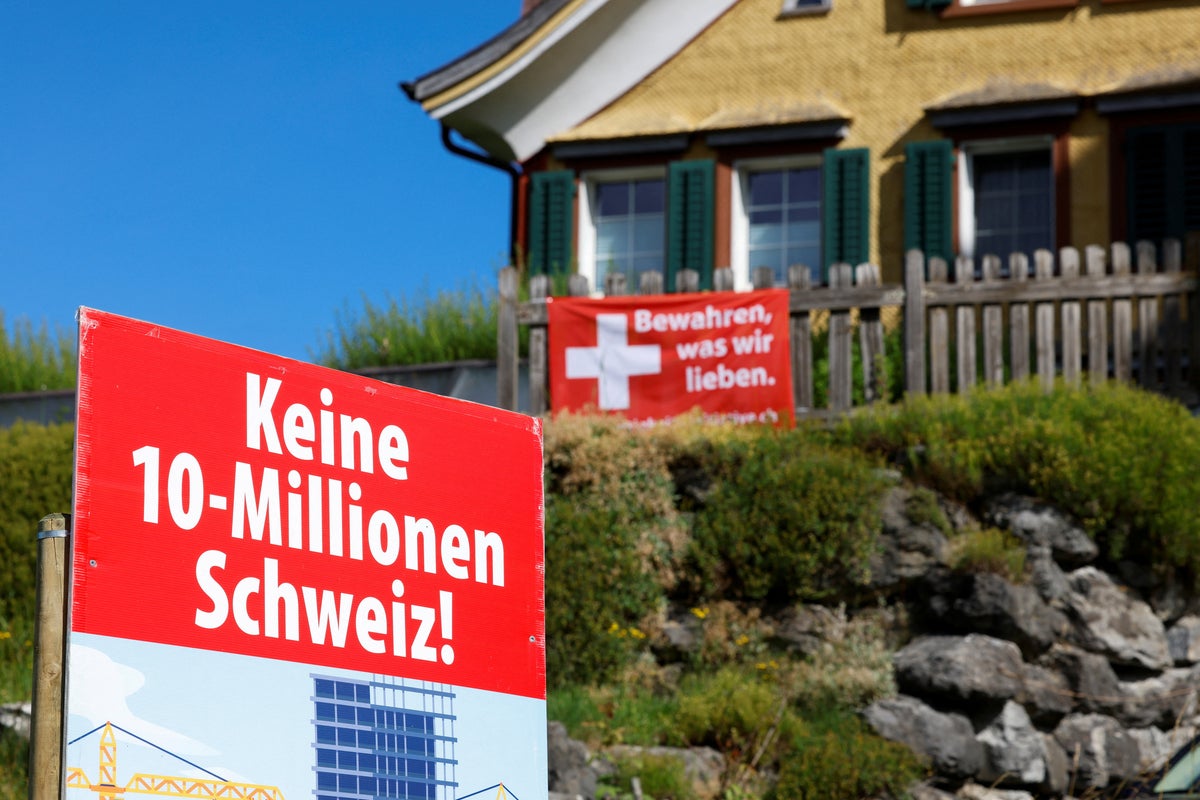
The mainstream media is treating the upcoming Swiss referendum on the "Sustainability Initiative" as a simple, binary battle: a xenophobic right-wing stunt versus a rational, pro-growth establishment. The conventional narrative insists that if Swiss voters reject the Swiss People’s Party (SVP) proposal to cap the population at 10 million, the status quo wins, the economy chugs along, and everyone goes back to eating fondue.
This is a lazy, surface-level consensus. It completely misses the structural reality of the Alpine economy.
The real crisis in Switzerland isn't whether the country reaches 10 million people by 2050. The crisis is that the nation’s entire economic model has become addicted to cheap, imported labor to mask a devastating stagnation in internal productivity. Capping the population by law is a blunt, destructive instrument. But pretending that infinite demographic expansion on a finite footprint is a viable economic strategy is equally delusional.
By focusing entirely on the political horse race, the establishment is ignoring a brutal truth: Switzerland is trading its long-term structural health for short-term GDP padding.
The Productivity Illusion: Growth is Not Wealth
The Swiss business lobby, Economiesuisse, regularly sound the alarm that any restriction on immigration will trigger immediate economic collapse. They point to aggregate GDP growth as proof that the current system works.
This is a fundamental misinterpretation of economic data. Aggregate GDP is a vanity metric. If you bring in 100,000 new workers, your economy will naturally expand because more people are buying groceries, renting flats, and paying for insurance. But true economic prosperity is measured by GDP per capita and labor productivity per hour worked.
Look at the data from the Swiss Federal Statistical Office (OFS). Over the last two decades, Switzerland’s aggregate GDP has looked healthy, but GDP per capita growth has flatlined, averaging less than 1% annually. In some quarters, it has even dipped into negative territory while overall GDP grew.
Imagine a scenario where a factory buys three new machines and hires four new operators, doubling its output. On paper, the factory is "growing." But if the output per worker actually drops because the floor is now overcrowded and the logistics are jammed, the factory has become less efficient, not more.
Switzerland is that overcrowded factory. By relying on an endless stream of cross-border commuters and EU migrants to fill labor shortages, Swiss corporations have found an easy exit ramp. They do not have to invest heavily in automation, deep tech, or processes that boost the output of their existing domestic workforce. Why spend millions optimizing a workflow when you can just hire three more engineers from Munich or Lyon? This is a capital allocation failure masquerading as an economic boom.
The Infrastructure Debt the Excel Sheets Ignore
The establishment's pro-migration argument treats humans as abstract units of production that exist solely within the walls of an office or a laboratory. They forget that these units require physical space outside of working hours.
Switzerland is a nation defined by its topography. You cannot simply build outward indefinitely; the Alps occupy roughly 60% of the country’s landmass. The habitable plateau (the Mittelland) is already intensely urbanized.
When the population swells, the strain on the public square manifests instantly:
- The Federal Railways (SBB/CFF/FFS): Long praised as the gold standard of global transit, the network is facing unprecedented bottlenecks. Punctuality rates on major arteries like the Zurich-Bern-Geneva line have noticeably slipped under the weight of historic ridership.
- The Housing Market: In cities like Zurich and Geneva, vacancy rates have plummeted below 1%. Rents are skyrocketing, pricing out the middle class and young local professionals.
- Energy Consumption: Switzerland is currently navigating a delicate transition away from nuclear power toward renewables. Adding another 1.2 million energy consumers accelerates the supply gap, forcing the country to rely on imported, dirty coal and gas power from Germany during peak winter months.
The corporate entities benefiting from the influx of foreign talent do not pay for the expansion of the train tracks, the creation of new green spaces, or the reinforcement of the electrical grid. Those externalities are dumped squarely onto the Swiss taxpayer. The current model privatizes the profits of demographic growth while socializing its staggering infrastructure costs.
Dismantling the "People Also Ask" Assumptions
When analyzing the Swiss demographic debate, public discourse is flooded with flawed premises. Let's dismantle the three most common.
1. "Without immigration, who will fund the Swiss pension system?"
The Swiss first-pillar pension scheme (AHV/AVS) is a pay-as-you-go system. The establishment loves to argue that an aging population requires a constant influx of young, foreign workers to prevent a demographic collapse where too few workers support too many retirees.
This is a classic Ponzi logic. Those young, foreign workers will eventually grow old themselves. To fund their pensions, Switzerland would need an even larger wave of immigrants a generation later, pushing the population to 12 million, then 15 million, and so on. You cannot solve a structural demographic imbalance with a geometric population expansion on a fixed territory. The solution to funding the AHV lies in structural reforms: indexing the retirement age to life expectancy and increasing investment returns through sovereign wealth strategies, not adding more bodies to the pile.
2. "Doesn't Switzerland's success depend entirely on the Bilateral Agreements with the EU?"
The SVP’s initiative would effectively force Switzerland to terminate or renegotiate the Free Movement of Persons agreement with the European Union. Critics correctly note that this could trigger the "guillotine clause," tearing up the entire web of bilateral treaties that grant Swiss companies access to the EU single market.
The contrarian truth is that the EU needs Switzerland just as much as Switzerland needs the EU. Switzerland is one of the EU’s largest trading partners and a massive net exporter of capital to the eurozone. Furthermore, Swiss transit infrastructure is the literal geographic keystone holding European freight logistics together. The idea that Brussels would completely sever economic ties out of pure spite ignores the pragmatic, transactional nature of European trade politics. A renegotiated quota system would be painful and messy, but it is not the apocalypse the business lobby claims.
3. "Is a population cap the best way to preserve Swiss quality of life?"
No, it isn't. And this is where the right-wing initiative fails completely.
Setting a hard ceiling of 10 million is an arbitrary, bureaucratic nightmare. What happens when the counter hits 9,999,999? Do you stop issuing birth certificates? Do you turn away a world-class oncology researcher at the border because the quota is full?
A legal cap focuses on the wrong variable. The problem isn’t the absolute number of people; it is the velocity of growth and the quality of the economic integration. A hard cap creates economic paralysis and legal chaos. Instead of a clumsy legal ceiling, Switzerland needs to change its tax incentives, making it more expensive for companies to import low-value labor and highly advantageous to invest in domestic automation and productivity.
The Real Risk of the Status Quo
Voters will likely reject this initiative because the Swiss electorate is historically risk-averse and distrustful of radical, disruptive mandates. The media will frame this as a triumph of reason over populism.
But the status quo carries a severe, quiet penalty. If Switzerland continues on its current path, it will slowly erode the very unique selling points that made it an economic superpower in the first place: hyper-efficiency, political stability, pristine natural landscapes, and social cohesion.
When your trains run late, your rent eats up half your salary, and your local countryside is paved over with generic apartment blocks to accommodate rapid growth, you are no longer Switzerland. You become just another dense, bureaucratic Western European state.
The real tragedy of this referendum is that it forces a choice between two flawed ideologies. The right offers a clumsy, unworkable wall; the center offers a reckless, unmitigated sprawl. Until the Swiss elite acknowledges that growth without productivity gains is a trap, the country will continue to drift toward a crowded, mediocre future—regardless of whether the 10 million mark is crossed next year or next decade.